
The ASX took a beating this week, shedding points across the indexes as inflation, higher interest rates, and a decisive cash rate hike from the RBA took their toll.
Over the last five days, the All Ordinaries fell 4.06% (304 points), the ASX S&P200 fell 3.8% (282 points) and the Small Ordinaries fell even further, plunging 5.5% or 173 points, all well below their 52-week averages.
For a more nuanced look at the ASX, Wealth Within chief analyst and founder Dale Gillham shares his sector insights and market predictions:
What are the best and worst performing sectors this week?
“The best performing sectors include Energy up over 6% followed by Utilities up over 1% and Healthcare, which is just in the green.
“The worst performing sectors include Financials down over 7% following the RBA announcement this week. Information technology is also down over 3% while Consumer Discretionary is down over 2%.
“The best performers in the S&P/ASX top 100 stocks include Atlas Arteria Group up over 13% followed by Woodside Energy Group Ltd (ASX:WDS, LSE:WDS, OTC:WOPEF) up over 11% and Tabcorp Holdings Ltd (ASX:TAH) up over 7%.
“The worst performing stocks include Magellan Financial Group Ltd (ASX:MFG) down over 14% followed by Westpac Banking Corp and Bendigo and Adelaide Bank (ASX:BEN) Ltd down over 11%, while Commonwealth Bank of Australia (ASX:CBA) and National Australian Bank Ltd are down over 9%.”
What's next for the Australian stock market?
“What a difference a week can make in the market given that the All Ordinaries Index is down over 3% so far this week following the RBA’s decision to raise interest rates.
“While I was indicating that the Australian market was unfolding in what appeared to be the start of a new bullish phase last week, the volatility this week is exactly why I have been telling investors to be cautious before buying any new stocks.
“Over the past 12 months, the Australian stock market has been very volatile with large swings in price in both directions and is now sitting below the level where it was a year ago, which is making it hard for investors to achieve good returns.
“It now remains to be seen whether the interest rate rise will drive our market lower or whether it will continue its sideways pattern.
“Right now, the market has pulled back to test the recent low on May 12 at 7,157 points and if it holds above this low and turns to rise, we are likely to see a bullish market in the third quarter of 2022.
“If it falls below the May 12 low, it could fall for a short period down to around 6,600 points or slightly below this level.
“Given this, I continue to urge investors to exercise patience and caution because as we experienced this week, the mood in our market can change quickly.”
Are we about to reach peak inflation?
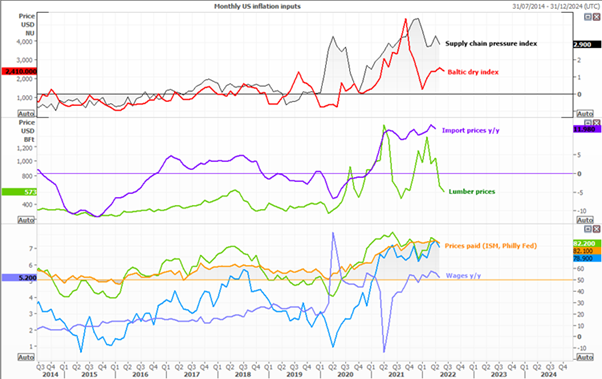
A report on US consumer price indexing (CPI) by City Index market analyst Matt Simpson argues that we may be approaching the peak of this most recent wave of inflation, with falling inflation inputs pointing to an easing in inflationary pressure.
“Annualised prints of CPI, core CPI, personal consumption expenditures (PCE) and core PCE all softened in April, and that’s an important first step to identifying a peak. But a month’s worth of data points don’t define a trend,” Simpson commented in the report.
“Therefore, Friday’s inflation report is really about convincing us that the worst of eye-watering levels of inflation really are behind us. We simply need to see it soften again. And if we look through some inflation inputs, it’s beginning to look promising that it is.”
Source: City Index
Simpson points to a number of inflationary inputs that have begun to fall off this last month or so, including import prices, wages (US), an easing of supply chain bottlenecks, and a downturn in the Baltic dry index – the representative index of sea freight costs.
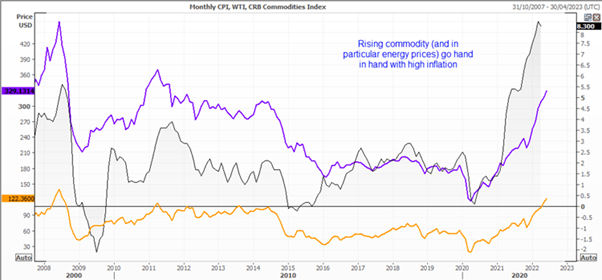
Despite that, commodity and energy prices are soaring, impacting manufacturing, transportation, and household energy security.
Source: City Index
“Oil therefore remains a major inflationary input for policy makers to mull over,” Simpson said.
“Earlier this week, US Secretary of the Treasury Janet Yellen said inflation is at “unacceptable levels” and likely to remain high. We suspect most agree.
“Going forward it is not so much the absolute level of inflation that matters so much as its direction and rate of change.”
Economists are currently expecting a fall in US inflation for the month of May (data is still being crunched) with core CPI forecast to fall to 0.5% month on month, down from 0.6% in April, and annual core CPI expected to fall to 5.9%, down from 6.2% year on year.
On the other hand, CPI (including food and energy) is forecast to rise to 0.7%, up month on month from 0.3%, though annual CPI in the US is expected to remain flat at an eye-watering 8.3%.
US markets are now poised to react to an incoming US inflation report, which could drive the market lower and the dollar higher if the numbers tell a grim story, or allow the indexes to recover some lost ground should the outlook be a positive one.
Australian markets – while not quite so intrinsically linked to US inflation – will no doubt also be affected by the inflation report.
As the adage goes; “when America sneezes, the world catches a cold.”
House prices predicted to fall across Australia in 2023
The Commonwealth Bank of Australia (CBA), ANZ and Westpac have all predicted single-digit growth in housing prices this year, to be followed by declines of up to 10% across the board in 2023.
CBA’s head of Australian economics Gareth Aird predicts the Reserve Bank will raise the cash rate to 1.25% by the end of the year, leading to a much-needed correction.
“A further tightening in macro-prudential policy looks unlikely in our view given higher fixed mortgage rates will deliver APRA the desired cooling in the market,” Aird said.
“The Australian housing market is in the twilight of an incredible boom that has been fuelled by record-low mortgage rates. The phenomenal lift in prices is not over yet given dwelling prices are still rising briskly in most capital cities.
“But near-term indicators of momentum coupled with the recent move higher in fixed-rate mortgages suggest that conditions will moderate from here.
“Interest rates become a headwind on property prices if they are rising. That is the place we believe we are moving towards over the next two years given our expectation for the RBA to commence normalising the cash rate in late 2022.”
The breakdown differs across states and cities, but ANZ is expecting a 4% correction, Westpac 5%, and CBA is the most bearish, predicting a 10% fall in housing prices.
Small cap weekly wins
Small cap wins were thin on the ground this week, unsurprising given how much the Small Ordinaries shed over the last five days. A shock to no one who’s been following commodity prices, it was the resource companies that managed to scrape some gains.
Kaiser Reef Ltd (ASX:KAU, ASX:) gained 10.5% today, after hitting more high-grade gold intersections up to 1.92 metres at 43.2g/t gold at its A1 Mine in Victoria.
Medallion Metals Ltd (ASX:MM8) was the other winner this week, gaining 5.45% over the last five days after encountering visual quartz-sulphide mineralisation during step-out drilling at the Harbour View deposit at Kundip Mining Centre.