
The US Dollar Index is a measure of the value of the US dollar relative to a basket of foreign currencies.
It surged to a 20-year high of 105.01 in May as concerns persisted that central bank actions to drive down high inflation would suppress global economic growth, boosting the US dollar’s safe-haven appeal.
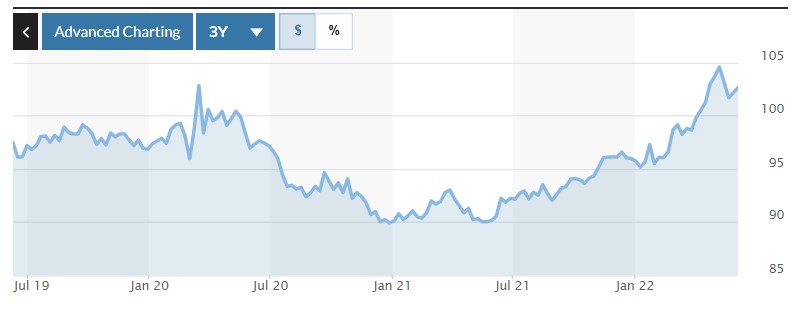
3-year USD index; Source: Marketwatch.com.
In this article:
- Monetary tightening helps the dollar
- Mixed news for the domestic economy
- Historical dollar-commodity price relationship
- US Dollar and oil rising together
- Interest rate and currency strength
- Japanese yen tumbles
Monetary tightening helps the dollar
The US dollar has been a beneficiary of the Federal Reserve’s tightening campaign as higher interest rates increase flows into US bonds and other dollar assets and out of other currencies.
The weakness in risk assets including stocks and crypto has also prompted safe-haven buying of dollars, as has Russia’s war against Ukraine.
Concern about a long-drawn stagflation environment of slow growth and high prices has reduced the appetite for risk.
The net result is that the dollar is up 7.1% so far this year (as at June 7), according to the ICE US Dollar index, or 6.6% as measured by the WSJ Dollar Index.
Over the last year, the ICE Dollar index is up 14.2%.
Mixed news for the domestic economy
A stronger greenback is mixed news for the American economy.
It makes imports cheaper, which can be helpful in offsetting inflation.
However, it makes the foreign earnings of US exporters and multinationals less valuable in dollar terms.
Last week, Microsoft slashed its outlook for earnings and revenue in the second quarter, citing dollar strength.
Microsoft’s Dollar Alarm Raises New Worry for Software Stocks
The strong US dollar is expected to weigh on software profits
Microsoft and Salesforce have warned of dollar-related drags pic.twitter.com/MRKMwkhctM
— G.A.R Capital (@garcapital) June 3, 2022
Historical dollar-commodity price relationship
The price of most raw materials in the world, from oil to cotton to gold, is set in US dollars.
In general, a strong dollar means weaker commodity prices — and vice versa.
This relationship between commodities and the dollar tends to act as a cushion for the global economy with one offsetting the other, which is particularly important for developing economies.
In 2008, Brent Crude Oil prices surged to an all-time high of US$147.50 a barrel, straining the finances of many nations.
However, the US dollar index fell to a record low in the same year, easing some of the pain.

US Dollar and oil rising together
Unfortunately, the historical dollar-oil price relationship has broken down.
Brent crude price has increased more than 70% over the past year, and currently trading at more than US$120 a barrel.
At the same time, the greenback has gained 10% since mid-2021.
This is creating a crisis in many oil-importing nations, particularly in Africa, Latin America and Asia.
With all the talk about peak #inflation, the price of #oil is above $120 per barrel, registering its highest weekly close since just prior to the 2008 Financial Crisis. I wonder how many people will still be talking about peak inflation when oil prices hit $150 over the summer!
— Peter Schiff (@PeterSchiff) June 3, 2022
India, the world’s third-largest oil consumer after the US and China, is paying about 45% more than it was 14 years ago due to the steep depreciation of the Indian rupee against the dollar.
Even countries in Europe and in Japan which can afford to pay higher prices in local currency are suffering from increased inflationary pressures.
The list of nations struggling to meet their energy bills is long.
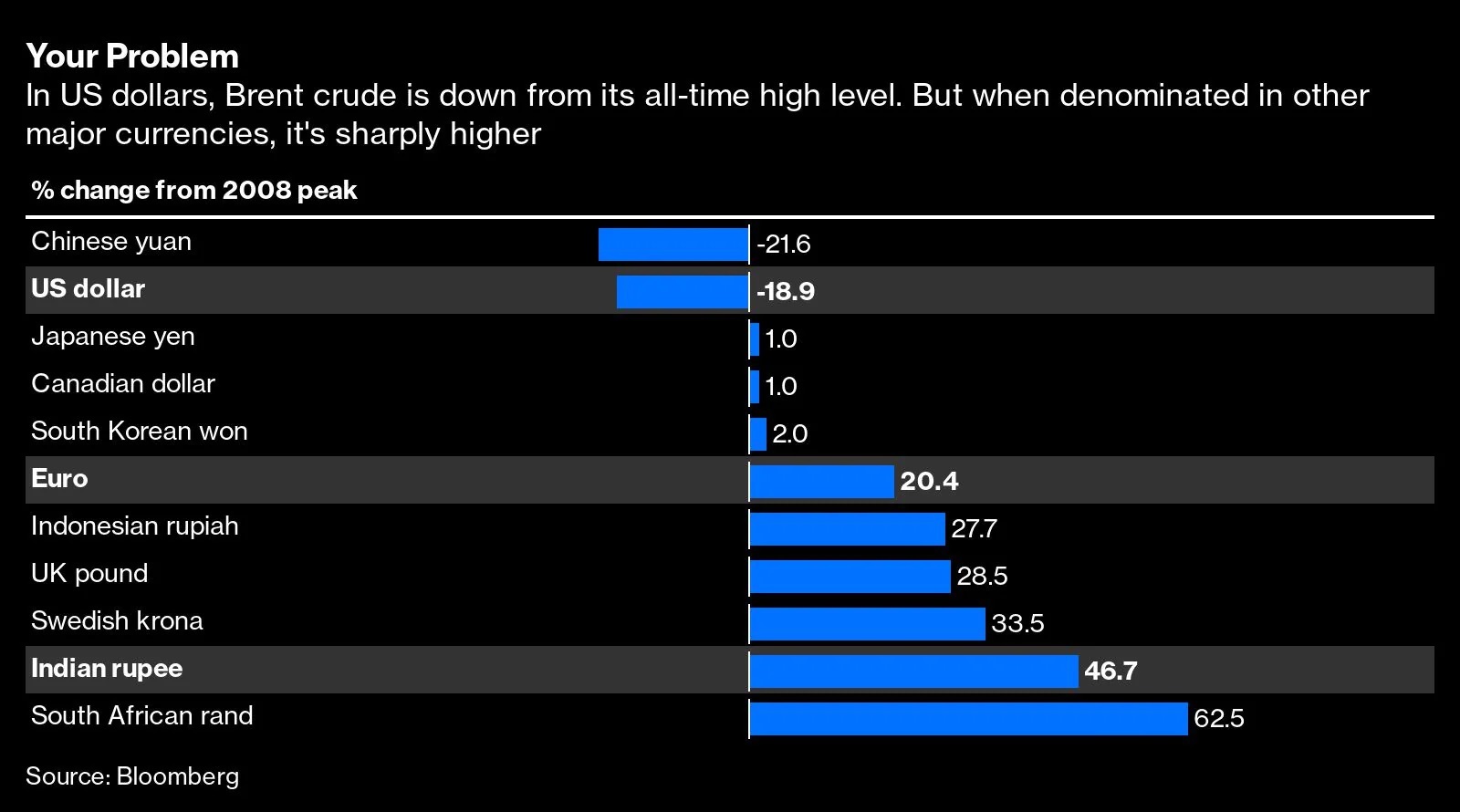
Predictably, the broken relationship between crude and the US dollar has delivered a windfall for the OPEC+ oil cartel, which has refused to increase output.
Goldman Sachs (NYSE:GS) Group noted that the strength of the US dollar has already added an average of about US$20 a barrel extra when measured in local currencies.
With a significant chunk of the world facing record energy prices, the demand for oil is expected to suffer.
Interest rate and currency strength
Several factors are behind the rise of the US dollar, including interest rates.
The interest rate in the US has moved up and is higher than in most advanced economies.
For example, 10-year US Treasury notes yield 3% a year, compared with 0.95% for Germany’s bund, 1.7% for the UK’s gilt and 0.2% for Japan’s 10-year government bonds.
The higher yield is an incentive for investors to put money in the US.
MIT economics professor Kristin Forbes explained to the Wall Street Journal: “The Federal Reserve is raising interest rates very quickly and very aggressively compared to other advanced countries.
“A stronger currency is the natural offshoot.”
Japanese yen tumbles
The Japanese yen fell to 134 for a US dollar on June 8, the lowest level since February 2002.
The yen’s value in dollar terms has tumbled 16% since the beginning of 2022, accelerating inflationary pressures because it takes more yen to pay for imported goods.
Energy is a particular concern because Japan imports almost all of its oil and gas and it takes more yen to import the oil denominated in dollars.
The yen is also sensitive to interest rate differentials between Japanese debt and US bonds.
With US 10-year Treasury yields climbing above 3%, the spread between 10-year US and Japanese debt is about 278 bps, not far from a 3-1/2 year high of 292 bps hit in May.
Meanwhile, Japan’s central bank renewed its pledge of super-loose policy on Monday, with Governor Haruhiko Kuroda saying the economy is still in the middle of a recovery from the pandemic.
Therefore “monetary tightening is not at all a suitable measure,” he said.
From December lows oil is up 87% in USD terms and up 120% in JPY terms. A whole world of pain is coming Japan's way pic.twitter.com/GsCLCmZER6
— Gianluca (@MenthorQpro) June 9, 2022