
Lithium Australia Ltd (ASX:LIT, OTC:LMMFF)’s exploration partner Charger Metals NL (ASX:CHR) has honed in on a large lithium system at the Lake Johnston Project in WA.
A project-wide soil geochemistry program was recently completed at the lithium camp and Charger identified three lithium-caesium-tantalum (LCT) pegmatite target zones along a 50-kilometre corridor.
The most advanced target — the Medcalf spodumene prospect — is being prepared for drilling in 2023’s March quarter.
In the meantime, Charger is waiting on the final soil analyses but will continue fieldwork at Lake Johnston’s Mt Day and Pagrus prospects.

Charger owns 70% of the lithium project, while Lithium Australia holds the remaining 30% stake.
Delivering priority drill targets
Commenting on the findings at Lake Johnston, Charger managing director David Crook said: “Charger has commenced the statutory approvals process required before drilling the spodumene-pegmatite target at the Medcalf spodumene prospect.
“ … [This target] has mineralised outcrops extending over at least 500 metres of strike and is where rock chip samples returned between 1.51% and 5.13% lithium oxide.
“Charger has successfully delivered new, priority drill targets at each of the company’s three projects.
“Despite delays out of our control, we continue to work proactively with Western Australian and Northern Territory regulatory bodies and other stakeholders to commence drilling on each project as soon as permitting is finalised.”
Beyond the Lake Johnston asset, Charger is exploring for battery and precious metals across three emerging provinces in the Northern Territory and WA.
The explorer is prospecting for nickel, copper, cobalt and platinum group elements at the Coates Project to Lake Johnston’s west, while it’s on the hunt for lithium and gold at the Lake Bynoe project in the NT.
Turning the soil at Medcalf
Charger plans to drill around 40 reverse circulation drill holes along Medcalf’s spodumene prospect pegmatites.
The target was uncovered during reconnaissance fieldwork in 2018 and 2019 — programs that included soil geochemistry, mapping and rock chip analysis centred on an area northeast of Lake Medcalf in WA.
This fieldwork identified a spodumene-pegmatite swarm, made up of about 20 anastomosing pegmatite dykes that outcrop in an area between 500 and 800 metres long within a corridor that measures 300 metres wide.
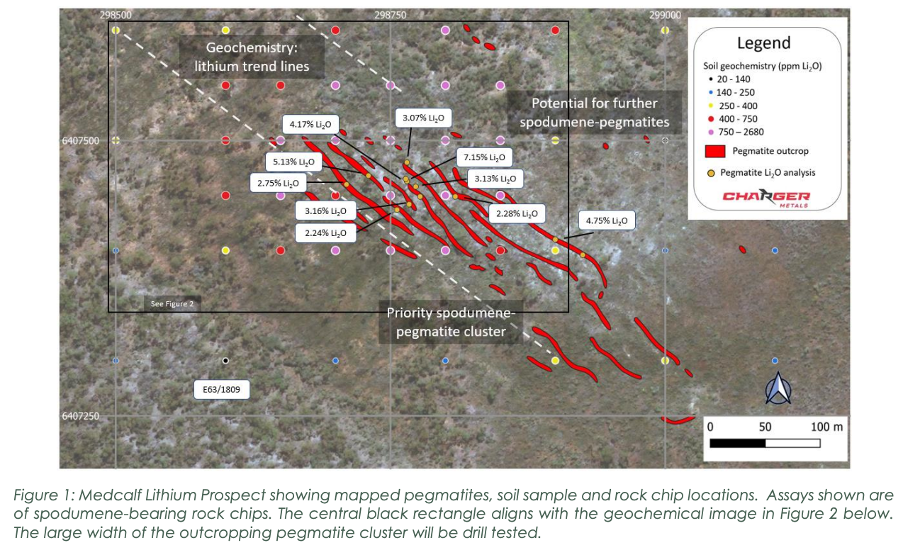
The strike direction of the pegmatite dykes is roughly northwest and dips to the southwest.
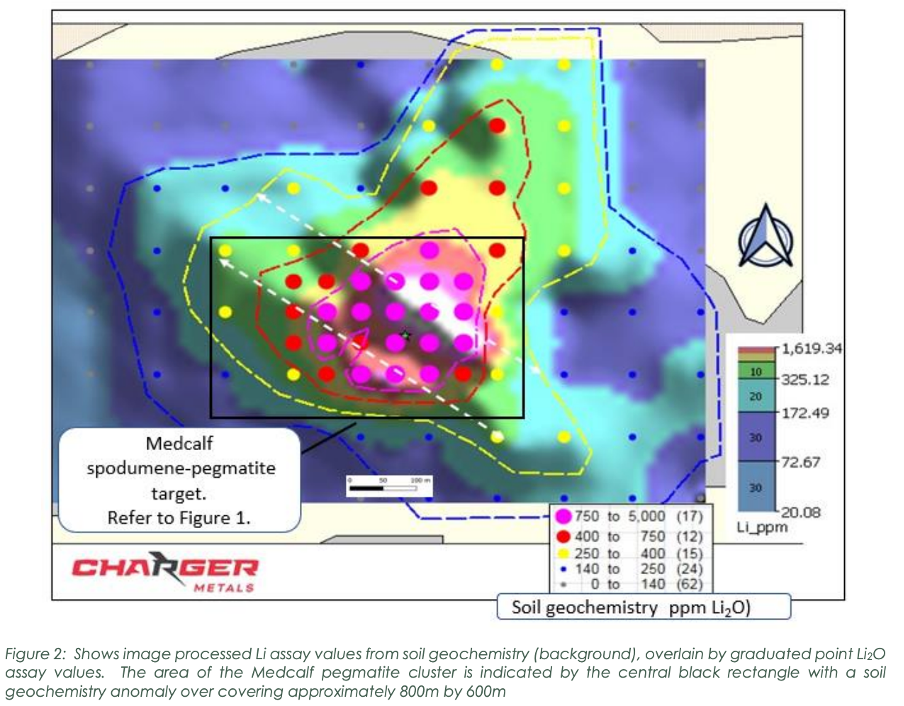
Charger’s 2022 soil geochemistry program extended the halo of the lithium-in-soil geochemical anomaly at Medcalf further north, into an area where pegmatite-derived sands and minor outcrops suggest a possibly sub-parallel zone just northeast of the main Medcalf pegmatite swarm.
Honing in on Mt Day
More than 6,000 soil samples were taken from the northern Lake Johnston tenement group during Charger’s sampling mission.
The geochemical responses that most likely represent LCT pegmatites were returned from the vicinity of the Mt Day pegmatite field, which is a 5.5-kilometre by 1.5-kilometre zone with numerous mapped pegmatite emplacements.
Samples were analysed with pXRF by commercial provider Portable Spectral Services, which then calculated a propriety lithium index value.
This measurement can be useful because it helps companies identify fertile LCT pegmatites quickly, thus expediting the exploration cycle.
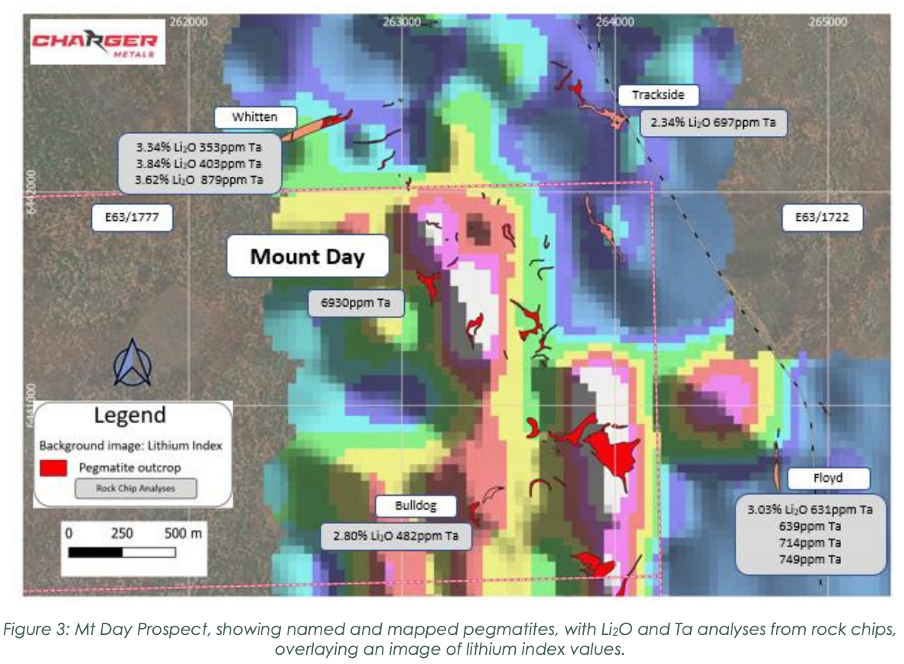
A selection of more than 1,100 samples have since been submitted to a commercial laboratory for conventional analysis, which will include lithium.
Importantly, other scattered anomalies may represent previously unrecognised pegmatites.