
- FTSE 100 closes down nearly six points
- Zara owner helps lift retailers
- Melrose lifted by buyback news
4.55pm: FTSE closes in red
FTSE 100 closed just slightly in the red on Wednesday as investors continue to be jittery about the weak outlook for the global economy.
The Footsie ended 5.93 points, or 0.08%, lower at 7,593.00.
It’s been another day of weakness for markets in Europe after the OECD followed up yesterday’s World Bank global growth downgrade, with one of its own," said Michael Hewson, analyst at CMC Markets UK.
"This really shouldn’t have come as too much of a surprise, however, markets, in general, tend to view the world through a rather rose-tinted prism, which is largely detached from the experiences of ordinary people on the ground.
"To have the risks to the global economy, particularly in Europe as well as the UK, spelt out so starkly, seems to have prompted increased anxiety amongst investors sending yields higher, and equity markets lower," he added.
3.50pm: Footsie remains downbeat into the close
Leading shares are off their worst levels but still in negative territory as we head into the close of trading.
Investors are once again unsettled by the prospect of an economic slowdown along with surging inflation, with central banks lifting interest rates and the likes of the OECD and World Bank cutting growth forecasts.
Michael Hewson, chief market analyst at CMC Markets UK, said: "It's been another day of weakness for markets in Europe after the OECD followed up yesterday’s World Bank global growth downgrade, with one of its own. The OECD said the global economy would pay a heavy price for Russia’s invasion of Ukraine, with much weaker growth and higher prices, which is likely to result in permanently higher inflation, and a weaker recovery.
"This really shouldn’t have come as too much of a surprise, however markets in general tend to view the world through a rather rose-tinted prism, which is largely detached from the experiences of ordinary people on the ground.
"To have the risks to the global economy, particularly in Europe as well as the UK, spelt out so starkly, seems to have prompted increased anxiety amongst investors sending yields higher, and equity markets lower."
So the FTSE 100 is down 21.98 points or 0.29% at 7576.95, although it has recovered from the day's low of 7550.
Among the fallers are Airtel Africa PLC (LSE:AAF), down 6.71%, Royal Mail PLC (LSE:RMG), 5.4% lower, and Schroders PLC (LSE:SDR), off 2.68%.
But there are some bright spots.
Aveva Group (LSE:AVV) has recovered from its earlier falls following its figures and is now p 11.2%.
And Melrose Industries PLC (LSE:MRO, OTC:MLSPF) is up 9.64% as it announced a share buyback programme starting tomorrow.
Better than expected first quarter results from Zara owner Inditex has given the retail sector a lift, with Next PLC (LSE:NXT) up 0.62% and JD Sports Fashion PLC (LSE:JD.) - under pressure yesterday - ahead by 2.32%.
2.55pm: Wall Street dips on recession fears
US stocks have opened lower as rising recession fears crush investor confidence.
Just after the open, the Dow had dipped 211 points at 32,970 points.
The S&P 500 was down 25 points at 4,136 points and the Nasdaq had shed 49 points at 12,126 points.
Shares in pharmaceutical company Novavax, Inc. (NASDAQ:NVAX) were up about 6% following the news that its COVID-19 vaccine has been recommended for adult use by the US Food and Drug Administration’s vaccine advisory committee.
Chinese tech stocks including Alibaba Group (NYSE:BABA) were also boosted by the country’s approval of publishing licences for 60 videogames on Tuesday, signalling an easing of regulatory pressures for the broader Chinese tech sector.
Alibaba's US-listed shares were up about 4% just after the open.
2.15pm: Footsie close to day's low but Aveva recovers
Leading shares continue to head lower.
With growing concerns about the state of the global economy after the OECD followed the World Bank in cutting growth forecasts, the FTSE 100 is close to the day's low, down 43.11 points or 0.57% at 7555.82.
The mid cap FTSE 250 is doing slightly better but is also in negative territory, down 0.37% at 20,24.58.
The fallers in the blue chip index are a mixed bag, with Airtel Africa PLC (LSE:AAF) down 6.19%, Royal Mail PLC (LSE:RMG) 5.08% lower and Antofagasta PLC (LSE:ANTO) off 3.45%.
But after an early fall in the wake of its full year loss, Aveva Group (LSE:AVV) has recovered and is now up 7.53%.
Melrose Industries PLC (LSE:MRO, OTC:MLSPF) has climbed 7.28% after it plans to begin a £500mln share buyback tomorrow after this week agreeing the disposal of its Ergotron business.
12.22pm: European growth revised upwards
The European economy grew more quickly in the first quarter than previously expected, according to the latest figures.
In the euro area, GDP increased by 0.6% compared to the previous quarter, and better than the initial reading of 0.3%. In the wider EU, it grew by 0.7%.
Once again, #eurozone #GDP has been revised after initial estimates proved inaccurately weak. Q1 GDP growth now estimated at +0.6% by Eurostat vs. prior estimate of +0.3%. The revision - once again - brings the GDP data more into line with the @SPGlobalPMI for the eurozone. pic.twitter.com/8c8AhLqsQ4
— Chris Williamson (@WilliamsonChris) June 8, 2022
11.47am: Wall Street set for downbeat start
US markets were expected to open lower on Wednesday amid concerns that the world’s biggest economy may slide into a recession.
A spike in oil prices with benchmark oil prices jumping above $120 a barrel and gloomy predictions for the global economy from the World Bank and the OECD are also weighing on investors' minds.
Futures for the Dow Jones Industrial Average lost 0.5 % in pre-market trading, while those for the broader S&P 500 index shed 0.4%, and contracts for the Nasdaq-100 were down 0.3%.
US CPI inflation data, scheduled for release on Friday, will be key as markets look for signs that price pressures have already peaked.
Back in the UK, the FTSE 100 is hovering around the day's low, down 27.37 points or 0.36% at 7571.56.
11.05am: UK to be worst performing major economy next year apart from Russia
Britain will be the worst performing major economy next year apart from sanctions-hit Russia, according to the latest report from the OECD thinktank.
The UK will grow by 3.6% this year but will see zero growth next year. Only six months ago, the thinktank was forecasting 4.7% growth for the UK this year and 2.1% in 2023.
Meanwhile inflation is expected to average 8.8% this year, peaking at 10%, and falling to a still high 7.4% in 2023.
The OECD said the UK was being hit by a combination of higher interest rates, higher taxes, reduced trade and rising energy prices.
It said the invasion of Ukraine immediately slowed the world's recovery from the COVID-19 pandemic and set the global economy on a course of lower growth and rising inflation.
Overall it expects global growth to decelerate sharply to around 3% this year and 2.8% in 2023, well below the 4.5% and 3.2% respectively projected in the previous Economic Outlook last December.
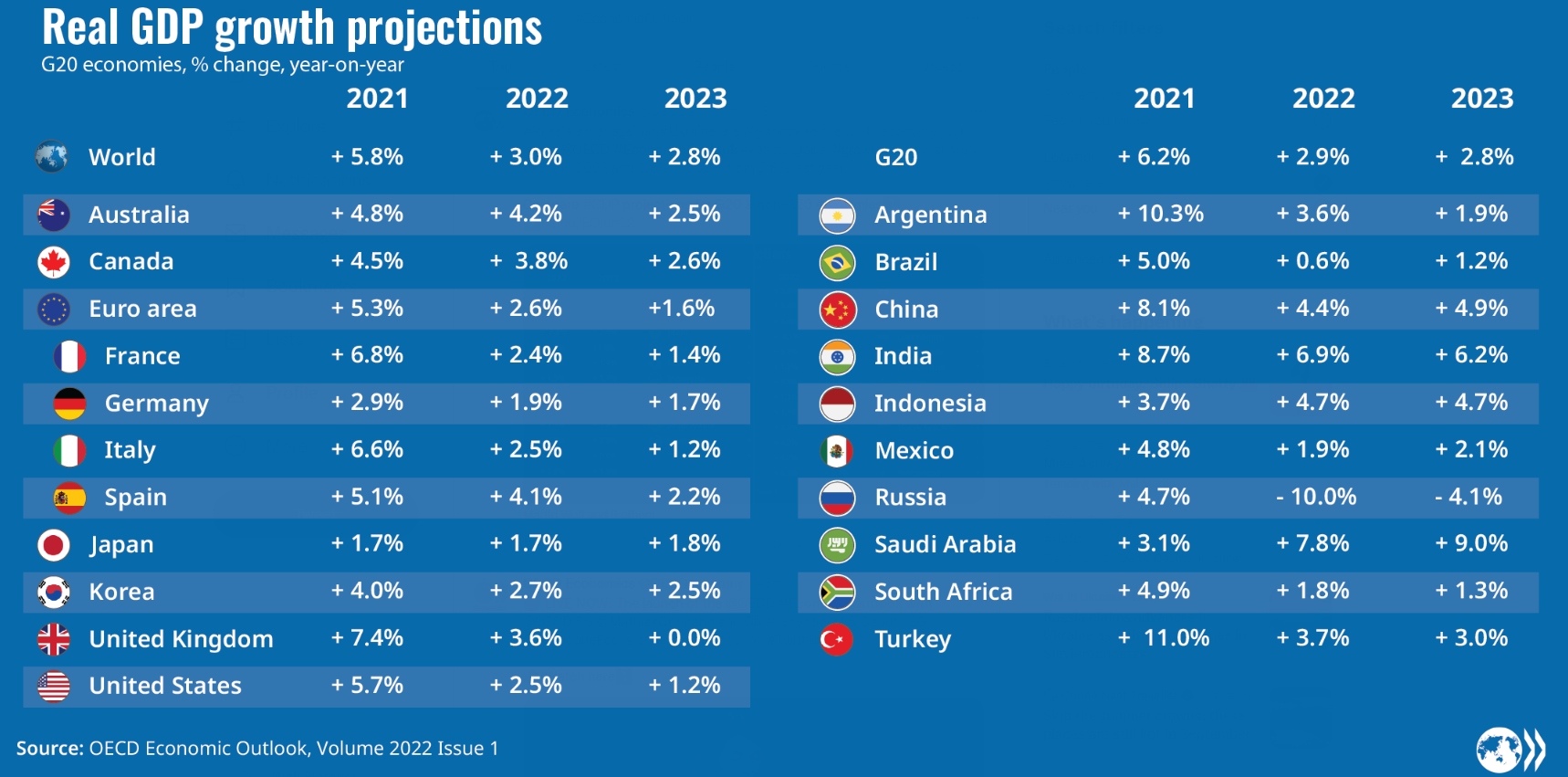
In the wake of the report, the market is heading lower again.
The FTSE 100 is now down 19.71 points or 0.26% at 7579.22.
9.47am: Housing market pulls construction activity lower
The UK construction sector saw a slowdown in growth in May, mainly due to the residential housing market.
The headline S&P Global/CIPS UK Construction Purchasing Managers’ Index – which measures month-on-month changes in total industry activity – registered 56.4 in May, down from 58.2 in April and below the expected figure of 56.6.
This was the lowest reading for four months.
Weaker trends in the house building sub-sector were the main brake on growth, with this index falling to 50.7 from 53.8 in April. This signalled the worst performance for residential work since May 2020.
The replies to the survey suggested that subdued consumer confidence and worries about the economic outlook had constrained demand. Higher borrowing costs and intense inflationary pressures were also cited as factors likely to hold back growth over the next 12 months.
The report indicated that business activity expectations at construction companies were the least upbeat since August 2020.
Unsurprisingly the vast majority of survey respondents (73%) reported a rise in purchasing prices. This was linked to rising fuel, energy and raw material costs. But the overall rate of inflation eased to a three month low.
Duncan Brock, group director at the Chartered Institute of Procurement & Supply, said: "Though still offering a comfortable margin above the no change mark, the construction sector saw growth ease to a four-month low with the usual suspects taking the heat out of the recovery – elevated inflation, future uncertainty and supply-chain disruption."
Back with the markets and the FTSE 100 has come back off its worst levels and has made it into positive territory - just.
The leading index is currently up 5.21 points at 7604.14 having fallen as low as 7574.

9.09am: Crude climbs ahead of US inventory figures
Oil prices continue to bubble up ahead of US inventory data later, with some experts predicting it could reach US$150 a barrel.
At the moment Brent crude has risen 0.63% to US$121.33 while West Texas Intermediate, the US benchmark, is 0.79% higher at US$120.35.
Jeffrey Halley at Oanda said: "The data releases across Europe and the US today are strictly second-tier. Probably the most interesting will be the US official crude inventory data after last week’s surprise 5 million-barrel drop. With Brent crude and WTI both around $120.00 a barrel, sharp falls in headline crude inventories or refined products could spur another rally in oil prices."
The strength of the crude price continues to support the oil giants.
BP PLC (LSE:BP.) is 1.14% better while Shell PLC (LSE:SHEL, NYSE:SHEL) is up 0.62%.
Susannah Streeter, senior investment and markets analyst at Hargreaves Lansdown, said: "The continuing intensity of the war in Ukraine is adding to fears that supply constraints will continue for longer, and the effect of oil cartel OPEC’s recent decision to turn on the taps more fully has faded fast. That’s been helping to lift shares in energy giants like BP and Shell, given that higher energy prices have seen cash pouring into their coffers."
Meanwhile Jeremy Weir, chief executive of oil and commodities trading giant Trafigura, has told an FT conference that crude prices were heading towards US$150 a barrel this year.
He said if oil reached that level demand could slump and trigger a slowdown in global economic growth.
Worries about the economy are helping to keep the FTSE 100 in negative territory. It is now down 21.87 points or 0.29% at 7577.06.
8.14am: Uncertain start for markets
Leading shares have made another uncertain start, as concerns about the global economy slowing at the same time as inflation soars continue to nag at investors.
Ipek Ozkardeskaya, senior analyst at Swissquote, said: "The World Bank [yesterday] cut its 2022 growth forecast for the second time this year, from 4.1% in January to 3.2% in April and to 2.9% this week on the back of several-years-long of above-average-inflation and below average growth, that will especially hit low to middle income economies.
"The probability of US recession is also being pulled higher by several big banks. Morgan Stanley, for example, recently said that the probability of recession in the US jumped from 5% to 35% since the start of the year."
Meanwhile after the Reserve Bank of Australia put up interest rates by more than expected this week, the Reserve Bank of India has raised a key interest rate by 50 basis points, the second hike in as many months.
In early trading the FTSE 100 has dipped 4.19 points to 7594.74.
Software group Aveva Group (LSE:AVV) is among the fallers, slipping 1.08% after it reported a 3.3% rise in annual revenues but moved from a £36.6mln profit to a £6.5mln loss from operations.
It said the integration of acquisition OSIsoft was progressing well.
7.40am: House prices past their peak?
UK house prices continue to rise, but at the slowest annual rate so far this year.
House prices increased by 1.0% in May, the eleventh consecutive monthly rise, according to the latest Halifax survey, with the average price at a record £289,099.
Annual house price inflation edged down from 10.8% in April to 10.5%.
But the Halifax points out that house prices have risen 74% in the last 10 years
Russell Galley, Halifax managing director, said: “The average cost of buying a home in the UK is up 1%, or £2,857, on last month, and has now risen for eleven consecutive months. Annual growth also remains in double-digits, at 10.5%, although this is the slowest rate of growth seen since the start of the year
“The average cost to buy a home in the UK is now £289,099, hitting yet another record high. Despite the very real cost of living pressures some people are experiencing, the imbalance between supply and demand for properties remains the primary reason driving the continued climb in house prices.
“For house hunters, the extent of the impact of property price inflation continues to be linked to the type of home they are looking to buy. Compared to May last year, you’d need around £10,000 more to buy a flat, but an additional £50,000 for a detached home. This clearly creates a knock-on effect for those looking to make their first home move, as the rungs on the housing ladder have become increasingly wider
“However, the housing market has begun to show signs of cooling. Mortgage activity has started to come down and, coupled with the inflationary pressures currently exerted on household budgets, it’s likely activity will start to slow.
“So, there is perhaps one green shoot for prospective purchasers; with overall buying demand down compared to last year, we may be past the peak sellers’ market.”
Graham Cox, founder of the Bristol-based broker, SelfEmployedMortgageHub.com, said: “I believe house prices will fall by 5% this year and possibly even more in 2023. Property prices are already coming off their record highs and transaction levels are falling. Mortgage costs, fuel, food and energy prices continue to soar with no end in sight. Throw in National Insurance and tax hikes, the terrible events unfolding in Ukraine and the autumn energy cap increase and it's a recipe for economic disaster that we won't see the full effects of until the winter. There is nowhere for house prices to go but down.”
6.50am: US expected to give a lift to Footsie
The FTSE 100 is seen on the front foot ahead of Wednesday’s open, following on from more positive trading last night in the US.
CFD firm IG Markets has the blue-chip benchmark around 20 points to the better, making a price of 7,622 to 7,625 with just over an hour to go until trading begins.
“Sentiment continues to remain extremely fickle, prone to the ebb and flow of inflation expectations, followed by fears that central banks will over react in combatting said inflation, which is then followed by concern about what that might do to global growth,” said Michael Hewson, analyst at CMC Markets.
“This argument which the market appears to be having with itself, over whether we see a recession, or a soft landing is likely to become a lot clearer, over the next week or so, starting with US CPI on Friday, followed by PPI and the Fed meeting a week from now.”
The Dow Jones added 264 points or 0.8% in Tuesday’s trade, to close at 33,180, whilst the S&P 500 advanced 0.95% to finish Tuesday at 4,160.
Similarly, the Nasdaq gained 113 points or 0.94% to 12,175.
Small-caps also finished Tuesday in positive territory with the Russell 2000 index up 1.57% to 1,919.
In Asia, Japan’s Nikkei added 247 points or 0.89% to trade at 28,192.
Hong Kong’s Hang Seng was up 1.6% to 21,877 though the Shanghai Composite dipped 0.26% to 3,233.
Around the markets
Pound: US$1.2573, down 0.1255%
Gold: US$1,849 per ounce, down 0.25%
Silver: US$22.12 per ounce, down 0.53%
Brent crude: US$120.98 per barrel, up 1.4%
WTI crude: US$119.96 per barrel, up 1.45%
Bitcoin: US$30,522, up 3.5%
Ethereum: US$1,809, up 3.2%