
Australian Potash Ltd (ASX:APC) has welcomed updated flow modelling that outlines the potential for increased production from brine at the Lake Wells Sulphate of Potash Project (LSOP) in WA.
After releasing a front end engineering and design (FEED) study last year, which focused on the Lake Wells’ borefield, the SOP company analysed results from its recently completed brine supply bores.
APC’s evaluation points to increased brine grade and sustainable pumping rates within the borefield, and by updating its hydrogeological flow model the company could increase annual SOP production by 15,000 tonnes.
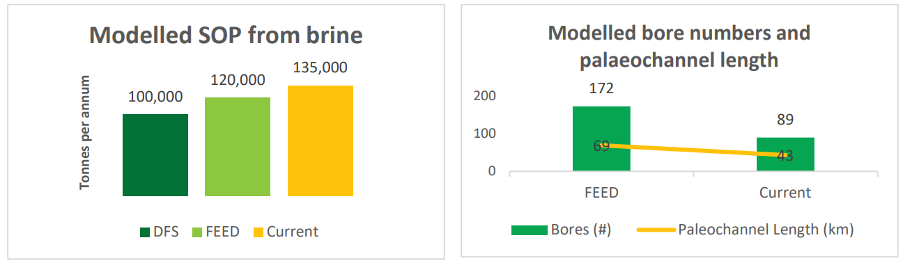
Ultimately, the 12.5% upgrade would bring the project’s production metrics up from the 120,000 tonnes per annum shown in the FEED study to a 130,000-tonne annual production rate.
What’s more, modelling suggests that 89 supply bores will be suitable for life-of-mine (LOM) operation, whereas the original FEED development model had 172 bores over the LOM — a 48% reduction in installed bores.
New financial modelling on the way
Australian Potash managing director and CEO Matt Shackleton said: “We continue to apply a rigorous de-risking methodology to the development and operational strategies at the LSOP, including crucially in the fundamental brine abstraction (mining) process.
“The LSOP will be developed as a 100% borefield abstraction project with no reliance on surface trenching to collect brine.
“The early works program we undertook through 2021 and early 2022 has demonstrated improvements in the brine borefield and data from constructed bores has allowed us to further optimise the flow model underpinning the LSOP development, providing us the opportunity to produce more SOP with less bores over the life of mine."
He said the financial implications of these results were being worked through, "but less bores means lower initial capital cost and lower sustaining capital costs, which we reasonably anticipate will flow through to the LSOP’s financial outcomes.
“Updated financial modelling will be announced to ASX as soon as it is available.”
Higher annual production rate
Initially, APC believed it could produce 100,000 tonnes of SOP every year with brine extraction, thanks to a 2019 definitive feasibility study (DFS).
Using 20% of the in-situ measured resource, the company calculated a probable reserve of 3.6 million tonnes.
The DFS also forecast another 50,000 tonnes per annum could be produced by converting Lake Wells’ muriate of potash (MOP) to SOP.
The brine abstraction rate was optimised through the FEED study, leading to optimised SOP output of 120,000 tonnes per annum.
Through the DFS, external consultants AQ2 prepared a hydrogeological model for LSOP’s proposed development.
This model has been updated regularly with actual data generated in the field.
By including data from bore test pumping to date in the hydrogeological model, APC’s modelling indicates there’s potential to increase the annual SOP production from brine abstraction to 135,000 tonnes per annum.
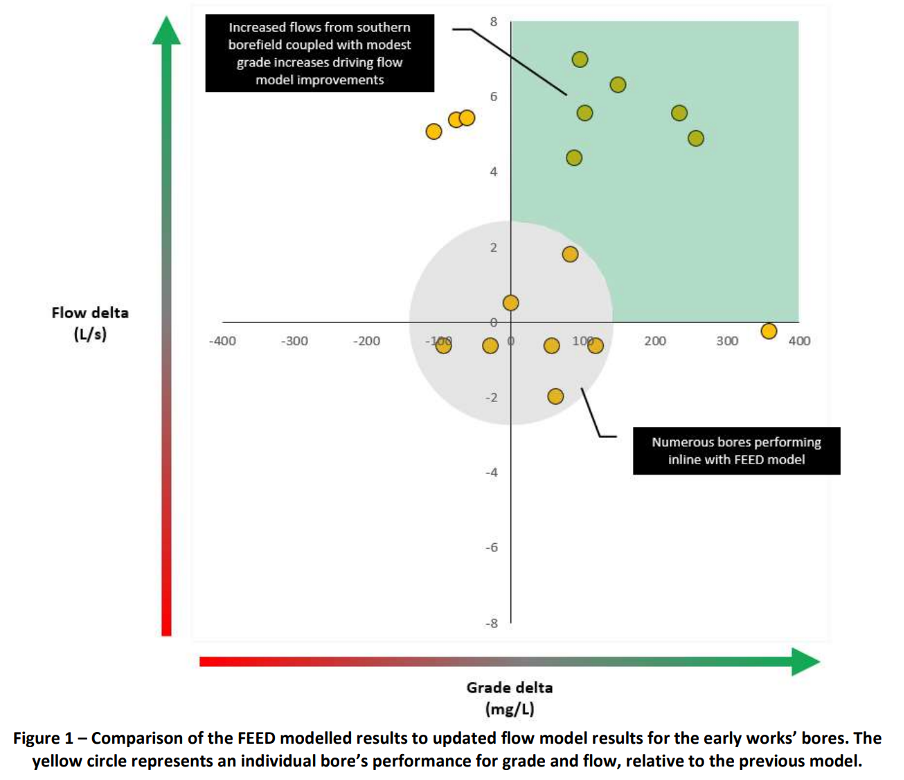
A further improvement from the updated flow model is a reduction in the number of bores required to produce the necessary brine flow.
Where the FEED model indicated a required 79 bores at startup, expanding to 172 bores over the life of the LSOP, the current model revises the required bores down to only 89 over the life of mine.
As a result, the potential cost savings over the life of the mine could be substantial.
Along with the reduction in bore number, the updated flow model predicts higher grade and a longer production profile.
The implications to LSOP’s pond network, harvest ponds and processing plant are being considered in light of the improved flow model.