
Sovereign Metals Ltd (ASX:SVM, AIM:SVML) has started its pre-feasibility study (PFS) drilling program across the Kasiya Rutile Project.
The 12,000-metre drilling program is designed to upgrade higher-grade mineral resource areas to underpin conversion to reserves as part of the planned PFS. This is the first significant work program for the PFS the company has started.

SVM will be busy over the course of the next month as it also looks to complete an updated scoping study incorporating the current resource in the coming weeks.
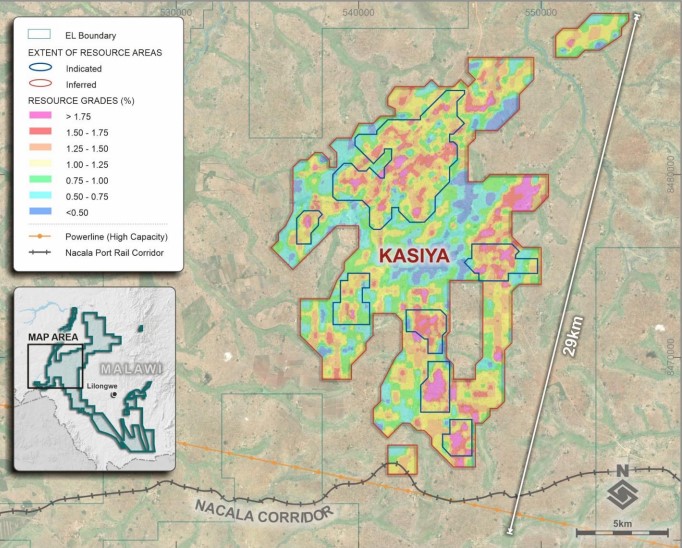
Map displaying rutile grades in the uppermost part of the updated Kasiya MRE block model.
The world’s largest rutile deposit
When SVM announced in April 2022 an updated mineral resource estimate (MRE) of 1.8 billion tonnes @ 1.01% rutile, it confirmed Kasiya as a Tier 1 deposit and a potential major source of two low-CO2-footprint critical raw materials – natural rutile and natural graphite.
The updated MRE positioned Kasiya as the largest rutile deposit in the world, with more than double the contained rutile of its nearest rutile peer, Sierra Rutile.
A further highlight was the graphite by-product MRE at Kasiya, which confirmed it as one of the largest flake graphite deposits in the world.
The MRE has broad zones of very high-grade rutile occurring contiguously across a very large area of over 180 square kilometres. Rutile mineralisation lies in laterally extensive, near surface, flat “blanket” style bodies in areas where the weathering profile is preserved and not significantly eroded.
The deposit is expansive with high-grade rutile mineralisation commonly grading 1.2% to 2% in the top 3 to 5 metres from surface. Moderate grade mineralisation generally grading 0.5% to 1.2% rutile commonly extends from 5 metres to end of hole where it remains open at depths of greater than 10 metres.
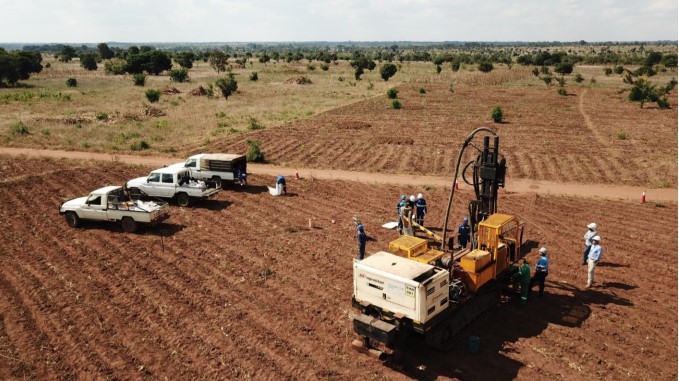
Drone photo of air-core drilling at Kasiya overseen by Sovereign’s geology team.
More about SVM’s drilling program
As per the updated MRE, there are several areas that remain open at depth: mineralisation is expected beyond the limit of previous drilling with many holes showing over 1% rutile at bottom of hole.
The 10,000-metre aircore drilling program was designed to extend indicated zones at depth to base of saprolite of roughly 25 metres, from the current 14-metre average drill depth. Drilling will be on a 200 metre by 200 metre grid to target indicated classification, which should convert to probable reserves as part of the forthcoming PFS.
SVM is also preparing for a core (push-tube) drilling program across inferred areas of the MRE.
This infill program is targeting nearer-surface, high-grade areas for conversion to indicated and measured resources. In parallel to these mechanical drill programs, SVM is continuing extensional and regional hand-auger drilling with multiple drill teams active across its extensive target areas at Kasiya, with the aim of expanding the overall mineralised footprint and identifying further high-grade rutile zones.
The low-cost, low-impact hand-auger drilling technique has proven to be a very effective exploration tool in the initial delineation of the Kasiya rutile and graphite MRE.
Completion of scoping study
SVM is close to finishing the updated scoping study, which will build on the initial scoping study released in December 2021.
The updated scoping study will incorporate the significant increase in the MRE tonnage as announced in April, assessing higher grade throughput, increased production rates and longer mine life. The updated scoping study is expected in the coming weeks.