
Duke Exploration Ltd (ASX:DEX) has received encouraging preliminary copper intersections from ongoing reverse circulation (RC) drilling at the flagship Bundarra Copper Project in North Queensland.
The company’s goal is to identify copper mineralised targets that have the potential to increase the resource base of the project, including three new areas being tested in the southwestern part of the Bundarra Intrusive Complex (BIC).
Notably, anomalous copper was intersected in all drill holes at the Rogers Prospect with pXRF readings highlighting:
- 1.18% copper over 5 metres from 143 metres;
- 0.76% copper over 7 metres from 23 metres; and
- 0.64% copper over 35 metres from 0 metres
After the initial RC program, follow up drilling is planned on targets that have the potential to be of sufficient scale and grade to support a mineral resource.
“Multiple zones of mineralisation”
Duke managing director Philip Condon said: “We are very encouraged to report the first pXRF results from the RC drilling program targeting eight prospects within the southwestern part of the BIC.
“This is the first part of this RC scout drilling phase and follows the successful diamond drilling campaign during Q4 2021 and Q1 2022 outside of our Mt Flora resource area.
“Of specific note is that the Browns South and Rogers prospects appear to be host to multiple zones of mineralisation within a 3-kilometre NE trending structural corridor.
“This corridor will be further investigated by ensuing drilling programs.
“This RC program is ongoing, and we are anticipating reporting on investigations on the Quorn prospect next week.”
Bundarra drill program
Duke drilling program entails a total of eight primary target areas including three new areas that are being tested in the southwestern part of the BIC.
Preliminary pXRF results are reported from the RC drill program which has to date completed 19 drill holes totalling 4,395 metres. These provide the company with an indication of its drilling outcomes as it awaits assay results.
Notably, the Rogers-Browns South corridor is emerging with mineralisation over a strike length of 3,000 metres
At Browns South, drill hole BNRC001 intersected average pXRF grades of 0.57% copper over 13 metres from 229 metres and BNRC002 intersected average pXRF grades of 0.21% copper over 21 metres from 177 metres.
At Absolon, drill hole BNRC020 drilled directly underneath the Absolon lode intersected pXRF 0.12% copper over 4 metres from 137 metres which is 170 metres down dip of the surface exposure of the mineralised zone.
Rogers drilling
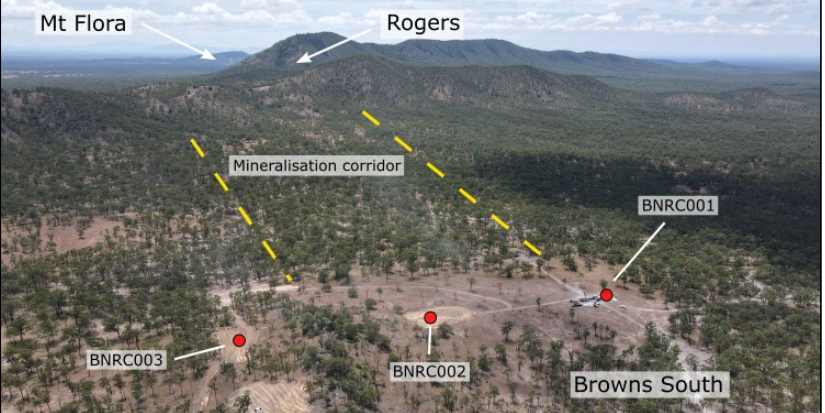
Browns South mineralised zone is associated with NE striking feldspar porphyry and magnetic diorite dykes in granodiorite that align along strike with mineralisation at Rogers.
The Rogers prospect is within an ‘embayment’ of hornfelsed argillite that lies between two overlapping intrusive phases of the BIC.
Recent diamond drilling by Duke at Rogers intersected narrow zones of mineralisation comprising magnetite-pyrite-chalcopyrite veins and zones of brecciation associated with strong potassic alteration overprinted by sericite.
Mineralisation is hosted by sulphide veins within hornfelsed argillite and brecciated zones within granodiorite.
Subsequently, Rogers RC drilling has tested the interpreted NE trending structures using three widely spaced 120 metres – 240 metres drill lines.
These structures were also identified for follow-up by the recent geophysics data interpretation.
A total of 25 significant mineralised zones were intersected over nine holes drilled into Rogers using a 0.1% Cu pXRF cut off, with a minimum width of one metre and including three metres of internal waste