
Dart Mining NL (ASX:DTM) has completed deep diamond drilling of induced polarisation (IP) geophysical targets at the Granite Flat Copper-Gold Porphyry Project in northeast Victoria.
The company encountered notable zones of alteration as well as copper and molybdenite mineralisation from three diamond drill holes totalling 996.8 metres of drilling which included:
- EMDDH006 terminated at 429 metres;
- EMDDH007 terminated at 268.3 metres; and
- EMDDH008 terminated at 299.5 metres.
Looking ahead, Dart is awaiting assay results from this drilling program with further drill testing scheduled at the beginning of June.
Copper and molybdenum mineralisation
Dart chairman James Chirnside said: “Dart has successfully completed a planned three-hole, deep diamond drilling program to test geophysical targets, identified last year, across the Granite Flat Copper-Gold project.
“Encouragingly, all holes encountered zones of copper and molybdenum mineralisation.
“Further drill testing is planned to start at the beginning of June.”
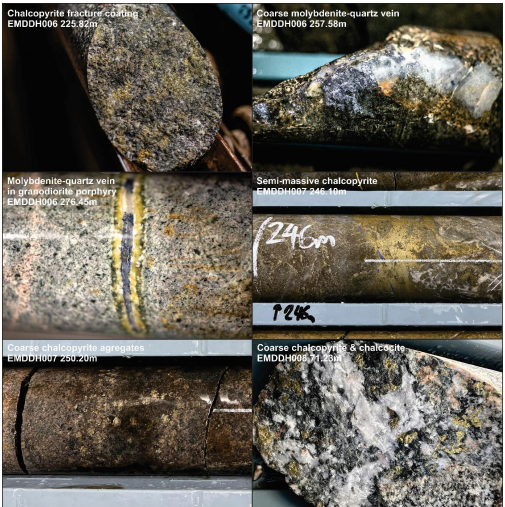
Examples of mineralisation styles encountered in the recent drill holes completed at Granite Flat.
Drilling summary
Amongst the three drill holes, drill hole EMDDH006 was designed to target a substantially induced polarisation (IP) geophysical anomaly identified in the IP survey completed in late 2021.
At 429 metres depth, EMDDH006 represented the deepest hole yet drilled in the Granite Flat project, with several intervals of potassic altered quartz-feldspar porphyry identified.
Similarly, EMDDH007 was located to target a second significant IP anomaly, 1.3 kilometres away on the southern side of the Granite Flat project.
Hole EMDDH007 was drilled to a depth of 260 metres and encountered basaltic dykes carrying disseminated pyrite and chalcopyrite, with narrow semi-massive sulphide mineralisation near the margins.
EMDDH006 and EMDDH007 intercepted broad notable zones of chalcopyrite mineralisation, adding further evidence to the scale of the mineralisation at Granite Flat.
The third deep diamond hole, EMDDH008, was above a zone of elevated resistivity and successfully targeted a sheeted vein system associated with the intrusion-related mineralisation style evident across the project.
Next steps
The vast majority of core from this latest drilling has been logged and sampled, with Dart Mining geologists eagerly awaiting assay results.
Assay laboratories are experiencing exceptionally high demand, and the company is expecting a two-month turnaround time on assay results for diamond drill core.
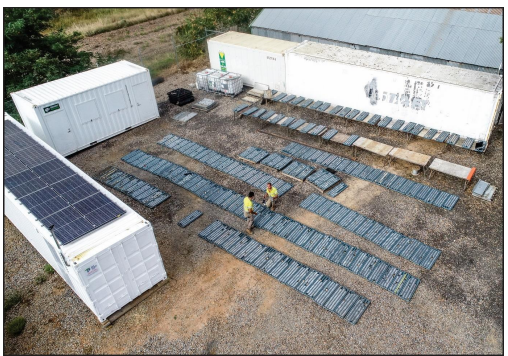
Dart Mining geologists examining core from the recent diamond drilling at Granite Flat.
About the project
Dart’s Granite Flat prospect is nine kilometres southeast of Mitta Mitta township and is accessed via the Omeo Highway.
Historically, the prospect was mined at several small production centres between 1856 and 1918, following an initial discovery identified by tracing the source of alluvial gold in the Mitta River upstream.
The broad intersections of low-grade copper-gold mineralisation returned in historic drilling and Dart’s recent 42 hole RAB drilling program are hosted within potassic, chlorite and epidote-altered granodiorite, further confirming the potential for porphyry-style mineralisation.
Mineralised zones at Granite Flat are hosted within the Banimboola Quartz Monzodiorite (BQM)
The BQM has been broadly identified as hosting a porphyry-style of copper-gold mineralisation associated with I-type granitoid and sulphide veins, with alteration varying from silicic to argillic to propylitic, with moderate to high background copper.