
Galileo Mining Ltd (ASX:GAL) has returned sulphide mineralisation in all drill holes at the Callisto palladium-platinum-copper-nickel discovery, part of the 100%-owned Norseman Project in WA.
Reverse circulation (RC) drill assays have confirmed palladium, platinum, gold, copper and nickel hits in five more drill holes at Callisto after the explorer hit strong results in a discovery hole.
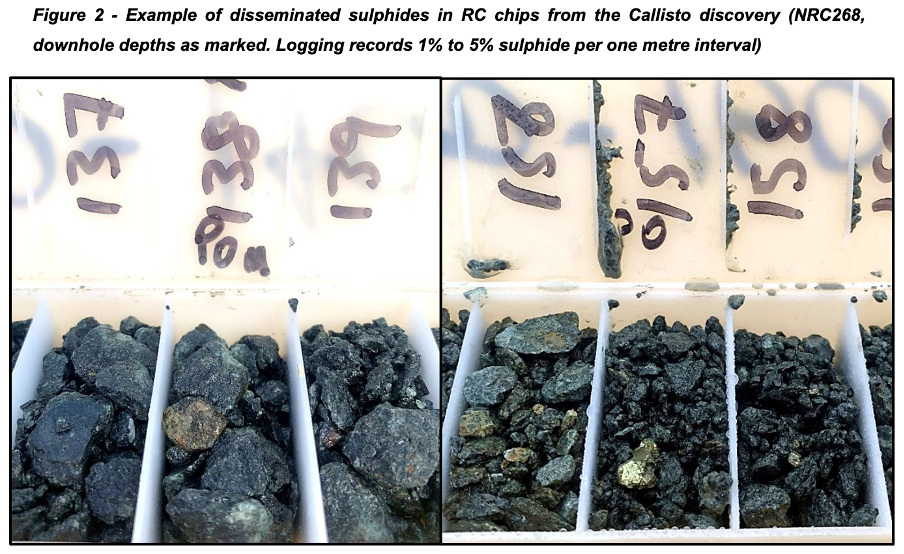
The reported assays all occur within wider disseminated sulphide zones, indicating the potential for a large mineralised system at Callisto.
RC drilling will resume late next week, with roughly 4,000 metres of drilling planned to priortise a target area east of Callisto’s discovery hole.
Drilling should take around five to six weeks to complete, with geological updates followed by assay results.
“Important step forward”
Speaking on the fresh results, Galileo managing director Brad Underwood said: “The assays from all drill holes undertaken at Callisto contain significant zones of mineralisation and confirm initial results from the discovery drill hole.
“Today’s results are a very important step forward as we have now shown the sulphides are carrying high-value metals in all six drill holes completed."

He said: “The next round of RC drilling is due to begin late next week with a focus on drilling across strike to determine the thickest and highest grades in the easterly direction.
“The same program of drilling will then continue to the north as we aim to move from discovery drilling to advanced and detailed resource drilling.
“The extensive prospective strike, combined with the thick and consistent mineralisation drilled to date, indicates the potential for a large mineralised system.
“Around 20 holes will be undertaken in the coming round of drilling and we look forward to updating the market with results from this exciting new discovery.”
Turning the soil at Callisto
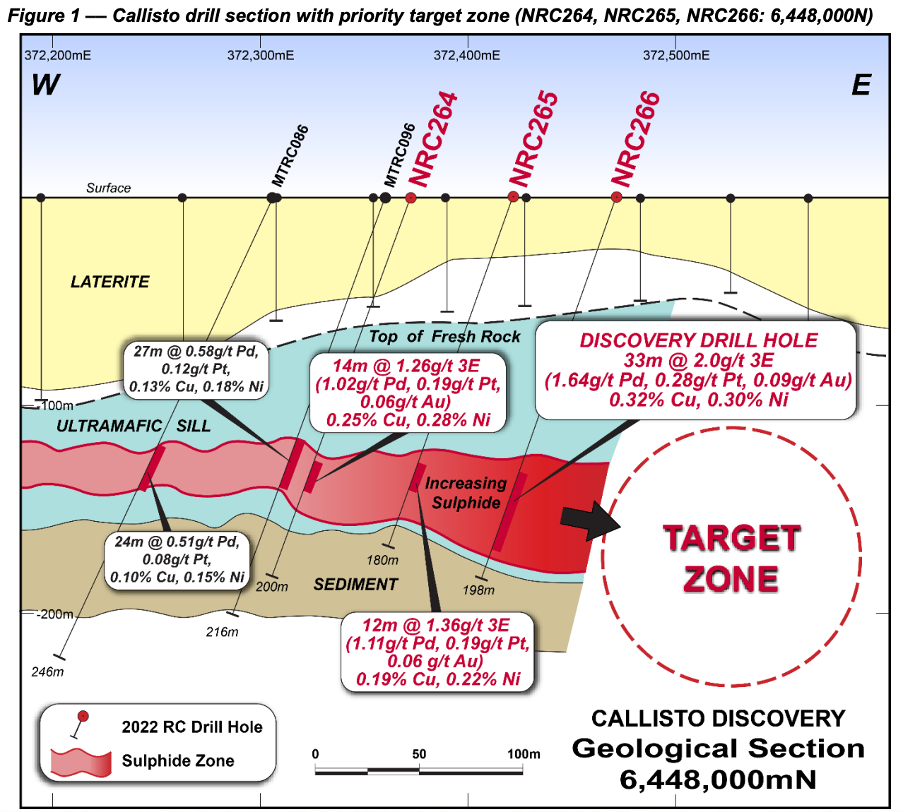
Galileo recently drilled six holes, covering 1,142 metres, across Norseman’s Callisto target.
The discovery hole recorded the widest interval of sulphide mineralisation, as reported earlier this month.
Now, five more drill holes have reported assays, including:
- 22 metres at 1.60 g/t palladium, platinum and gold (3E), 0.25% copper and 0.26% nickel from 135 metres;
- 28 metres at 1.58 g/t 3E, 0.27% copper and 0.26% nickel from 137 metres;
- 19 metres at 1.69 g/t 3E, 0.24% copper and 0.28% nickel from 124 metres;
- 12 metres at 1.36 g/t 3E, 0.19% copper and 0.22% nickel from 135 metres; and
- 14 metres at 1.26 g/t 3E, 0.25% copper and 0.28% nickel from 133 metres.
The zone east of Callisto’s discovery hole is now a priority target and will be tested in the program starting next week.
Encouragingly, every drill hole exhibits a consistent geological mineralisation pattern.
Drill holes in the initial program were completed on two east-west lines spaced 50 metres apart with a 50-metre drill spacing along the lines.
Now, drill holes in the upcoming program will continue to be spaced roughly 50 metres apart in a bid to define the grade variation across strike prior to step-out drilling along strike to the north.
What now?
An initial interpretation of results from the Callisto discovery continues to show similarities with South Africa’s Platreef deposits, with disseminated sulphide mineralisation hosted in the lower unit of a layered ultramafic sill.
The first samples from the discovery hole are at the laboratory for nickel sulphide collection fire assay, with assays pending to test for rhodium, osmium, ruthenium and iridium mineralisation.
If rhodium or other platinum group elements are found, it could add to the property’s prospectivity.
In the meantime, downhole electromagnetic surveying has been completed over two of Callisto’s holes, with a strong electromagnetic response below the holes modelled as a single large plate and interpreted to represent a sediment.
Deep diamond drilling is planned for later in the year to explore for additional mineralisation below the sediment.