Matador Mining Ltd (ASX:MZZ, OTCQX:MZZMF) has hit high-grade gold mineralisation in a winter diamond drilling program at the flagship Cape Ray Gold Project’s Central Zone in Newfoundland, Canada.
The company has reported the first assays from the winter drilling campaign, which took place between February and April this year.
During the program, the explorer intersected strong gold mineralisation, such as:
- 6 metres at 13.3 g/t gold from 214 metres, including 1-metre at 45.8 g/t from 217 metres and 1-metre at 11.7 g/t from 219 metres;
- 6 metres at 7.1 g/t from 228 metres, including 1-metre at 22.4 g/t from 229 metres;
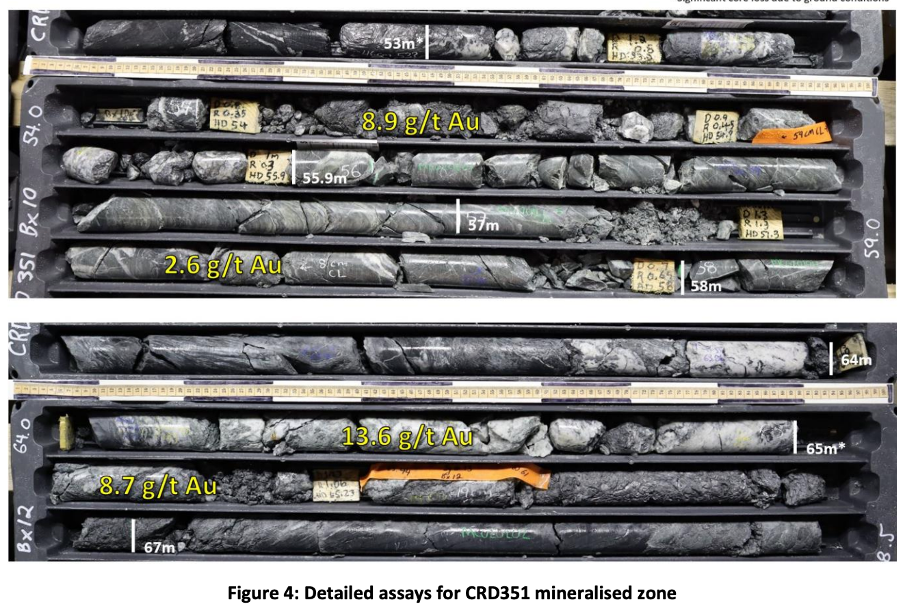
- 5 metres at 5.4 g/t from 53 metres, including 2.9 metres at 8.9 g/t from 53 metres; and
- 2 metres at 11.1 g/t from 64 metres, including 1-metre at 13.6 g/t from 64 metres.
There’s more to come from the Cape Ray project, with pending results for:
- 29 exploration diamond holes at the Window Glass Hill Granite, PW East and Stag Hill targets;
- Four Central Zone geotechnical drill holes;
- The remainder of the Stag Hill Power Auger sampling program; and
- 96 gold grain samples from the Malachite greenfield reconnaissance program.
Increasing understanding
Matador chief geologist Warren Potma said the company was very pleased with the initial set of drill results from Matador’s first winter diamond campaign.
“Drilling at Central Zone has returned positive results from drill hole CRD352, with two separate zones of high-grade mineralisation recorded in an 80-metre gap in the previous mineral resource drilling.
“It appears some of the historical drilling in this area may have reported anomalously low grades relating to variable core recovery associated with the highly sheared host rocks.
“These new results indicate potential for higher grades and increased widths compared to the current mineral resource estimate.
“The Central Zone drill results have increased our understanding of the structural controls of gold mineralisation at Cape Ray, which is particularly important as we step out to explore new greenfields targets such as Malachite.”
Hole CRD352
Gold mineralisation at the Central Zone deposits occurs as quartz veins and vein arrays, parallel to and splaying off the Cape Ray Shear Zone.
Interestingly, the gold-bearing quartz veins dip moderately to steeply towards the southeast.
Drill hole CRD352 tested an identified 80-metre-wide gap within the current mineral resource drilling.
The drill hole returned multiple intercepts, with assays totalling 130.4 grams of gold and confirming the interpreted upward continuation of a wide mineralised zone encountered at depth.
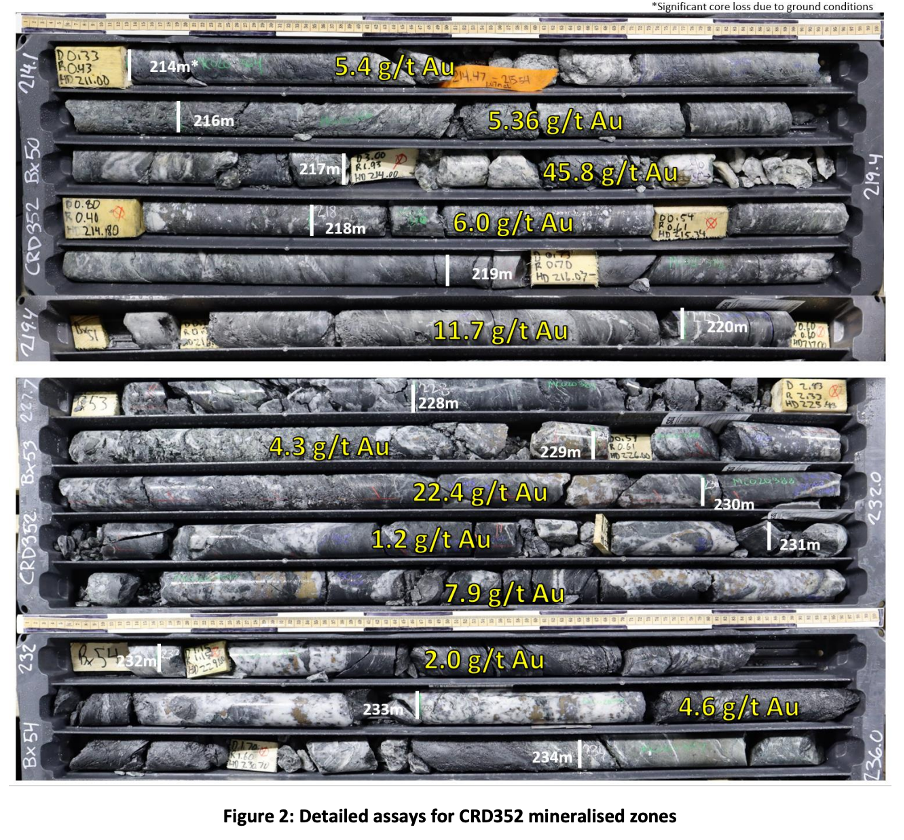
Two main zones of mineralisation were intersected, reporting the 6 metres at 13.3 g/t and 6 metres at 7.1 g/t gold hits.
Hole CRD351
Meanwhile, drill hole CRD351 was designed to twin a historical drill hole to provide supplementary structural information on the mineralisation controls.
Drilling conditions associated with a highly sheared country rock were difficult, resulting in core loss and poor core orientation results.
However, the hole intersected the targeted mineralised zone and returned high-grade intercepts such as 5 metres at 5.38 g/t and 2 metres at 11.1 g/t.