
Kin Mining NL (ASX:KIN) has fielded high-grade drilling results of up to 2 metres at 14.5 g/t gold from 120 metres that confirm an extension to the Cardinia Hill prospect at the 1.275-million-ounce Cardinia Gold Project (CGP) near Leonora in Western Australia.
Final assay results from reverse circulation (RC) drilling at Cardinia Hill’s North Extension have extended the 106,000-ounce deposit to the north.
High-grade results
High-grade lodes can now be traced for more than 1.1 kilometres and the north plunging zone remains open to the north and at depth.
Other strong results from the RC program are:
- 4 metres at 2.79 g/t gold from 96 metres;
- 1-metre at 6.11 g/t from 63 metres; and
- 1-metre at 7.17 g/t from 50 metres.
Kin Mining managing director Andrew Munckton said: “These results from the northern extension drilling of the Cardinia Hill deposit provide confirmation that Cardinia Hill high-grade gold lodes can be traced for over 1.1 kilometres and remain open to the north and at depth.”

RC program
The RC drilling program at Cardinia Hill north extension was completed in March 2022 and comprised 21 RC holes for 2,100 metres on nine lines at approximately 40-metre line spacing.
Multi-element assay results for sulphide mineralisation within the RC holes have confirmed that the mineralisation is associated with anomalous silver, copper, antimony, molybdenum, selenium and tellurium in sulphide-rich vein structures within altered mafic rocks.
These final assays and other significant results are on a single quartz and sulphide-rich zone trending north from Cardinia Hill towards the East Lynne high-grade aircore drilling results around 600 metres north of the latest results.
East Lynne next
Munckton said: “The next significant drilling along the Cardinia Hill structure is at East Lynne approximately 600 metres north where previous aircore drilling intersected exceptional grades (5 metres at 35 g/t gold).
“The exploration team is now assessing, with a small additional RC drilling program at East Lynne, if the two deposits lie on the same mineralised structure and may be continuous.”
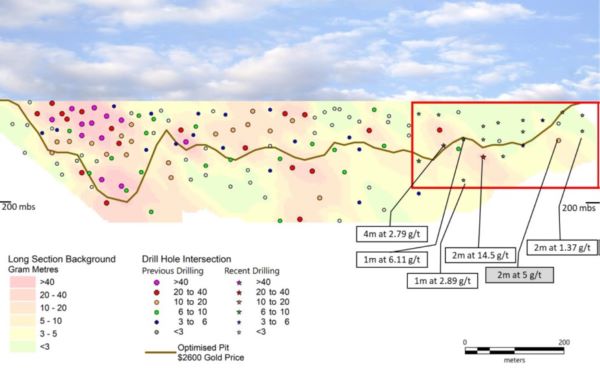
Cardinia Hill RC drilling results long section with recent RC results in white labels and historical drilling results in grey labels.
Eastern Corridor system
The new results support and reinforce previous results at Cardinia Hill and from the nearby Rangoon deposits confirming that deposits within the Eastern Corridor, including Cardinia Hill, Helens, Fiona, Rangoon and East Lynne form a coherent mineralised system that spans an area of about 5 kilometres by 1-kilometre.
“These Cardinia Hill results combined with recent high-grade results from Rangoon, Fiona and historical drilling at the nearby Helens deposit demonstrate that the Eastern Corridor area is strongly endowed with multiple structurally controlled ore positions, all of which contain high-grade sulphide and quartz vein mineralisation that has a common source,” Munckton said.
"The company has only drilled the near-surface environment at the Eastern Corridor and believes that with further drilling supported by our advanced geological understanding and aided by our detailed gravity model, further significant mineralised positions in this exciting area will be revealed.
“Given the widespread nature of the ore grade intercepts and the nearby location of this exciting area to the Cardinia plant site, we have prioritised for deeper RC drilling the Eastern Corridor which has already commenced at Rangoon and East Lynne.”
The Cardinia Hill deposit was originally discovered by broad spaced aircore drilling in early 2020 testing a substantial gold in soil anomaly highlighted during systematic early-stage exploration conducted in 2019.
A significant number of other targets in the Eastern Corridor were also highlighted by this 2019 soil geochemistry program and remain to be drill tested.