
The economic consequences of China’s COVID-19 lockdowns have unleashed chaos on companies and consumers across the globe.
Beijing’s zero-tolerance approach and stringent rules to curb the pandemic have disrupted supply chains between Asia, the US and Europe.
The double whammy of Chinese lockdowns and Russia’s war in Ukraine is threatening to derail the recovery from the pandemic, already rocked by inflation pressures and rising interest rates.
CHINA'S LOCKDOWNS FROM COVID, HAVE LED TO CHINA'S 2ND CONTRACTION FROM LAST WEEKS DATA OF RETAIL SALES AND INDUSTRIAL PRODUCTION YOY pic.twitter.com/jSKoDeYioc
— MacroAce (@MacroAce_) May 23, 2022
In this article:
Container delays
Chip shortages
Automobile output falls
Impact on healthcare
Apparel and shoes
Accelerating the trend towards deglobalisation
Container delays
China accounts for about 12% of global trade and lockdowns have idled factories and warehouses, slowed truck deliveries and worsened container hold-ups.
Slowly, the upheaval has trickled down to the rest of the world, threatening to further stoke rising inflation.
In April, it took an average of 111 days for goods to reach a warehouse in the US after they are ready to leave an Asian factory, close to the record of 113 set in January and more than double the time in 2019, according to Flexport Inc data.
The time taken for goods to reach Europe is even longer — a near-record 118 days.
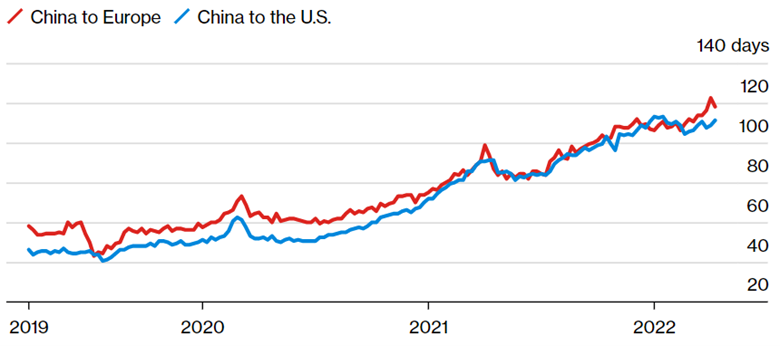
Shipping From Asia - delivery time for ocean freight has more than doubled in the pandemic. Source: Bloomberg, Flexport.
The waiting time for container ships has surged after Shanghai, home to the world’s largest container port, initiated a city-wide lockdown in late March to combat COVID-19.
By late April, the total number of vessels in port and off the hub’s shared anchorage with nearby Ningbo stood at 230, a 35% increase from this time last year, according to Bloomberg shipping data.
China's lockdowns may be slowly easing as #COVID case growth recedes; # of container ships in Shanghai-Ningbo-Zhoushan region still 11% above last year's median & volume of container goods moving in/out of Shanghai has declined
@Bloomberg @IHSMarkit @genscape pic.twitter.com/qRVYpbidFL
— Liz Ann Sonders (@LizAnnSonders) May 19, 2022
The waiting time for imported containers in mid-April was averaging 12.1 days at Shanghai’s port before they are picked up by truck and delivered to destinations inland, according to data provider project44.
This was almost triple the 4.6 days in late March.
Supply chain analysts see more trouble ahead as once Shanghai opens up, all the delayed vessels will head towards their destinations, posing new challenges due to more congestion.
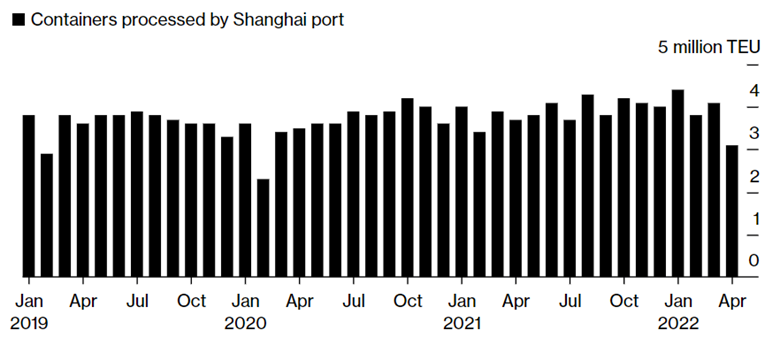
The Shanghai port dealt with 17% fewer containers in April 2022 compared with April 2021, but still not back at the 2020 low. Source: Bloomberg, Shanghai International Port Group.
Chip shortages
In late April, US chipmaker Texas Instruments flagged disruptions at the factories of its customers in China and said it expected current-quarter revenue below Wall Street estimates.
South Korea’s LG Display Co Ltd said supply chain problems caused by the lockdowns in China had affected panel production and shipments.
Stateside, Microsoft Corp said the lockdowns would disrupt sales and make it harder to produce products like the Xbox.
Apple CEO Tim Cook said in an earnings call that "we have estimated the constraints to be in the range of US$4 to US$8 billion and these constraints are primarily centred around the Shanghai corridor".
Automobile output falls
Tesla Inc (NASDAQ:TSLA)’s plant in Shanghai, known as Gigafactory 3, was closed down for three weeks in April after being plagued by disruptions.
The factory, which typically shipped around 60,000 cars a month, delivered only 1,512 vehicles in April.
Early in May, Tesla announced a plan to return to pre-lockdown production levels by May 16, but then delayed that target by a week, Reuters reported.
Bringing production back to pre-lockdown levels has been a challenge for Tesla because of problems stemming from Shanghai’s strict controls imposed from March on the movement of people and goods to curb the spread of COVID-19.
Tesla GF3 production line optimization completion to be postponed until Jul due lockdown, Q3-Q4 production could reach 80K-90K units/month.
(HAITONG INTERNATIONAL) https://t.co/lrwSZjEW4j
— Moneyball (@DKurac) May 18, 2022
Reuters recently reported that Toyota Motor (NYSE:TM) Corp would suspend operations on 14 lines at eight domestic factories for up to six days in May due to the COVID lockdown in China.
The duration would be between May 16 and May 21, Toyota said, expanding the number of lines and factories affected by partial suspension to a total of 20 and 12, respectively.
The partial suspension would affect the output of about 30,000 vehicles.
Impact on healthcare
China’s COVID-19 restrictions are also having an impact on healthcare, as lockdowns have triggered a global shortage of chemicals used in medical imaging.
The Greater New York Hospital Association said in early May that healthcare facilities had seen shortages of an iodinated contrast medium known as Omnipaque that’s produced at a GE Healthcare factory in Shanghai.
Omnipaque is a critical chemical agent that is widely used in X-rays, radiography and CT scans.
The association warned that supplies may be curtailed by as much as 80% in June and July, even though the factory had now resumed production.
China’s COVID lockdown has caused contrast dye shortages for med tests. This is not good. Docs rely on dye assisted studies in making impt decisions. The implications of COVID continue to impact on us worldwide.
— Karl Rosenfeld (@kneerecon) May 23, 2022
Apparel and shoes
Vietnam is the second-largest supplier of clothes and shoes to the US, according to the American Apparel & Footwear Association.
The supply of key raw materials for shoe factories, which derive about 60% of supplies from China, has significantly reduced.
Clothing factories in the Southeast Asian nation are also struggling to meet orders as supplies of key materials from China are drying up.
Accelerating the trend towards deglobalisation
For three decades, a defining feature of the world economy has been its ability to produce ever more goods at ever-lower prices.
However, the last four years have not been smooth sailing for global trade.
In the short run, the disruption caused by China’s lockdowns will mean more costly disruptions in the $US22 trillion global merchandise trade, which tumbled in 2020 and rebounded last year.
In the longer run, such chaos may force countries and companies to rethink supply chains tied together by cross-border commerce.
For some companies, onshoring or nearshoring supply chain networks is no longer a patriotic political slogan — it is a necessity given all the uncertainty.