
- FTSE 100 closes 29 points lower
- Tech stocks lead Wall Street drops
- Snap profit warning weighs
4.50pm: Footsie back below 7,500
The FTSE 100 index ended modestly lower on Tuesday, dipping back below 7,500 after a rebound on Monday with an afternoon rally smothered by a poor performance on Wall Street as tech stocks took another kicking following a profit warning from Snap Inc (NYSE:SNAP) and the day's UK data all proving weak.
The UK blue-chip index closed 29.09 points, or 0.4% lower at 7,484.35, midway between the session peak of 7,529.65 and the day's low of 7,434.46.
In New York, around London’s close, the Dow Jones Industrial Average was down 327 points, or 1.0% at 31,552, while the broader S&P 500 index shed 1.9%, and the Nasdaq Composite dropped 3.0%.
Chris Beauchamp, chief market analyst at online trading platform IG commented: “It should be clear by now, even to the most enthusiastic dip buyer, that markets are not going to bounce any time soon. Last week’s rally at least extended into the middle of the week, but this bounce barely made it to the end of Monday’s session.
“Snap seems to have taken the blame for the market’s inability to hold its limited gains, but in reality, investors are still taking every chance they can to cut back on stocks, particularly those previous market darlings in the tech sector.”
But, Beauchamp added: “In contrast, the FTSE 100 has seen only slight losses, holding close to its highs of the week. It has rarely been a better time to be an index dominated by commodity-linked stocks, which once again have held the pass while almost every other index heads sharply into the red.”
However, UK data out Tuesday was far from positive with purchasing managers' surveys falling, the housing market slowing, and the retail outlook worsening. Meanwhile, regulator Ofgem said it expects the energy price cap to go up to £2,800 from £1,971.
3.50pm: Footsie slips back heading into the close
The positive mood did not last long, and the leading index is now back in the red on the continuing worries about the state of the economy, the cost of living crisis and of course the continuing war in Ukraine.
The FTSE 100 is currently down 21.16 points or 0.28% at 7492.28, but well off its low of 7434.
Michael Hewson, chief market analyst at CMC Markets UK, said: "Markets in Europe have given back some of yesterday’s gains, weighed down by further evidence of economic weakness in the form of a big earnings downgrade from US social media company Snap Inc (NYSE:SNAP), after last night’s US close, and lacklustre PMI reports that suggests rising prices, are reducing profits and demand.
"The FTSE100 has once again outperformed due to its more defensive qualities, although utilities, which traditionally do well are being hampered by the prospect that the UK government might be considering submitting to populist demands for a windfall tax, on not only oil companies, but energy companies as well."
That prospect has seen SSE PLC (LSE:SSE) slide 7.98% and - in the midcap index - Drax Group (LSE:DRX) drop 16.56% and British Gas owner Centrica PLC (LSE:CNA) lost 8.66%.
Back in the leading index, other fallers include WPP PLC (LSE:WPP), down 6.9%, and ITV PLC (LSE:ITV), off 5.38%.
Tech investor Scottish Mortgage Investment Trust PLC (LSE:SMT) has lost 4.78% on the weakness on the Nasdaq market.
Heading higher are the banks, which benefit from interest rate rises. HSBC Holdings PLC (LSE:HSBA) is 3.33% higher, Barclays PLC (LSE:BARC) is 3.13% better as it starts its share buyback programme and Standard Chartered PLC (LSE:STAN) is up 2.16%.
2.57pm: US markets off to a downbeat start
After Monday’s rally, US stocks opened lower on Tuesday led by renewed pressure on tech companies.
Just after the open, the tech-heavy Nasdaq was down 221 points or 1.9% at 11,314 points.
The Dow had shed 152 points or 0.5% at 31,728 points and the S&P 500 was down 42 points or 1% at 3,932 points.
The downward spiral has been spurred by Snap Inc (NYSE:SNAP), the parent company of social media platform Snapchat, slashing its forecast amid rising inflation and interest rates, and supply chain and labor challenges.
After last week’s disappointing retail earnings, Snap’s profit warning has reiterated the impact of inflationary pressures on corporate bottom lines, sparking concern among investors.
According to Bloomberg, following Snap’s warning social media stocks are on course to shed more than $100 billion, with other social media companies including Facebook’s parent companyMeta Platforms Inc (NASDAQ:FB), Google’s parent company Alphabet Inc (NASDAQ:GOOG), Twitter Inc (NYSE:TWTR), and Pinterest Inc (NYSE:PINS) dropping in pre-market trading.
After dropping about 30% in pre-market trading, Snap was down about 36% just after the open.
Meta, Alphabet, Twitter, and Pinterest had dropped 7%, 6%, 2%, and 17% respectively.
Back in the UK, the FTSE 100 has shrugged off these falls and has now actually moved into positive territory.
The leading index is up 8.09 points at 7521.53 after earlier dropping as low as 7434.
Banks are leading the way, with their balance sheets set to benefit from further interest rate rises.
HSBC Holdings PLC (LSE:HSBA) is 3.93% higher, Barclays PLC (LSE:BARC) is 3.6% better as it starts its belated £1bn share buyback programme and Standard Chartered PLC (LSE:STAN) is up 2.92%.
2.42pm: Energy price cap to soar to £2,800 in October - Ofgem
There are likely to be yet more calls for a windfall tax on energy companies to help out struggling households, following news that regulator Ofgem expects the price cap to go up to £2,800 from £1,971.
Justina Miltienyte, head of policy at Uswitch.com, comments: “This admission from Ofgem confirms the worst fears of everyone who is currently struggling to pay their energy bill. Although we have long expected the price cap will rise again in October, this is the first time the regulator has estimated how high it could soar.
“The final figure is still uncertain as we have a few months left before the announcement, so it could go further up or down, depending on the market volatility.
“This revelation by Ofgem will be especially worrying for those on the lowest incomes who are already struggling, and the need for more support could not be more urgent.
“Nearly a quarter of consumers are already in debt to their supplier, and are facing financial pressures from all sides. Now is the time for the government to act and put together a comprehensive package of help for the most vulnerable before it is too late.”
A reminder that the price cap was £1,277 in October 2021. This is a staggering rise, and one lost of families simply won't be able to afford.
— Daniel Hewitt (@DanielHewittITV) May 24, 2022
1.36pm: Official figures show impact of pandemic on UK economy
The pandemic had the biggest impact on UK economic growth since the Second World War, according to a new report from the number crunchers at the Office for National Statistics.
Public health measures including social distancing, travel restrictions and closure of non-essential shops drove a 19.8% fall in GDP between April and June 2020.
Household spending fell by over 20% over this period, the largest quarterly contraction on record, which was driven by falls in spending on restaurants, hotels, transport and recreation.
#COVID19 had a greater impact on GDP than any economic shock since World War 2.
Between April and June 2020, GDP fell by a record 19.4%, before rebounding 17.6% as the country reopened over the summer.
— Office for National Statistics (ONS) (@ONS) May 24, 2022
12.58pm: Footsie off the worst but still in negative territory
Leading shares have recovered much of their earlier falls and have edged back above 7500, but they remain in the red.
After a 123 point gain on Monday, the FTSE 100 has failed to capitalise on a strong start to the week and is now off 13.07 points at 7500.37.
Craig Erlam, senior market analyst at OANDA, said: "These wild swings from one day to the next have become the norm as investors try to pick the bottom in the markets only to be dealt another blow from one negative headline or another. And they continue to come thick and fast, leaving equity markets vulnerable to further drops.
"Pessimistic Chinese growth forecasts and a profit and revenue warning from Snap appear to have been behind the latest tumble, although there are so many headlines pouring out, you could probably pick another half a dozen reasons to explain the selling. Ultimately it comes down to the fact that the level of economic uncertainty is immense and while recessions are not the base case, they are a very realistic prospect."
Erlam pointed to the UK, where the latest purchasing managers' survey is hardly encouraging.
He said: "[UK] PMIs slipped back to levels not seen since lockdown. Except that the economy is fully open and operating without any restrictions at all, which is deeply concerning. The cost-of-living crisis is already having an impact and is expected to hit the economy hard, with the Bank of England anticipating double-digit inflation and a possible recession."
11.50am: US markets set for fall
US stocks were expected to open lower on Tuesday, resuming falls amid renewed concerns about the impact of a slowing economy on corporate bottom lines, killing off the rally seen yesterday.
The reversal is seen after Snap Inc (NYSE:SNAP), the parent company of social media platform Snapchat, slumped nearly 30% in after hours trading on Monday after the firm warned about the macroeconomic headwinds it faces, putting the focus on the uncertain outlook for corporate earnings, especially in the technology sector.
Futures for the Dow Jones Industrial Average were down 0.7% in pre-market trading, while those for the broader S&P 500 index fell 1.1%, and contracts for the tech-heavy Nasdaq-100 shed 1.7%.
Ipek Ozkardeskaya, senior analyst at Swissquote Bank, predicted that Monday’s gains were likely to remain short-lived, citing the plunge in Snap shares.
“The bad news from Snap pulled Meta 7% lower in the after hours. As a result, the US futures point at a negative start. It’s like we are coming back to reality after a sunny day in the markets,” she said.
Purchasing Managers Indexes (PMIs) for the US manufacturing and services sectors will also be in focus. Flash headline PMI readings are expected to show continued growth although at a slightly easier pace.
Investors will also pay attention to a speech from US Federal Reserve chairman Jerome Powell later.
On the geopolitical front, news that the US may reverse some of the tariffs it has imposed on China was seen as a move that could dampen inflation and be largely positive for equities. But the favorable impact was partly offset by news that the US military will defend Taiwan if the island nation is invaded by China.
“This represents significant volatility for the global markets as the US has not used its military in the ongoing war in Ukraine, but it has provided weapons and financial aid,” said Naeem Aslam, chief market analyst at avatrade.com. Against this backdrop, he said, the S&P 500 may well head towards bear market territory.
Back in the UK, the FTSE 100 is still down but well off its worst levels, 20.87 points or 0.28% lower at 7492.57.
11.10am: Retail sales average for the time of year but expected to worsen
Shop sales improved in May but are expected to decline again as rising costs and economic gloom hit home.
Year-on-year retail sales were broadly flat (-1% from -35% in April) and are expected to fall at a modest pace next month (-4%), according to the latest CBI quarterly distributive trades survey.
Retailers said sales were average for the time of year in May but they are expected to be below seasonal norms next month (-13%).
However, wholesalers and motor traders both reported sales as good for the time of year in May.
Retailers reported average sales for the time of year in May but expect them to dip below seasonal norms again next month, according to the CBI’s latest quarterly #DTS pic.twitter.com/IxSx3dsb4B
— CBI Economics (@CBI_Economics) May 24, 2022
Year-on-year selling prices continued to grow at a similarly rapid pace to February, though retailers expect price growth to ease slightly in the coming quarter.
Sentiment in the retail sector deteriorated at its quickest pace since November 2020. Investment intentions for the year ahead stand at their weakest level since the early stages of the COVID-19 pandemic in May 2020.
Martin Sartorius, principal economist at the CBI, said: “Despite retail sales returning to their average for the time of year in May, the outlook for the sector has worsened due to high inflation and broader economic uncertainty. As a result, retailers are reining in their investment plans for the year ahead to the greatest extent since May 2020.
“Government action to ensure the economic security of the poorest households and support the investment ambitions of retailers will be crucial to ensure the longer-term prosperity of the UK economy and society.”
10.33am: Housing market slows in April
The UK housing market saw a slowdown in April, according to the latest government figures.
The non-seasonally adjusted estimate of UK residential transactions in April 2022 was 97,970, 13.9% lower than April 2021 and 10.5% lower than March 2022.
But this time last year, the stamp duty holiday saw strong demand from potential buyers.
Iain McKenzie, chief executive of The Guild of Property Professionals, says: “Last month saw a slowdown in property sales and while it’s tempting to assume this is the result of the current economic downturn, this may not be the case.
“The volume of sales is starting to look closer to pre-pandemic levels now, which could eventually cool price growth enough to entice more people onto the property ladder.
“A reduction in the number of properties being sold was always expected, so it shouldn’t come as a surprise when we see slower months than usual, especially since March was a month of such high demand.
“In some parts of the country, we are still seeing a shortage of stock, with estate agents finding it difficult to offer buyers enough choice. This is especially the case in commuter towns, as people continue to work from home or adopt a hybrid working policy.
“While the cost-of-living crisis could make first-time buyers more hesitant to part with their deposit, the demand for quality homes is still high, and will ensure that sales remain buoyant in the short term.”
10.20am: Power firms blow a fuse
The prospect of the government announcing a windfall tax on power companies - surely not as a distraction from the Partygate pictures and Sue Gray report? - continues to short circuit the sector.
SSE PLC (LSE:SSE) has dropped 10.1%, Drax Group (LSE:DRX) is down 17.43% and British Gas owner Centrica PLC (LSE:CNA) is off 10.36%.
Greencoat UK Wind PLC (LSE:UKW) is down 5.59%.
SSE and Drax have not been helped by downgrades from analysts at Citigroup.
Russ Mould, investment director at AJ Bell, said: "[SSE] plummeted on reports that the government might impose a windfall tax on big profits from electricity generators including wind farm operators.
“The government wants to raise money to help households hit by a sharp rise in energy bills.
"While it is right that some support should be given to those most in need during these difficult times, the way in which new funds are raised means the Government runs the risk that energy companies slow down investment in new green projects which could make it harder for the country to hit its net zero emissions targets."
Overall though, the market is recovering from its worst levels.
The FTSE 100 is now down 34.44 points or 0.46% at 7479, having been as low as 7434.
The FTSE 250 has fallen 0.96% to 19,953, recovering from an earlier drop to 19.922.

9.43am: UK demand hit by uncertainty
The UK economy suffered a sharp slowdown in May, according to the latest purchasing managers report, as inflationary pressures and geopolitical uncertainty hit demand.
The S&P Global/CIPS initial readings showed the composite PMI falling from 58.2 to 51.8, a fifteen month low.
The month-on-month loss of momentum in May (-6.4 index points) was the fourth-largest on record and exceeded anything seen prior to the pandemic.
Services dropped from 58.9 to 51.8 and manufacturing from 55.8 to 54.6.
Firms also reported the fastest rise in operating expenses since this index began in January 1998, led by a rapid acceleration in input cost inflation across the service economy. Concerns about squeezed margins and weaker order books resulted in a considerable drop in business expectations for the year ahead, said S&P.
UK #PMI data signal major economic slowdown in May. S&P Global/CIPS flash PMI dives from 58.2 in April to 51.8, its lowest since the COVID-19 lockdowns of February 2021. Roughly indicative of #GDP expanding at a quarterly rate of just 0.1%. https://t.co/AkzkaSqpxg pic.twitter.com/saApduJtFw
— Chris Williamson (@WilliamsonChris) May 24, 2022
Chris Williamson, chief business enomist at S&P Global Market Intelligence said: “The UK PMI survey data signal a severe slowing in the rate of economic growth in May, with forward-looking indicators hinting that worse is to come. Meanwhile, the inflation picture has worsened as the rate of increase of companies' costs hit yet another all-time high.
“The survey data therefore point to the economy almost grinding to a halt as inflationary pressure rises to unprecedented levels.
“The tailwind from the reopening of the economy has faded, having been overcome by headwinds of soaring prices, supply delays, labour shortages and increasingly gloomy prospects. Companies cite increasingly cautious moods among households and business customers, linked to the cost-of-living crisis, Brexit, rising interest rates, China's lockdowns and the war in Ukraine.
“There are some signs that the rate of inflation could soon peak, with companies reporting price resistance from customers, and it is likely that the slowing in demand will help pull prices down in coming months. However, the latest data indicate a heightened risk of the economy falling into recession as the Bank of England fights to control inflation.”
Earlier the eurozone economy continued to grow in May, albeit more slowly than previously.
The S&P Global composite PMI index dipped from 55.8 in April to 54.9, a two month low but still above the 50 level which indicates expansion.
Within that, services fell from 57.7 to 56.3 and manufacturing from 55.5 to 54.4.
S&P said: "Eurozone economic growth remained robust in May despite headwinds associated with the Ukraine war, pandemic supply constraints and the rising cost of living. However, while the service sector continued to report strong growth from pent-up pandemic demand, the manufacturing sector saw only a modest expansion for the second month running amid falling order book inflows."
Robust flash #eurozone #PMI data are consistent with the economy growing at a solid quarterly rate of 0.6% so far in the second quarter. More athttps://t.co/wJ3iWYzqbJ pic.twitter.com/HyAv3cU7C6
— Chris Williamson (@WilliamsonChris) May 24, 2022
9.12am: Will government help ease cost of living crisis?
Whether or not the government decides in the end to impose a windfall tax on power companies - and what's another U-turn among many? - the public sector finance figures might give some leeway to help ease the cost of living crisis.
Susannah Streeter, senior investment and markets analyst at Hargreaves Lansdown, said: "In the UK, the cost-of-living crisis is still taking centre stage with clamour ratcheting up for support for the poorest households, as the Bank of England prepares borrowers to expect more interest rate rises as it attempts to keep a lid on rampant inflation.
"Chancellor Rishi Sunak, the finance minister, has been given more wriggle room to take action with public borrowing coming in lower than expected at £18.6bn in April. Tax receipts piled up higher than forecast partly due to the increase in National Insurance contributions during the month, which added to the household budget squeeze
" However, the Treasury will be concerned that this may be a short term gain and there could be long term pain coming as the economy contracts, so ministers are unlikely to start splashing the cash, instead the purse strings are likely to loosen for small targeted support schemes."
8.40am: Grocery sales slump again
Supermarkets are hoping for a Jubilee boost after another set of weak shopping figures.
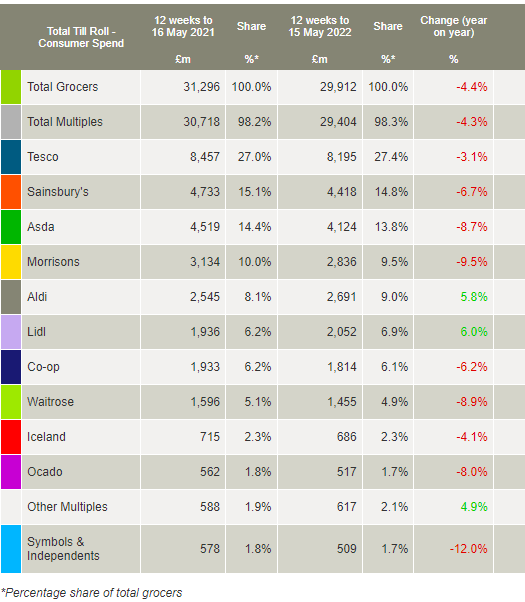
Grocery sales fell by 4.4% during the 12 weeks to 15 May 2022 according to the latest figures from Kantar.
But the most recent month saw a slightly better performance, down by just 1.7% and the market’s best performance since Christmas ahead of the Platinum Jubilee weekend.
There are no signs of a let up in the cost of living crisis, however.
Like-for-like grocery prices have risen by 7.0% over the past four weeks compared with the same time last year, the highest level of grocery inflation since May 2009.
Fraser McKevitt, head of retail and consumer insight at Kantar, said: “People are really feeling the squeeze at the supermarket tills and they’re having to stretch their budgets further to accommodate rising prices. To put the most recent numbers into context, if you were picking up supplies for a family fry up over the long weekend with toast, eggs, sausages, bacon, and beans it would cost you £6.83 – that’s a significant 40p increase on last year.
“Understandably, only a third of consumers now think of themselves as being in a ‘comfortable’ financial situation. In our recent Kantar Pressure Groups survey, 43% of households described themselves as ‘managing’ while 22% said they were ‘struggling’. Within the growing group of shoppers struggling to make ends meet, the rising price of groceries is of concern to over 9 in ten people, making it the second most important issue behind the spiralling cost of energy bills.”
But he added: “With a four-day bank holiday weekend on the horizon, we’re expecting people to celebrate with friends and family. Looking back at the Diamond Jubilee in 2012, we saw a 10% boost in supermarket sales during the week leading up to the festivities. We should never underestimate the appetite for a party, especially a royal one."
Unsurprisingly, given the squeeze on household spending, it was discounters Lidl and Aldi who recorded the best sales performance in the past 12 weeks, up 6% and 5.8% respectively.
Tesco PLC (LSE:TSCO) was down 3.1% while J Sainsbury PLC (LSE:SBRY) dropped 6.7% and Ocado Group PLC (LSE:OCDO) lost 8%.
8.18am: Markets make a downbeat start
Leading shares have opened sharply lower as continuing global tensions and fears of an economic slowdown amid soaring inflation continue to dominate sentiment.
With the war in Ukraine showing no signs of easing, worries about food shortages are adding to the general woes.
And investors are also wary of central banks raising rates at such a time of uncertainty, with the Europe Central Bank hinting at a possible rate rise in July in a blogpost on Monday.
A drop in the US futures market after a slump in Snap Inc (NYSE:SNAP) shares after the markets closed is not helping sentiment.
In early trading the FTSE 100 has fallen 60.36 points or 0.8% to 7453.08.
Richard Hunter, head of markets at interactive investor, said: "While the premier index has managed to maintain its progress in the year to date, remaining up by 0.8%, sharp reversals in reaction to breaking news as evidenced last week can wipe out these hard-won gains in an instant.
"The latest set of UK borrowing figures provided another reminder that economic pressure remains, with the consumer edging nearer to a summer of discontent."
The fallers are a mixed bunch, with SSE PLC (LSE:SSE) down 7.25% on reports there will after all be a windfall tax on power companies.
Royal Mail PLC (LSE:RMG) is 7.02% lower after Peel Hunt cut from buy to sell and ITV PLC (LSE:ITV) off 3.44%.
But Barclays PLC (LSE:BARC) is 1.84% better as it began its delayed £1bn share buyback programme.
7.53am: Government borrowing remains high
The UK's public finances came in better than expected in April, but are still close to record levels.
Borrowing of £17.8bn was lower than the forecast £17.9bn but higher than the previous figure of £13.9bn, itself revised down from £17.3bn.
Excluding public sector banks, the government borrowed £18.6bn, the fourth highest borrowing in April for 29 years.
This was £5.6bn less than in April 2021 and lower than the forecast £18.9bn, but still £7.9bn more than in April 2019, before the coronavirus pandemic.
Public sector net borrowing excluding public sector banks was £18.6 billion in April 2022 - the fourth-highest April borrowing since records began in 1993.
This was £5.6 billion less than in April 2021 but £7.9 billion more than in April 2019 https://t.co/rgvslKAFhB pic.twitter.com/LZES3oEf6a
— Office for National Statistics (ONS) (@ONS) May 24, 2022
The controversial rise in national insurance contributions helped boost the government's coffers.
Borrowing for the financial year to March was £144.6bn, revised down by £7.2bn from last month’s first provisional estimate, but remaining the third-highest financial year borrowing since records began in 1947.
6.50am: Footsie under pressure ahead of busy day
The FTSE 100 is expected to fall on Tuesday, ahead of a busy day of corporate news, UK public sector borrowing data and preliminary PMI surveys for major economies.
Following two up-days that left it almost unchanged since the start of the year at 7,513.44, London’s blue-chip index is being called 51 points lower on spread-betting platforms.
Overnight, US markets finished higher, with the Dow Jones rising up almost 2%, the S&P 500 gaining 1.9% and the Nasdaq Composite rising 1.6%, before futures dived into the red after Snapchat owner Snap Inc (NYSE:SNAP) slashed profit and revenue forecasts after Wall Street closed.
Most Asian markets are in the red this morning, however, led by the Hang Seng and Shanghai indices, down 1.6% and 1.2%.
This comes after US President Joe Biden added to geopolitical tensions yesterday by saying that the US would intervene to defend Taiwan in the event of a Chinese invasion, though he was asked a direct question about this and it is a statement he has made before.
“Investors and traders are already tired of one war that is taking place between Ukraine and Russia,” said market analyst Naeem Aslam at Avatrade.
“The soaring inflation situation is the direct result of this war, which fuelled energy prices, but we are also on the verge of an agriculture commodity crisis.”
On that note, the head of the World Food Programme at Davos called for world leaders, the private sector and billionaires to help avert a “devastating global hunger crisis at our doorstep”.
One idea being floated is naval intervention, analysts at Rabobank noted, with the UK reported to be seriously considering backing a Lithuanian proposal to send a non-NATO naval coalition ‘of the willing’ to de-mine the Black Sea, and then escort merchant shipping there to take out Ukraine’s grain.
This morning we have UK public sector borrowing for April, which is expected to show borrowing rose by £17.9bn, a modest increase on March’s £17.3bn figure and a significant drop from the same month in the two previous pandemic years, but above levels in the years leading up to 2020.
Then we have flash PMI numbers that, said analyst Michael Hewson at CMC Markets, are “rapidly losing credibility in terms of the headline numbers at least, when it comes to assessing the resilience or otherwise of the French, German and UK economies”.
“In terms of the wider economy, it is quite apparent that economic growth is struggling across the bloc as well as here in the UK.
“Yet to look at the PMI numbers it would be tempting to think that all is well. Nothing could be further from the truth with rising energy prices and supply chain disruptions posing significant challenges to business, large and small,” he said.