
Eclipse Metals Ltd (ASX:EPM) has identified several high amplitude and vertically extensive magnetic bodies indicative of rare earth element (REE) mineralisation during magnetic modelling of airborne magnetic data from Grønnedal-Ika carbonatite-syenite complex at its Ivittuut multi-commodity project in southwest Greenland.
Consequently, the company has applied to Greenland’s mineral resources authority to proceed with a drilling program at Grønnedal-Ika in the 2022 field season.
Notably, Eclipse has observed modelled magnetic bodies up to 2,700 metres long and 1,000 metres wide, extending to greater than 900 metres below surface. These are spatially coincident with a cluster of electromagnetic (EM) bedrock conductors identified by a previous explorer.
Looking ahead, these findings provide Eclipse Metals with a new REE targeting model and clear targets for follow-up.
“REE mineralisation”
Eclipse executive chairman Carl Popal said: “We are delighted that our geophysical modelling and data review has helped to further constrain our REE exploration targeting model, clearly highlighting the spatial and genetic relationship between areas of strong magnetic and electromagnetic anomalism and REE mineralisation.
“The size and depth extent of the modelled, magnetically anomalous bodies bodes well with respect to the possible scale of REE mineralisation.
“These findings give Eclipse confidence to progress toward drilling.
“We have submitted an application to the MLSA (Mineral Resources Authority in Greenland) to proceed with a drilling program to be conducted in the 2022 field season.”
Magnetic modelling
Eclipse recently contracted Fathom Geophysics Australia to complete 3D inversion modelling of magnetic data relating to a semi-regional (200-metre line spaced), heliborne DIGHEM survey conducted in 1995, with survey parameters and data re-processing described previously.
This 3D unconstrained inversion of the magnetic data was undertaken to estimate the subsurface distribution of magnetite in the bedrock and gain a better understanding of the potential depth extent and geometry of the magnetic bodies.
In the case of the Grønnedal-Ika complex, the igneous rocks mapped at surface correlate with distinct magnetic anomalies identified in the modelling.
Reconnaissance exploration by Eclipse Metals in 2021 found a strong correlation at Grønnedal-Ika between REE mineralisation and zones of strong positive magnetic anomalism.
Magnetic anomalism at Grønnedal-Ika is known to be associated with magnetite bearing carbonatite, which was explored from 1948 to 1950 for its magnetite and niobium potential but not for REE.
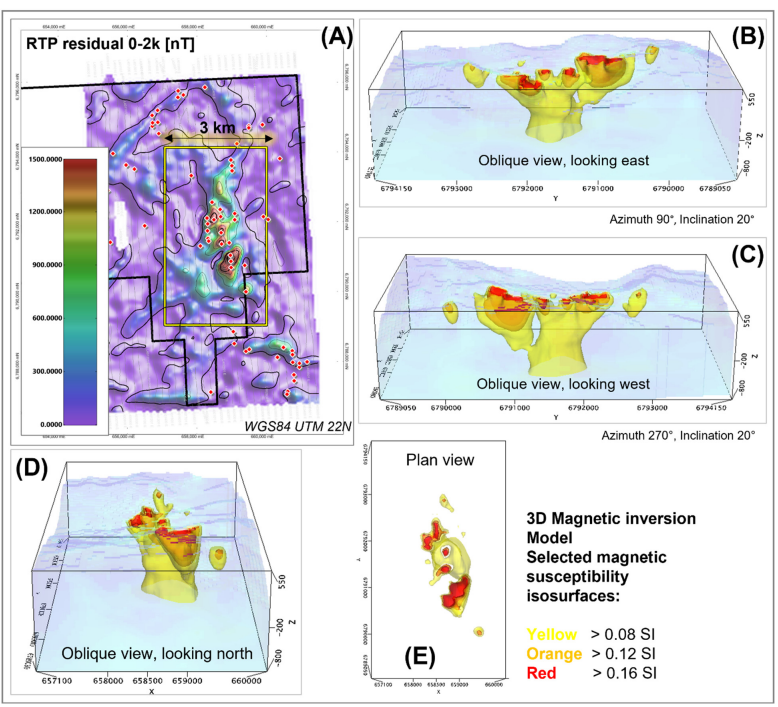
Results of the 3D magnetic inversion modelling and review of historic electromagnetic (EM) data.
Prime REE target
The Grønnedal-Ika complex is one of the larger intrusions of the Gardar Province, a suite of alkaline igneous rocks emplaced into a continental rift system in south Greenland in Mesoproterozoic times.
The igneous complex at Grønnedal-Ika measures about 8 by 3 kilometres in exposed dimension and consists primarily of layered nepheline syenites that were intruded by a porphyritic syenite and a plug of carbonatite.
Grønnedal-Ika forms part of Eclipse Metals’ SW Greenland multi-commodity project, which also includes the historic Ivittuut mine.
The Grønnedal-Ika complex is recognised by the Geological Survey of Denmark and Greenland (GEUS) as one of Greenland’s prime REE targets
Next steps
The latest findings provide Eclipse Metals with a new REE targeting model and clear targets for follow-up exploration:
The next steps envisaged by the company include:
- Field reconnaissance of and grab sampling in areas of magnetic and EM anomalism;
- Detailed geological mapping and the re-logging of historic drill core;
- Data integration and interpretation; and
- Generation and testing of drill targets.