
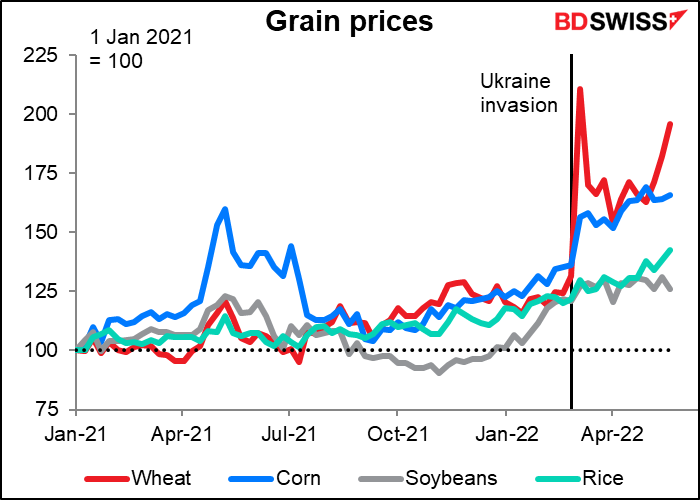
Wheat prices have soared since India announced that it would halt exports, and the situation is complicated and difficult, say analysts, with risks for all agricultural commodities and consequences for most countries and many companies.
With the expected level of 33mln tonnes of wheat exports from Ukraine and Russia decimated because of the war, and with wheat supplies in the US and some other countries expected to be lower than last year, what we are seeing is “global warming intersecting with geopolitics”, said Marshall Gittler, head of investment research at BDSwiss.
READ: Bank of England governor warns of 'apocalyptic' food prices
“The big danger I see is not only to the global wheat market but also to all agricultural commodities. As prices rise, the temptation of governments to cut back on exports and supply their domestic markets first becomes irresistible,” he said, quoting Bob Marley's lyrics that 'a hungry mob is a angry mob.'
Or, as Naeem Aslam at AvaTrade put it, “Investors and traders are worried that the ongoing conflict between Ukraine and Russia has disturbed the global supply chain of soft commodities, and now countries like India have started to secure their future food supply by banning the export of the essential soft commodity.
“So far, the conflict between the US and Russia over Ukraine has brought us higher energy prices. Now it seems like the actual impact of this conflict has started to filter through, which is likely to cause even bigger panic than anyone has anticipated.”
The impact for companies is going to be most notable for those where wheat is a major input, such as baker Greggs PLC (LSE:GRG) and Associated British Foods PLC, and is good news for the likes of agricultural or fertiliser groups such as Agriterra (AIM:AGTA) Limited, Emmerson Plc and Wynnstay Group PLC.
Agricultural funds have also taken off, with the Wisdomtree Agriculture ETC up over 5% over the past five days, it's highest level in a decade, and the Invesco DB Agriculture Fund up almost 6% to its highest since 2015.
India hopes dashed
India is the world’s second-largest wheat grower behind China but hasn’t been a major exporter as it normally grows what it consumes, Gittler pointed out.
While India was aiming to step into the breach and ship 10mln tonnes to help make up the global shortage caused by Russia's invasion, it has now decided to ban exports after a heatwave decimated the wheat crops, sending local prices to a record high.
Along with India's wheat ban, which it said it would only circumvent in certain cases for lower-income countries that require wheat for food security needs, other countries are also cutting exports of other foodstuffs, with Indonesia halting palm oil exports and Serbia and Kazakhstan imposing quotas on grain shipments.
More price volatility on the way
Such restrictions as those by India, Indonesia, Serbia and Kazakhstan will “exacerbate price volatility, limit the buffer capacity of the global market, and have negative impacts over the medium term,” the Food and Agriculture Organization of the United Nations warned.
As Bank of England governor Andrew Bailey warned late yesterday food prices are becoming "apocalyptic" around the world.
The global wheat outlook according to the US Department of Agricultural’s World Agricultural Supply and Demand Estimates (WASDE) for 2022/23 is for lower supplies and consumption, increased trade, and lower ending stocks.
Global production is forecast at 774.8mln tons, 4.5mln lower than in 2021/22, with reduced production in Ukraine, Australia and Morocco partly offset by increases in Canada, Russia, and the US.
However, US wheat supplies for example are expected to be down 3% from the previous year.
However, Gittler said the WASDE report is already out of date, with a forecast for a 5mln increase in global trade to a record 204.9mln tons based on the idea that India is “expected to remain a significant wheat exporter”.
Taking India’s expected 10mn tonnes of exports out of the market, then the global trade would be down 5mn tonnes from last year, not up, said Gittler, adding that “the situation is difficult".
He pointed to the USDA's acknowledgement that “most wheat is imported by developing countries with limited production potential and that wheat is a staple food in many low- and middle-income countries.”
The UN’s FAO estimated that last year around 193mln people were already “acutely food insecure,” up nearly 40mn people from 2020 and now estimate that the global number of undernourished people could increase by 8-13 million people in 2022/23, “with the most pronounced increases taking place in Asia-Pacific, followed by sub-Saharan Africa, and the Near East and North Africa.”