
Emyria Ltd (ASX:EMD) has made headway on its MDMA analogue development program, run in partnership with the University of Western Australia (UWA).
As part of a screening program, 16 of 17 compounds successfully passed the screening test, meaning these compounds showed no evidence of interactions with one or more of the enzymes or cell receptors (known as anti-targets) that can be associated with unwanted clinical side effects.
The latest results bring the total number of successfully screened MDMA analogues to date to 83 out of 85.
A third batch of MDMA analogues is being prepared for an initial screening test with laboratory testing service Eurofins.
Identifying compounds with treatment potential
Speaking to the findings, Emyria managing director Dr Michael Winlo said the company and UWA now had a set of more than 80 MDMA-like compounds with strong IP and therapeutic potential.
“We are now planning pivotal preclinical studies to help identify which of these compounds may have the potency of common MDMA, but with enhanced safety and shorter-acting times and half-lives,” Dr Winlo explained.
“We anticipate this screening program will help identify compounds with the potential to become registered treatments for other neuropsychiatric conditions.
“Emyria’s MDMA-analogue development continues to advance in parallel to the proprietary, ultra-pure cannabinoid drug registration programs, with the EMD-RX5 phase one trial now complete and results expected later this week.”
The MDMA analogue library
Last year, Emyria recently secured exclusive rights to a library of more than 100 novel MDMA analogues (and counting) from the University of Western Australia, creating a unique drug-discovery pipeline.
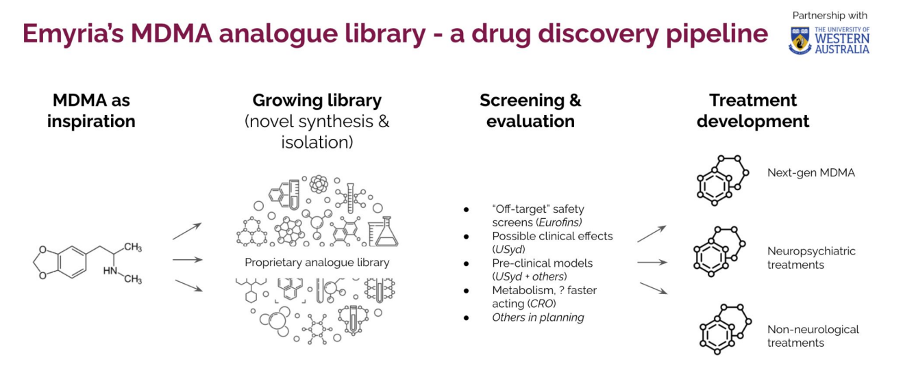
The analogues are unique chemical entities that are structurally similar to MDMA, but designed to engage different neurological targets based on feedback from earlier screening work.
In fact, MDMA analogues have shown promise as next-generation psychedelic-assisted therapies and treatments for neurological disorders, such as Parkinson’s Disease.
For some indications, it may be desirable to moderate (meaning to increase, decrease or remove) the euphoric and stimulant effects of MDMA.
As such, the development program is designed to create MDMA-like compounds that are more selective for specific neurological receptors and with the potential to become treatments for large patient populations.
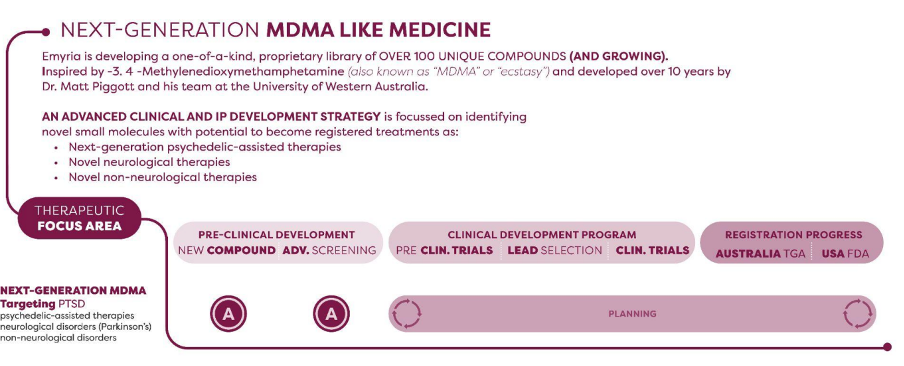
Now, follow-on preclinical development programs are being planned with Emyria and UWA’s key partners.
These campaigns are designed to identify which compounds have the strongest IP and the greatest potential to become either next-generation psychedelic-assisted therapies or treatments for other neurological disorders.
Next steps
Moving ahead, additional preclinical screening is being planned with a leading CRO, who will evaluate several key aspects of each compound.
These assays can help predict absorption and brain uptake rates, meaning it’ll help Emyria identify compounds that are similar to MDMA in potency, but with faster onset and shorter half-lives, which may be more suitable for clinical applications.
Leading MDMA analogues will undergo more sophisticated pharmacokinetic studies — a move Emyria says is important for selecting compounds to participate in the next round efficacy studies.