
Recent research shows that 36% of the adult Australian population own investments listed on the stock market.
That’s nearly 6.5 million investors, some investing as individuals and some investing through self-managed super funds (SMSFs).
Millions more own shares in privately-owned companies, often family businesses which they own and run. The most common way for companies to pay returns to shareholders is by way of a cash dividend.
Significantly, whether you hold shares in a private company or a publicly listed one, the rules about how you’re taxed on any dividends you receive as a shareholder are essentially the same.
All about dividends
Dividends are paid out of profits which have already been subject to Australian company tax which is currently 30% (or 25% for small companies). Recognising that it would be unfair if shareholders were taxed again on the same profits, shareholders receive a rebate for the tax paid by the company on profits distributed as dividends.
These dividends are described as being 'franked'. Franked dividends have a franking credit attached to them which represents the amount of tax the company has already paid. Franking credits are also known as imputation credits.
The shareholder who receives a dividend is entitled to receive a credit for any tax the company has paid. If the shareholder’s top tax rate is less than 30% (or 25% where the paying company is a small company), the ATO will refund the difference.
Superannuation funds pay tax at 15% on their earnings while in the accumulation phase, so most super funds will receive refunds of franking credits every year.
How tax on dividends works
Let's say the taxpayer holds 1,000 shares in ABC Pty Ltd.
ABC makes $5 of profit per share. It must pay 30% tax on that profit which is $1.50 per share, leaving $3.50 per share to be either retained by the business or paid out as dividends to shareholders.
ABC decides to retain 50% of the profits within the business and to pay shareholders the remaining $1.75 as a fully franked dividend. Shareholders receive this with a 30% imputation credit, which isn’t physically received but must be declared in the shareholder’s tax return as income. This can then potentially be claimed back as a tax refund.
The taxpayer, therefore, receives $2,500 taxable income from ABC Pty Ltd, being $1,750 in dividend income and a $750 franking credit, as follows:

Applying that to different investors with different tax rates:
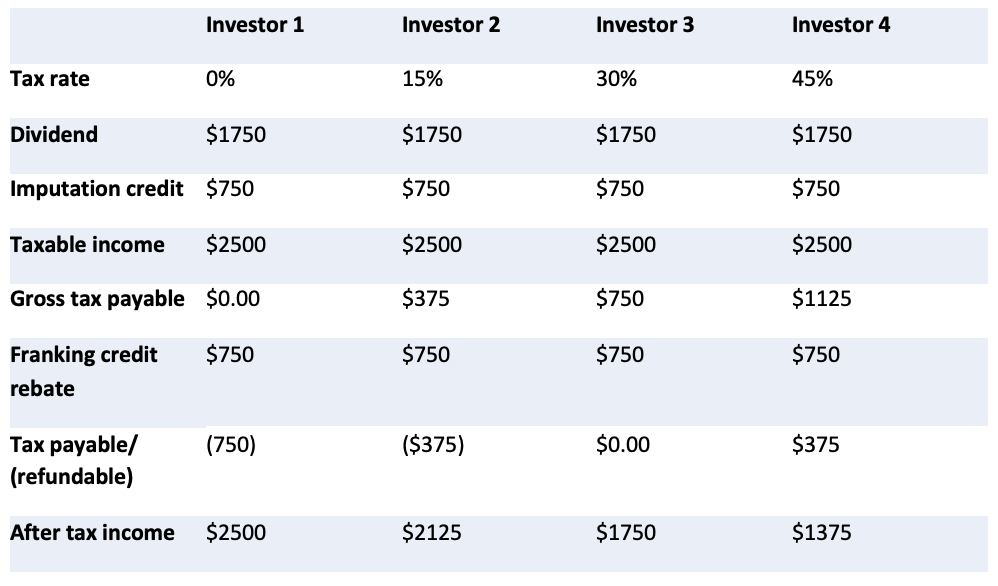
So, investors 1 and 2 both receive refunds.
Investor 1 might be a super fund in pension phase, which doesn’t have to pay tax at all and uses the franking credit refund to fund the pension payments they are required to make. Alternatively, it could be an individual with no other source of income other than the dividends on these shares.
Investor 2 might be an SMSF in the accumulation phase, which uses the excess franking credit rebate to offset the 15% contributions tax.
Investor 3 would typically be a “middle income” individual who does not have to pay any extra tax, despite having received $1750 in income.
Investor 4 would be a higher income earner who has to pay some tax on the $1,750 dividend but has reduced his tax rate on this income considerably due to the franking credits attached.
The bottom line
When a company pays a dividend, it must provide each recipient shareholder with a distribution statement containing information about the paying entity and details of the dividend (including the amount of the dividend and the amount of the franking credit), which can then be used to help complete the relevant parts of your tax return.
Public companies must provide you with a distribution statement on or before the day on which the dividend is paid, but private companies have until up to four months after the end of the income year in which the dividend was paid to provide you with the statement.
In addition, public companies provide the ATO with information about dividends paid, which means that – provided the paying company has provided the information on a timely basis – the relevant parts of your tax return will be pre-filled.
Mark Chapman is the director of tax communications at H&R Block (NYSE:HRB). As well as operating his own private practice, Mark spent seven years as a Senior Director with the Australian Taxation Office. Mark is a Chartered Accountant, CPA and Chartered Tax Adviser and holds a Masters of Tax Law from the University of New South Wales.