
- FTSE 100 down 115 points
- Wall Street weak as US jobs data strong
- McColl's saved by Asda co-owner
5.00pm: Friday freefall
The FTSE 100 finished the week on a negative note at 7,388 points, a 115.33 point or 1.54% loss.
Chris Beauchamp, chief market analyst at online trading platform IG, said selling pressure continued thanks to another solid solid US jobs report.
"Stocks had been hoping for a quiet end to the week, with some breathing space after all the volatility, but it is not to be," commented Beauchamp.
"Investors continue to fret about the possibility of a recession in the US and elsewhere caused by monetary tightening. Earnings season has done little to assuage concerns about pressured consumer spending, leaving markets on the back foot once again," he added.
3.30pm: Disappointing week for the FTSE
Michael Hewson, chief market analyst at CMC markets, recaps on the past week.
"European markets have ended the week very much on a downswing as yesterday’s big sell-off in the US has rippled over into today’s price action, pulling markets into negative territory for the week, with the DAX set to finish lower for the fifth week in a row."
"The FTSE100 has also had a disappointing week, sliding to a one week low, with the energy sector saving it from a worse fate with both BP and Shell finishing the week very much on the front foot, after their strong numbers earlier this week."
"Rate hike talk has dominated this week, with the Fed raising rates by 50bps, with more to come, the Bank of England hiking rates by 25bps, and now several ECB officials have started raising the prospect of following suit in July, in comments made today in response to concerns over higher prices to help anchor future inflation expectations."
"These comments appear to have accelerated today’s weakness as the economic outlook starts to darken."
"Today’s price action has been dominated by weakness in consumer discretionary on concerns over weak demand as higher prices prompt a decline in consumer spending. Travel and leisure have also been caught up in today’s weakness with IAG the worst faller on the FTSE100."
3.11pm: US open
US markets open lower as expected, adding to yesterday’s battering.
The Dow Jones is down 1.03%, to 32,642, while the S&P 500 is down 1.28% to 4,092.
The tech laden Nasdaq shaved 1.57% to 12,122.
All this has seemingly read across to the UK and London’s blue chip index, which has 70 points since the US markets opened.
2.40pm: US jobs figures shows tightness in market
More on the US non-farm payroll numbers from Rob Clarry, investment strategist at wealth manager Tilney Smith & Williamson.
“First, the US economy continues to add jobs at a robust pace, indicating growing tightness in the labour market."
“There remain more job openings than people looking for work, which should keep upward pressure on wages in near term. This will provide support to the US economy and consumption, which ─ despite the first quaryer GDP contraction ─ has been relatively strong.
"In a week when the US Federal Reserve hiked its benchmark interest rate by 50 basis points, the labour market data supports the view that the real economy can withstand the gradual rate rises pencilled in for this year."
“Second, the outlook for the labour market will largely depend on how many people return to the workforce. Despite the healthy-looking unemployment rate, the labour force participation rate of 62.2% remains below the pre-pandemic level of 63.4%."
"With public health improving, plenty of job openings and higher wages, companies will be hoping that more people return to employment to alleviate some of the tightness we are seeing."
“This would also help to reduce inflationary pressures and the probability of a wage-price spiral rearing its ugly head.”
2.12pm: Asda co-owner to save McColl's
Sky News is reporting that EG Group, co-owners of Asda, are coming to the rescue of McColl's.
McColl’s had said earlier it collapsed into administration, putting 16,000 jobs at risk.
Accountancy firm PwC has been appointed administrators and will look for a buyer “as soon as possible.”
The administration puts 16,000 jobs at risk.
Sky News reported earlier today that Morrisons, which is already in partnership with the convenience store, had offered a last gasp buy-out package.
However, McColl’s said that while “significant progress” had been made, its lenders made clear that discussions with the fourth largest supermarket would not reach an acceptable conclusion.
1.43pm: US non-farm payroll
Payroll employment increased in America by 428,000 in April in the non-farm payroll (NFP) report released today.
That figure is the same as last month, and ahead of analyst predictions of 391,000.
The unemployment rate remained unchanged at 3.6%, with leisure and hospitality, manufacturing, transportation and warehouse the sectors leader the way for job growth.
Naeem Aslam, a market analyst at AvaTrade, provides some comments.
“Unstagflation is the word which comes to mind when we look at the US data today. Basically, the US NFP number failed to bring any flare in the market. We have seen little to no reaction in the gold prices and in the equity futures. “
“However, here is something that is important to note and that the US NFP data isn’t going off the rails and this is a positive news for the US economy. The only thing which matters for the market is the inflation reading.”
1.21pm: US preview
US stocks were expected to open lower on Friday, retreating further after yesterday’s steep falls amid continuing fears that rising price pressures and a series of interest rate hikes are a threat to economic growth, with April non-farm payrolls due for release today..
Investors are clear that the Federal Reserve is set on a path of aggressive interest rate hikes after it decided on a 50 basis point (bp) increase on Wednesday, the first such hike in two decades.
Futures for the Dow Jones Industrial Average fell 0.2% in pre-market trading, while those for the broader S&P 500 index shed 0.3%, and contracts for the Nasdaq-100 lost 0.5%.
“The Federal Reserve ‘magic’ didn’t last long, and the US stocks recorded the worst day of the year yesterday, after posting the biggest gains of the year the day before, under the pretext that the Fed wouldn’t raise the rates by 75bp points,” said Ipek Ozkardeskaya, senior analyst at Swissquote Bank, notiing that the Fed is expected to deliver 50 bps rate increases at its the next two meetings.
On Thursday, the Dow Jones Industrial Average and the S&P 500 dived over 3.5% while the Nasdaq Composite slumped over 5% as technology stocks took a heavy beating.
The closely watched US non-farm payrolls report, due at 8.30am ET, could trigger further stock price falls if the labor market in the world’s biggest economy continues to strengthen.
“Even though the Fed will turn a blind eye on softening jobs data in the coming months to focus on its fight against inflation, a strong NFP data could further revive the Fed hawks and the prospects of more aggressive Fed over the next couple of meetings, whereas a soft data could bring in some Fed doves,” noted Ozkardeskaya
“But again, the Fed must make a choice as it can’t boost growth and tame inflation at the same time,” she added.
The prospect of spiraling inflation and higher interest rates are making investors worry that the wider economy will weaken even as inflation stays elevated, debting corporate America in the process.
Benchmark crude oil prices continued higher, signaling that commodity price pressures are here to stay. WTI futures were up 2.2% at $110.62 a barrel while Brent crude futures rose 2.2% to $113.29 a barrel.
12.53pm: Still no windfall tax
Boris Johnson has again refused to implement a windfall tax on UK oil and gas companies Shell and BP, despite inflation spiking to 10%.
Speaking to Sky News, Johnson said the way Shell and BP can help with soaring prices is by investing “massively in clean, green renewables, in stuff that will make a difference to energy prices.”
However, such projects are already underway.
BP is spending £18bn over the next eight years in the North sea, offshore wind, hydrogen facilities and electric vehicle and carbon capture projects, which wouldn’t stop if there was a windfall tax.
12.20pm: Morrison's to the rescue
Shares in corner shop chain McColl's jumped on reports Morrison's has arrived with a last-ditch bid to save the conveinance store.
The company confirmed overnight that it "remains in discussions" about potential financing to help with its funding issues but said, "no decision has yet been made".
According to Sky News on Friday, Morrisons has proposed "a last-gasp rescue deal."
McColl's added that if short-term funding cannot be agreed it was "increasingly likely" that it would be placed into administration.
Following that statement, Morrisons later tabled a proposal to take on the chain's loans in full and protect its pension scheme, Sky reported.
Its shares dropped around 90% since the start of the year, after warning that even a successful outcome in funding talks is "likely to result in little or no value" to its shares.
11.53am: Chelsea takeover edges closer
Ted Boehly is set to become the new owner of Chelsea, subject to government approval.
There had been rumours that a deal was in jeopardy after Roman Abramovich was allegedly demanding repayment of the £1.5bn loan, although the sanctioned Russian himself squashed those whispers.
Part of the £4bn takeover includes owners Boehly and the consortium not paying any dividends or management fees until 2032.
As well as that, discussions prohibiting the sale of shares in the club, also for 10 years, and agreeing to strict limits on the level of debt are also believed to be on the agenda.
11.20am: Scottish Mortage down
Scottish Mortgage Investment Trust is down 1.24%, although it didn’t quite mirror the losses made by the tech-laden Nasdaq in the US yesterday, which lost nearly 7%.
The trust, which features plenty of tech stocks, will often follow the movements of the Nasdaq index in the US.
Like most tech stocks, indices and trusts, Scottish Mortgage has taken a beating this year as inflation and war in Ukraine hit on investor sentiment.
For the year so far, it is down 33% to 859.9p.
10.51am: Local elections
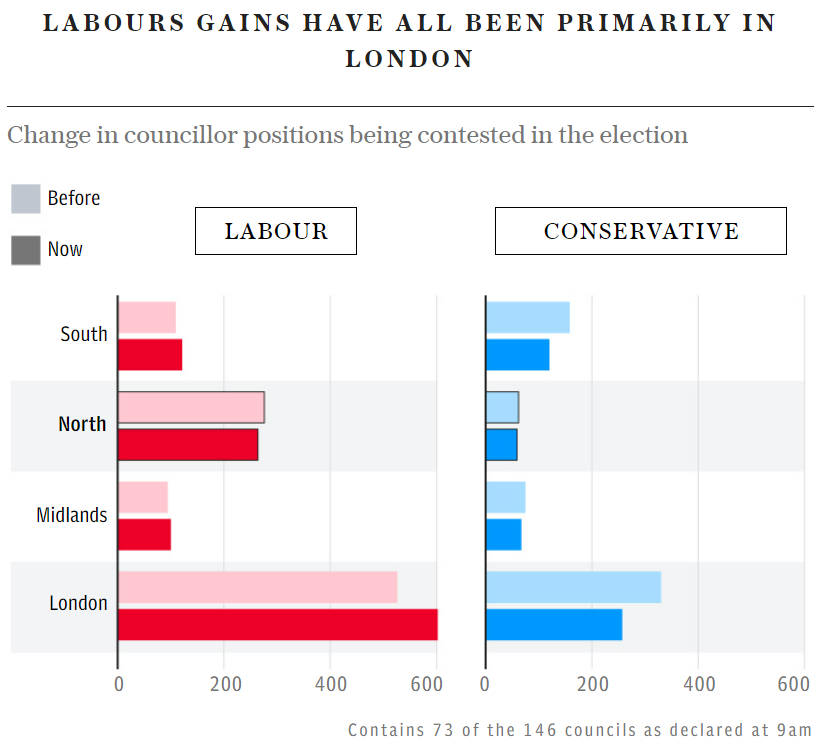
With counting for local elections underway, and some of the votes already in, let's take a look at where we stand at the moment.
Labour has taken the majority of the Conservative’s local councils in London, taking traditionally blue seats in Wandsworth, Barnet and Westminster.
It’s a similar story outside of the capital for the Tories, although it’s the Liberal Democrats who are gaining from them in the rest of the country.
(Image credit: The Telegraph)
10.06am: Construction slows in April
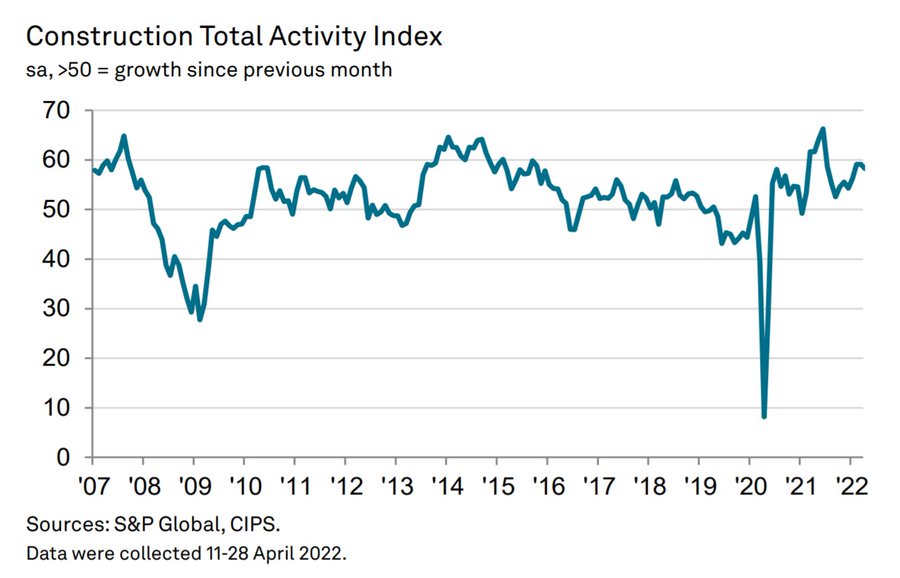
The S&P/ CIPS UK Construction PMI found that April saw the weakest rise in construction workers since December 2021.
Total construction output also expanded at a slower pace last month, with growth projections easing to the lowest level since September 2020.
The index, which measures the monthly changes in industry activity, was down from 59.1 to 58.2, although crucially it remained above the 50.0 no-change mark.
Commercial work and civil engineering remained the fastest-growing sectors, while residential work was the worst-performing sub-sector.
Tim Moore, Economics Director at S&P Global, which compiles the survey said, "The construction sector is moving towards a more subdued recovery phase as sharply rising energy and raw material costs hit client budgets.”
“House building saw the greatest loss of momentum in April, with the latest expansion in activity the weakest since September 2021. Commercial and civil engineering work were the most resilient segments, supported by COVID-19 recovery spending and major infrastructure projects respectively.”
"Construction companies have built up strong order books since the reopening of the UK economy, which led to another round of rising employment in April and these project starts should keep the sector in expansion mode during the remainder of the second quarter.”
"However, tender opportunities were less plentiful in April as rising inflation and higher borrowing costs started to bite. Consequently, longer-term growth projections have slumped from January's peak, with business optimism now the weakest since September 2020."
9.40am: Snapshot of the market
A quick snapshot of what's on in the markets.
FTSE 100 slid 50 points to 7,453 as a hammering for US markets overnight on Wall Street soured the mood. British Airways owner IAG is the index’s largest faller despite forecasting profitability for the rest of the year as travel demand rebounds.
The European Union’s ban on Russian oil imports is already at risk amid Hungary’s disapproval. Its Prime Minister will negotiate to meet its needs, with 58% of its oil coming from Russia.
Convenience store chain McColl’s is on the brink of collapse, placing 16,000 jobs at risk. The retailer, which has a partnership with Morrisons, is hoping for a rescue deal.
House prices reached a fresh record high in April as prices grew for the 10th consecutive month. The Halifax said that the growth is expected to slow this year.
4imprint Group expects operating profit for the year to be above forecasts with revenues on track to break US$1bn. The marketer of promotional merchandise said excellent demand led to a strong financial performance in the first four months of the year.
Technology Minerals signed an agreement for the sale of a 10% interest in the Blackbird Creek and Emperium projects. The contract sees Bluebird Metals acquire the project stake for £900,000 in cash.
NetScientifc is acquiring a stake in a former investee company for £300,000. It has conditionally agreed to buy a 30% stake in Vortex Biotech Holdings, having sold a 95% holding in the business in 2019.
9.13am: House prices hit record high
House prices climbed 1.1% in April, hitting new record highs, although last did show signs of a slow down.
March saw prices increase by 1.5%, and while a 1.1% increase is slightly lower, it was still above the 12 month average and left annual price growth in double-digits for the third month in succession.
Martin Beck, chief economic advisor to the EY ITEM Club said, “After Nationwide’s measure of house prices showed another month of growth in April, with values rising 0.3% month-on-month, Halifax’s gauge followed suit, but with a stronger 1.1% gain.”
“This was down from growth of 1.5% in March, but above the 0.9% rise averaged over the previous 12 months. Annual growth in April stood at 10.8%, the third month in a row to see a double-digit increase.”
“There is cause to think house price increases could shortly run out of fuel. The squeeze on real incomes from high inflation means fewer people will be able to afford to borrow the necessary amount they need to buy at higher mortgage rates.”
“Consumer confidence, including households’ expectations of their own personal finances, fell to a near-record low in April. And the rise in Bank Rate announced in this week’s MPC meeting is likely to push up the cost of mortgages.”
“But the housing market also has factors in its favour which should provide protection from current economic headwinds.”
“Notably, cost of living pressures from rising inflation and the increasing price of essentials, such as energy, are weighing heavier on low-income households, who disproportionately rent, than on the better-off, who are primarily owner-occupiers or in the market to buy.”
“Meanwhile, those with incomes high enough to be in a position to buy a property are more likely to have accumulated unplanned savings during the pandemic, an element of which may be going towards deposits on houses and flats.”
“And the dominance of fixed-rate mortgages means it will take time for higher mortgage rates to affect the finances of homeowners. The EY ITEM Club continues to think that a period of slower price growth will ultimately arise. But those expecting any major correction in property values are likely to be disappointed.”
8.37am: IAG drags market
The Footsie opened lower as analysts expected, losing 62 points to 7,440.
International Consolidated Airlines Group SA (LSE:IAG), the owner of British Airways, is the index’s largest faller so far, losing 5.7% closely followed Ladbrokes owner Entain PLC (LSE:ENT), which is down 3.3%.
At the other end, insurer Admiral Group Plc (LSE:ADM) and oiler BP PLC (LSE:BP.) lead the way, up 1.7% and 1.5%.
6.37am: FTSE 100 to open lower
Considering the Dow Jones had a quadruple-digit fall yesterday and the Conservative party lost control of some flagship boroughs in UK local elections, the prospects for the FTSE 100 don’t look too bad.
The expectation is that the blue-chip index will open around 23 points lower at 7,480, although the reluctance of traders to bet on a sell-off might be due to the usual reticence on the first Friday of the months when the market-moving US jobless figures are scheduled for release in the afternoon.
What a difference a day makes, declared Michael Hewson, perhaps outing himself as a Dinah Washington fan.
“Having rallied strongly in the aftermath of the Federal Reserve’s decision to hike rates by 50bps [half a point] on Wednesday evening, and not go harder, US stock markets went into full reversal mode yesterday, dragging European markets down with them,” Hewson said.
“It’s not immediately obvious what the catalyst was for yesterday’s reversal; however, the losses seemed to gain traction after the Bank of England proffered a gloomy outlook for the UK economy in the aftermath of its decision to hike rates by 25bps to 1%, sending the pound sharply lower in the process. Whereas Chairman Powell of the Fed adopted a sombre but optimistic tone that the Fed could achieve a soft landing, Bailey was much gloomier about the outlook as the Bank of England downgraded the outlook for the UK economy to a contraction in 2023,” Hewson added.
“Today’s European open is set to be a slightly weaker one ahead of today’s US jobs report for April, as financial markets become increasingly concerned about the outlook for the US economy, as well as the wider global economy,” Hewson noted.
The Dow Jones crashed 1,063 points to 32,998 while the S&P 500 collapsed 153 points to 4,147. The Nasdaq Composite was even harder hit, shedding 647 points (5.0%) at 12,318.
If the investment apocalypse is around the corner, investors in Japan do not seem to have noticed as the Nikkei 225 is trading 169 points higher at 26,988.
In Hong Kong, the Hang Seng index is a bit more on theme, plunging 772 points to 20,022.
In London, while traders wait for the random number generator that is the US jobs report, the focus will be on the hospitality sector with British Airways owner International Consolidated Airlines Group SA (LSE:IAG) and hotels operator InterContinental Hotels Group PLC set to report.
There is also likely to be a lot of interest in the trading statement from Ted Baker PLC (LSE:TED), the retailer that reluctantly put itself up for sale after it received a flurry of bid approaches.
Around the markets
- Sterling: US$1.2366, up 0.07 cents
- Gilt: 1.967%, down 0.25 basis points
- Gold: US$1,875,70 an ounce, unchanged
- Oil: US$111.23 a barrel, up 0.33 cents
- Bitcoin: US$36,454, up US$22
- Ethereum: US$2,749, down US$5
6.50am: Early Markets - Asia / Australia
Asia-Pacific shares mostly declined on Friday after an overnight drop on Wall Street which sent the Nasdaq to its lowest level since November 2020.
The Shanghai Composite in China declined 2.08% and Hong Kong’s Hang Seng index tumbled 3.42%.
Japan's Nikkei 225 was an exception, rising 0.69%, while South Korea’s Kospi slipped 1.15%.
Australia’s S&P/ASX200 dived 2.2%, taking the benchmark’s weekly loss to 3.1%.