
Chalice Mining Ltd (ASX:CHN, OTCQB:CGMLF) has fielded high-grade results from an extensional drilling campaign at its Julimar Nickel-Copper-Platinum Group Element (PGE) Project in Western Australia.
The explorer continues to turn the soil as part of a wide-spaced drill program across Julimar’s Gonneville deposit, aiming to expand the high-grade, in-pit, indicated and inferred resource into the underground category and potentially increase the size of the resource pit shell.
Promisingly, Chalice’s latest findings have stretched up to 260 metres beyond the current Gonneville pit shell limit.
What’s more, an intersection at the resource’s northern base — measuring 16 metres and grading 10.2 g/t palladium, platinum and gold (3E), 0.2% nickel, 0.4% copper and 0.02% cobalt (4.1% nickel equivalent) — also highlights the potential to deepen the pit shell.
The new results will be included in a resource update scheduled for June. More assays are pending and an infill moving loop EM survey continues across the Julimar Complex.
“Keeps getting better and better”
Speaking to the findings, Chalice Mining managing director and CEO Alex Dorsch said: “With each new round of drilling results, the scale, quality and potential upside of this world-class critical minerals system just keeps getting better and better.
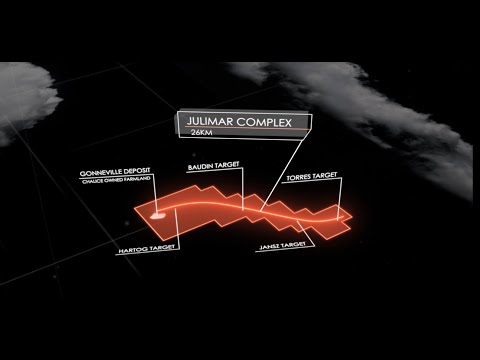
“Notwithstanding the district-scale opportunity that exists along the more than 30-kilometre Julimar Complex to the north, these latest drill results from Gonneville have reminded us of the obvious growth potential just at Gonneville itself.
“Targeted drilling outside the November 2021 mineral resource pit shell has intersected extensive intervals of high-grade mineralisation that will be included in our next resource update, which is on track to be delivered in June.
“This bodes well for the potential to expand the current high-grade, in-pit resource."
Advancing Gonneville
Chalice has gone all out to expand its understanding of the Julimar Project’s mineralisation.
Five diamond and one reverse circulation (RC) drill rigs are on the ground, completing step-out, infill and metallurgical drilling across the Gonneville property.
All up, 870 diamond and RC drill holes, covering roughly 220,000 metres, and 643 aircore drill holes have been completed at the project to date.
So far, Chalice has received new assays for 78 RC and diamond holes at Gonneville. One hole, which drilled the furthest down-plunge, intersected three high-grade mineralised zones:
- 12 metres at 3.4 g/t palladium, 0.7 g/t platinum, 0.0 g/t gold, 0.5% nickel, 0.2% copper and 0.03% cobalt (2.2% nickel equivalent) from 633 metres;
- 3.4 metres at 3.7 g/t palladium, 1.6 g/t platinum, 1.0% nickel, 0.4% copper and 0.07% cobalt (3.3% nickel equivalent) from 661.7 metres, including 2.2 metres at 5.3 g/t palladium, 2.5 g/t platinum, 1.6% nickel, 0.6% copper and 0.10% cobalt (4.8% nickel equivalent) from 661.7 metres;
- 16.4 metres at 4.4 g/t palladium, 0.9 g/t platinum, 0.1 g/t gold, 0.5% nickel, 1.3% copper and 0.03% cobalt (3.4% nickel equivalent) from 667.9 metres, including 6.1 metres at 9.3 g/t palladium, 2.1 g/t platinum, 0.1 g/t gold, 1.0% nickel, 0.4% copper and 0.06% cobalt (5.4% nickel equivalent) from 667.9 metres; and
- 3.8 metres at 2.6 g/t palladium, 0.2 g/t platinum, 0.1 g/t gold, 0.5% nickel, 4.7% copper and 0.04% cobalt (4.7% nickel equivalent) from 677 metres.
The hole also intersected an extensive zone of disseminated mineralisation, measuring 105 metres long and grading 0.6 g/t palladium, 0.2 g/t platinum, 0.2% nickel, 0.1% copper and 0.02% cobalt (0.6% nickel equivalent) from 702 metres.
Ultimately, results show that drilling activity has extended the high-grade sulphide zones beyond the Gonneville resource pit shell.
Importantly, sulphide mineralisation has now been extended up to 400 metres below the limit of the Gonneville resource pit shell, which indicates the potential for material growth into a future underground resource category.
Gonneville’s high-grade, in-pit, indicated and inferred resource stands at 74 million tonnes at 1.8 g/t palladium, platinum and gold (3E), 0.22% nickel, 0.21% copper and 0.021% cobalt (roughly 1% nickel equivalent).
Dorsch continued: “One of the key emerging developments at Gonneville is that the high-grade extensions we are delineating at depth continue to confirm the emerging underground potential, which is likely to be a key growth avenue for us into the future. Importantly everything we drill at depth continues to remain open.
“Our initial strategy will be to define inferred resources at depth to assist in determining the potential opportunity for a future underground mining operation, before upgrading these with infill drilling to indicated resources to underpin future underground mining studies.
“The indications from our recent drilling are that Gonneville has the potential to be a very long life open-pit and underground mine, without taking into consideration anything we may find at our exciting targets along the Julimar Complex to the north.”
Following up at Hartog
One other area that’s piqued Chalice’s interest is the Hartog target, north of Gonneville.
Initial, early-stage exploration is in the works across this and other targets, however, access remains restricted across large parts of the Julimar Complex.
So far, eight of 70-plus planned sites have been drilled at Hartog, all targeting lower priority targets while access is restricted to the existing tracks.
Although it’s early days, Chalice says that ortho-magmatic nickel-copper sulphides — unearthed in mafic-ultramafic rocks at Hartog — are a highly encouraging indication of prospectivity.
Looking ahead, assays are pending for a further 55 drill holes at Gonneville and Hartog, with laboratory turnaround times averaging eight weeks.
Dorsch concluded: “Our drilling to the north is still restricted by access constraints, which we hope are resolved soon, however, we are also very excited to see tantalising indications of an emerging mineralised system at the Hartog target, with several narrow intervals of ortho-magmatic nickel-copper sulphides observed in the right mafic-ultramafic rocks in recent drilling.
“This is an exciting development and the recent results reinforce the potential of the northern targets, which we plan to drill as our exploration effort expands.”
CHN securities were as much as 3.17% higher intraday to A$7.17 with more than 1.72 million changing hands.