
With an interest rate rise looming tomorrow, the ASX will likely follow Wall Street’s downward spiral, where stocks tumbled into the closing bell on Friday.
ASX SPI 200 futures are down 1.3% to 7,315 ahead of potential interest rate hikes in Australia and the US this week.
The Dow Jones Industrial Average shed 938 points, or 2.8%, ending the session near 32,977. Continued carnage in technology-related stocks (Amazon reported its first loss in seven years) forced the S&P 500 index down 3.6% on Friday, while the Nasdaq Composite Index lost 4.2%.
Wall Street’s decline was the worst month for the Dow and S&P 500 since March 2020, while the 13.3% monthly drop for the Nasdaq was its biggest decline since October 2008.
According to MarketWatch, “the Federal Reserve is expected to pull the trigger on its first half-percentage point interest rate increase since 2000, as it looks to potentially tighten financial conditions dramatically to fight inflation that's been running at 40-year highs.
"The central bank also could begin reducing its near $9 trillion balance sheet, reversing its large-scale asset purchases used to help stabilise markets during the COVID crisis.”
Here’s what we saw (source Commsec):
- The Euro fell from highs near US$1.0588 to lows near US$1.0510 and was near US$1.0540 at the US close.
- The Aussie dollar fell from highs near US71.80 cents to lows near US70.58 cents and was near US70.63 cents at the US close.
- Global oil prices were mixed on Friday with volatility provided by a number of expiring energy contracts. The Brent crude price rose by US$1.75 or 1.6% to US$109.34 a barrel.
- US Nymex crude fell by US67 cents or 0.6% to US$104.69 a barrel. Over the week Brent rose by 2.5% and Nymex rose by 2.6%.
- Base metal prices were mixed on Friday. Nickel fell 3.7% and zinc lost 1.1%. But other metals rose by up to 0.8%. Over the week metals fell 3.4-7.7% with copper down the least and zinc down the most.
- The gold futures price rose by US$20.40 or 1.1% to US$1,911.70 an ounce.
- Spot gold was trading near US$1,896 an ounce at the US close. Over the week gold fell by 1.2%.
- The iron ore futures price fell by US$4.31 or 2.9% to US$146.30 a tonne. Over the week iron ore fell by 4.6%.
Australian market
Best and worst performing sectors last week
The best-performing sectors included Utilities (just in the green), followed by Industrials (just in the red) and Consumer Discretionary, which was down just over 1%. The worst-performing sectors were Information Technology down over 3%, followed by Consumer Staples and Energy, down over 2%.
Best performers in the S&P/ASX top 100 stocks were AMP Ltd up over 9%, Amcor CDI (NYSE:CDI) up over 4% and Orora Limited up over 3%. The worst-performing stocks were Northern Star Resources Ltd (ASX:NST) down over 9% followed by Allken Ltd down over 7% and Bluescope Steel Ltd down over 6%.
RBA expected to lift cash rate tomorrow
The first Tuesday of each month marks the monthly Reserve Bank of Australia cash rate meeting.
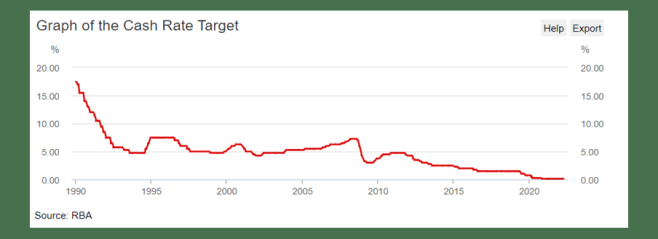
Tomorrow, we could see the cash rate rise for the first time in more than a decade.
Chad Hoy Poy, national lending manager at Australian digital lending and payments provider WLTH, says, "With CPI headline number at 5.1% and the “underlying inflation” now 3.7%, which is above the RBAs preferred 2%-3%, this will cause the RBA to review increasing the Cash Rate when they next meet.
"We could expect a rate rise around the 0.15% sooner than many expected.
"This rate increase could land as early as May or June. It will vary between lenders but I expect them to pass on the increased cost of funds to their customers in the form of higher variable rates. This may scare some mortgage owners away from variable rates to the predictability of a fixed rate, but I believe the variable rate rises won't be high enough to justify switching to fixed rates that start with a 4.
"I expect a measured approach to increasing the Cash Rate over the coming 12-18 months."
City Index senior analyst Tony Sycamore has offered up three scenarios, analysing the probabilities of a no change, a hike to 25bps or a hike to 50bps following tomorrow’s RBA board meeting. Here is his take:
Last week’s Q1 inflation blowout means the possibility of a rate hike this week has become a necessity.
The longer high inflation persists, the higher inflation expectations rise. Thereby bringing into question the RBA’s most important asset, its credibility, and its ability to tame inflation without sending the economy into recession.
While a 40bp hike is warranted, to limit the fallout in the lead up to the Federal Election, the RBA will likely raise rates by 15 bps on Tuesday, taking the cash rate to 0.25%, before lifting rates to 1.5% by year-end.
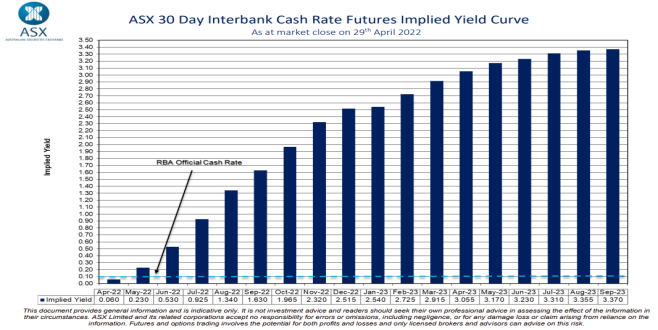
As viewed on the chart below, there is currently 22bp of hikes priced for Tuesday’s meeting. The cash rate is now at 0.1%, so a 15bp or 40bp hike would see the RBA’s cash rate return to the 25bp intervals, the RBA typically prefers to move rates between.
The chart below also shows the market is fully priced for the RBA’s cash rate to be at 2.5% by year-end.
How will markets react?
The RBA’s decision on Tuesday has the potential to move the local equity market and the currency market in the short term.
In the medium-term, larger macro forces remain the driver, including the war in Ukraine, Chinese Covid lockdowns, commodity, energy prices, inflation, and Federal Reserve rate hikes.
Australian headline inflation at 5.1% is still well below the 8.5% rate in the U.S. and the ~7% rate in Europe. The lower inflation rate in Australia will allow the RBA to raise rates more cautiously than the Federal Reserve.
Predicted Market Reactions to Various RBA Scenarios
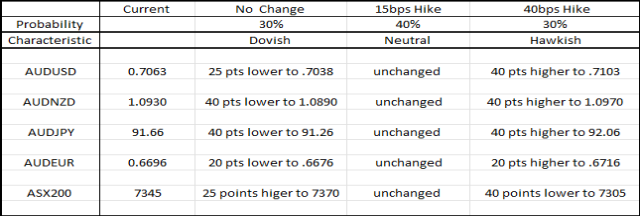
If the RBA leaves rates unchanged, the AUDUSD and AUD cross rates would likely fall modestly, and the ASX200 would stage a short-term relief rally.
If the RBA raise rates by 40bp, it will likely cause a rally in AUDUSD and AUD cross rates and a fall in the ASX200 of around -0.5%.
If the RBA raises rates by 15bp (the market expects this), the reaction will be limited to the shake-out of short-term speculative positions being unwound. In turn, the larger macro forces outlined above will dictate movements.
What's next for Australian stock market?
As we do each week, we asked Dale Gillham to comment on his expectations for the market.
“In the last few weeks, I have stated that given how our market has traded over the past couple of years, we need to expect the unexpected and last week has proven just that. While in prior weeks the market traded higher earlier in the week only to exhibit weakness and fall away towards the end of the week, last week the opposite occurred.
“By market close on Wednesday, the Australian stock market was down almost 3% with many investors becoming concerned and talk of the market crashing reared its ugly head again. Then on Thursday, the market rose strongly to erase almost half of the fall over the prior two trading days. The question most investors are now asking is whether we should be bracing for further falls or consider the current weakness as an opportunity.
“Earlier this month, I indicated that the All Ordinaries Index could fall to as low as 7,600 points before rising again. While the market did fall to 7,514 points on Wednesday, where it closed on Friday will tell us what we can expect moving forward. Closing higher at around 7,700 points, indicated that the bulls are not done and the current weakness may not continue.
“For now, I recommend continuing to play the wait and see game until the Australian stock market confirms a direction. If it trades lower, then investors may need to sell to protect capital, however, if it trades up as I suspect it will, there will be some great buying opportunities.”
US markets
Shares in Amazon fell 14.1%, shares in Apple fell 3.7% and shares in Chevron fell 3.2% in response to disappointing quarterly updates.
Over the week the Dow fell 2.5%; the S&P500 fell by 3.3%; and the Nasdaq fell 3.9%.
Over April the Dow fell 4.9%; the S&P 500 fell by 8.8%; and the Nasdaq fell by 13.3% - its worst monthly performance since October 2008.
European markets
Did the opposite to Wall St.
European markets rose on Friday in response to positive earnings results and a rally in miners.
The metals and mining index rose 2.5% after China vowed to support its economy.
The pan European STOXX 600 index lifted 0.7% but was still 1.2% lower for the month.
The German Dax rose 0.8% and the UK FTSE lifted by 0.5%.
In London trade, shares of Rio Tinto rose by 1.4% while shares in BHP rose 0.9%.