
- FTSE 100 climbs 84 points
- Standard Chartered leads the way
- Sainsburys among the fallers
4.50pm: Footsie ends in the green
The FTSE 100 index ended higher on Thursday despite mixed news from some of its larger components and negative growth data from the US. Sentiment was boosted by some forecast-beating earnings and after the Bank of Japan decided to defy a global shift towards tighter monetary policy as it vowed to keep bond yields at zero, said Fawad Razaqzada, market analyst with City Index and FOREX.com
In London, the UK blue-chip index closed 84 points, or 1.1% higher at 7,509, below the session peak of 7,520.
"I remain sceptical about the recovery we have seen across the major indices since Wednesday," Razaqzada commented. "Granted, the Bank of Japan’s inaction and mostly upbeat company earnings have bolstered the bull case, there are just too many worries for investors to ignore. Continued choppy price action is likely to dominate the agenda, as investors look ahead to a busy next week when the Fed is likely to hike rates by 50 basis points."
In addition, Razaqzada said the energy situation in Europe remains unclear after Russia’s decision to suspend gas supplies to Poland and Bulgaria, with Russian President Vladimir Putin again warning that any country interfering in Ukraine will be met with a "lightning-fast" response.
"Meanwhile growth fears concerning China amid its dogged pursuit of Covid Zero may come back to haunt investors, as cities across the nation roll out swift measures in an effort to keep virus flare ups at bay," Razaqzada concluded.
3.49pm: Footsie accentuates the positive
Leading shares are holding on to their gains without too much difficulty as we head into the close.
With Wall Street still ahead despite the surprise fall in in US GDP, the FTSE 100 is currently up 60.6 points or 0.82% at 7486.21.
It's a big day for company results and inevitably these are having an impact.
Standard Chartered PLC (LSE:STAN) is up 13.11% following its update, as are Smith & Nephew PLC (LSE:SN), ahead by 3.43%, and Barclays PLC (LSE:BARC), 3.24% better.
But J Sainsbury PLC (LSE:SBRY) is down 5.23% as the supermarket warned this year's profits would be below last year's level.
A number of shares going ex-dividend also proved a drag, including Fresnillo PLC (LSE:FRES), which fell 4.79%, St James's Place PLC (LSE:STJ), down 3.23% , and London Stock Exchange Group PLC (LSE:LSEG), which lost1.53%.
3.06pm: US investors shrug off GDP fall
US stocks started higher on Thursday as traders mulled over the latest economic data, which showed the US economy shrank 1.4% in the first quarter.
The Dow Jones Industrial Average gained 161 points to 33,463 in New York, while the S&P 500 added around 46 points to stand at 4,230.
The technology-laden Nasdaq exchange gained around 192 points at 12,680.
Official figures showed that gross domestic product (GDP) was much weaker in the first three months of the year, while GDP surged by 6.9% at the end of 2021. But the US trade deficit alone had reduced GDP by 3.2 percentage points - the third highest number on record.
Primary Health Properties PLC (LSE:PHP, OTC:PHPRF): Proactive analyst Richard Jeans has some research hot off this press this afternoon digging into the numbers following the group's quarterlies. Click here for more.
"A soft headline Q1 GDP number has been in the cards for some time so this does not change our view on the outlook," noted Ian Shepherdson, chief economist at Pantheon Macroeconomics.
"The Fed won’t be swayed next week by this report; we still expect a 50bp hike. And our expectation of a hefty rebound in growth in the second quarter means that the growth story alone won’t ease the upward pressure on rates," he added.
On the corporate front, shares in Facebook parent company Meta Platforms Inc (NASDAQ:FB) (Meta Platforms Inc (NASDAQ:FB)) shot up almost 15% after the tech giant reported better-than-expected profit in Q1. Earnings per share came in at US 2.72 compared to analyst expectations for US$2.56. But revenue was US$27.91 billion, lower than estimates. In addition, active daily users grew to 1.96 billion in the first three months, marking a turnaround from 2021 when it reported a decline for the first time.
in the UK the FTSE 100 is up 60.01 points or 0.81% at 7485.62.
2.28pm: Breakdown of US GDP
Inventory and exports falls appear to have done the main damage to US GDP, leading to the fall of 1.4% in the first quarter compared to expectations of a rise of at least 1% and the 6.9% gain seen in the final three months of last year.
The composition of US GDP growth in Q1 was: -1.4% = +1.8 consumption +1.2 business investment -0.8 inventory +0.1 housing -0.5 government spending -3.2 net exports.
— Patrick Chovanec (@prchovanec) April 28, 2022
Interestingly, core growth remained fairly stable. It was inventory and net exports that saw the big swing from positive to negative.
— Patrick Chovanec (@prchovanec) April 28, 2022
2.07pm: Dilemma for the Fed after GDP fall
The US Federal Reserve is widely expected to raise interest rates next week, but the surprise fall in GDP presents a problem for the central bank.
Richard Flynn, managing director at Charles Schwab UK, said: "today’s figures confirm there is now no shortage of headwinds facing the US economy, including the consequences of the Russian invasion of Ukraine, persistently high inflation, and tightening monetary policy.
“Consumer confidence is low. We’re in a period of counter-cyclical inflation – when high prices put downward pressure on demand and growth. The Fed’s eye is on inflation as it tightens monetary policy in a bid to slow aggregate demand and cool price rises.
"With high inflation and low growth expectations, it may be difficult for the Fed to raise rates without slowing growth. Economic data has been generally weakening recently, which is likely to persist, increasing the probability of a downturn.”
Naeem Aslam, chief market analyst at Avatrade, said: "The Fed needs to pay much closer attention to economic data. Basically, the Fed is standing with a massive bazooka, and they want to increase the interest rate aggressively, but the economic data is telling us a different story."
On the other hand:
A recession could be coming, but the -1.4% Q1 GDP number today is unlikely to be the beginning of it. You had a 0.8% inventory subtraction from GDP and -3.2% from net trade. Consumer was good at +2.7% (a touch light) and biz investment doing great at +9.2%.
— Steve Liesman (@steveliesman) April 28, 2022
1.52pm: US jobless claims lower
Overshadowed by the surprise fall in US GDP, there was some good news on the jobs front.
Weekly US jobs claims fell to 180,000, in line with forecasts, from 185,000 the previous week, itself revised up by 1,000.
1.38pm: US GDP shrinks by 1.4%
The US economy unexpectedly shrank in the first quarter as the Omicron variant spread, after a strong final three months at the end of last year.
Annualised GDP fell 1.4% compared to expectations of a 1% rise, and down from a 6.9% increase in the fourth quarter.
This is the first contraction since the second quarter of 2020 when the pandemic struck.
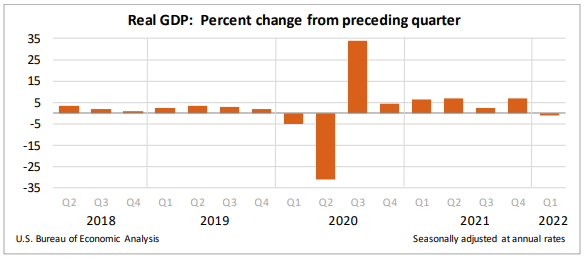
The Bureau of Economic Affairs pointed to the resurgence of COVID-19 cases in the period and decreases in government pandemic assistance payments.
It said there were falls in private inventory investment, federal government spending, while imports - which count as a subtraction in the GDP figures - increased.
US GDP Annualised (Q/Q) Q1 A: -1.4% (est 1.0%; prev 6.9%)
- US Personal Consumption Q1 A: 2.7% (est 3.5%; prev 2.5%)
- US GDP Price Index Q1 A: 8.0% (est 7.2%; prev 7.1%)
- US Core PCE (Q/Q) Q1 A: 5.2% (est 5.5%; prev 5.0%)
— LiveSquawk (@LiveSquawk) April 28, 2022
11.58am: US markets set to move higher ahead of GDP figures
US stocks were expected to open higher on Thursday with the focus again on big tech earnings after Facebook’s owner Meta Platforms reported stronger than expected first-quarter figures yesterday, setting the stage for results from Twitter, Apple and Amazon after the New York close tonight.
Worries about inflationary pressures continue to rumble on as Russia’s invasion of Ukraine, now in its third month, continues without any clear sign of progress towards peace. Over in the US, the spectre of rising interest rates is keeping investors worried about economic growth prospects. Both factors continue to keep markets on edge.
Futures for the Dow Jones Industrial Average gained 0.9% in Thursday’s pre-market trading, while those for the broader S&P 500 index were up 1.5%, and contracts for the tech-heavy Nasdaq 100 added 2.1%.
“Facebook owner Meta Platforms' first quarter numbers weren’t as bad as markets had feared, sending the shares higher after hours in what looks like a bit of a relief rally,” said Michael Hewson, chief market analyst at CMC Markets UK. “April has been a disappointing month for stock markets in general, but for US markets it’s been particularly bad with the Nasdaq 100 hitting one-year lows yesterday, before managing to finish more or less unchanged.”
Meta Platforms was up over 17% in premarket trading.
US first-quarter GDP data will also be in focus, together with US weekly jobless claims.
Elsewhere, oil prices were a little higher, reflecting supply-side concerns. Benchmark Brent crude futures were up 0.3% at $105.25 a barrel, while WTI was 0.4% higher at $102.47 a barrel.
Back in the UK, the FTSE 100 is now up 68.15 points or 0.92% at 7493.76.
11.05am: Pound weakness makes Bank of England rate rise more likely
The pound is a little lower against the dollar but off its lows.
Sterling is currently down 0.13% at US$1.2523, having fallen to US$1.2491 earlier.
Michael Hewson at CMC Markets UK said: "The pound has rebounded off US$1.2490 which is currently a decent area of support, however we could well head lower towards US$1.2200 if this level gives way.
"[A] lower pound makes it much more difficult for the Bank of England to meet its inflation target with the recent decline from US$1.3000 the equivalent of a rate cut.
"This makes it much more likely the Bank of England will raise rates next week with the only question being whether they move by 25 basis points or 50 basis points."
Against the euro the pound is up 0.08% at €1.1892.
The single currency has been weakened by the prospect of rate rises elsewhere, and more recently worries about the economic fallout from Russia cutting off the gas taps to Poland and Bulgaria.
Meanwhile the FTSE 100 continues to hold up well, climbing 71.01 points or 0.96% to 7496.62.
Standard Chartered PLC (LSE:STAN) continues to lead the way following its latest figures, jumping 16.2%.
Software group Aveva Group (LSE:AVV) has added 3.92%, recovering after this week's fall in the wake of its update.
Smith & Nephew PLC (LSE:SN) is up 3.07% after it said a strong first quarter performance put it on track to meet full year guidance.
But Fresnillo PLC (LSE:FRES) has fallen 4.64% as its shares go ex-dividend, while the warning on profits fromm J Sainsbury PLC (LSE:SBRY) has seen the supermarket's shares lose 2.89%.
10.15am: Car production drops in the first quarter
UK car production continues to slump, as the Ukraine crisis adds to the already serious shortage of parts, notably semiconductors.
The number of new cars produced in the first quarter dropped by 32.4% to 207,347, according to the Society of Motor Manufacturers and Traders, a decline of 99,211 units on the pandemic-affected first quarter of 2021.
And in March output fell by 33.4% to 76,900 units, as 4.3% rise in production for the UK failed to offset a 41.4% exports decline.
Global supply challenges wipe 100,000 cars from UK automotive output in first quarterhttps://t.co/hajflxrbfN pic.twitter.com/u9KCU1YYXA
— SMMT (@SMMT) April 28, 2022
The SMMT said production volumes remained constricted with the ongoing global semiconductor shortage, the Ukraine crisis exacerbating parts supply challenges and manufacturers facing an increasingly challenging economic environment with rising energy costs and other inflationary factors.
Mike Hawes, SMMT Chief Executive, said: "Two years after the start of the pandemic, automotive production is still suffering badly, with nearly 100,000 units lost in the first quarter.
"Recovery has not yet begun and, with a backdrop of an increasingly difficult economic environment, including escalating energy costs, urgent action is needed to protect the competitiveness of UK manufacturing. We want the UK to be at the forefront of the transition to electrified vehicles, not just as a market but as a manufacturer so action is urgently needed if we are to safeguard jobs and livelihoods."
Meanwhile the number of UK businesses closing in the first quarter jumped by 23% compared to the same time last year to 137,210, the worst performance since 2017.
All industrial groups except for agriculture, forestry, and fishing showing an increase in closures, said the Office for National Statistics.
A significant increase in closures came in the transport and storage industry (up 75%), mainly due to a drop in freight transport by road and courier activities.
Business closures were up 23% in Jan-Mar 2022 compared with the same time in 2021, with a big increase in transport and storage, which had seen strong creations in 2020 and 2021.
Find out more https://t.co/yefWM8GACd pic.twitter.com/jH2dw4ktLa
— Office for National Statistics (ONS) (@ONS) April 28, 2022
9.35am: More supply chain issues on the way?
The clampdown in China due to COVID-19 is adding to the problems facing the global economy.
Susannah Streeter, senior investment and markets analyst at Hargreaves Lansdown, said: "Just as soaring commodity costs were topping worry lists among many companies, fresh supply chain issues are looming with yet another Chinese commercial hub facing hugely disruptive lockdowns.
"More than 12 million citizens in the e-commerce centre of Hangzhou are set to undergo testing, a move which was a precursor to the hugely disruptive Shanghai shutdown and Beijing has also reported an increase in cases, with some residential areas sealed off. The worry is that China is committed to its zero COVID-19 policy for the long haul and that is set to mean ongoing disruption for trade."
8.47am: Ex-div falls fail to halt rally
J Sainsbury PLC (LSE:SBRY) may be the biggest faller in the leading index, down 4.69%.
But it is joined by a number of companies going ex-dividend.
Heading lower for this reason are Fresnillo PLC (LSE:FRES), which has fallen 3.28%, RELX PLC (LSE:REL), down 1.37%, London Stock Exchange Group PLC (LSE:LSEG), off 1.01% and Reckitt Benckiser Group PLC (LSE:RKT, ETR:3RB), which has lost 1%.
Even so, the FTSE 100 remains buoyant, up 64.44 points or 0.87% at 7490.05.
8.35am: Barclays and Standard Chartered boost banking sector
Shares in Barclays PLC (LSE:BARC) have also moved higher, up 1.25%.
The bank's first quarter profits fell from £2.4bn to £2.2bn, not helped by a £500mln charge relating to over-issuance of securities in the US.
The outcome was however well ahead of expectations of a figure of £1.3bnn,
Richard Hunter, head of markets at interactive investor, said: "The £500mln impairment for these litigation and conduct charges has also worsened the CET1 and cost income ratios and has also delayed the start of the share buyback programme to the second quarter, once discussions with the US regulator have been completed. The spectre of litigation which tarnishes the sector as a whole has clearly not yet been resolved..
"More positively, the bank is more comfortable with its overall credit loss provisions, despite the headwinds of rising inflation and general consumer affordability issues. While the provision has risen to £14mln versus £55mln the previous year, these numbers are minimal compared to the swings already seen in the updates from HSBC and Lloyds."
Still in the banking sector Standard Chartered PLC (LSE:STAN) has surged 11.9% after it beat estimates with a 6% rise in first quarter profits to US$1.49bn.
The Asia-focused bank also said income growth this year was likely to slightly exceed its previously forecast range of 5% to 7%.
8.24am: Markets move higher despite companies warnings on costs
Leading shares have taken heart from the positive update from Facebook owner Meta, as well as from pledges of further fiscal support from Chinese policymakers amid continuing COVID-19 lockdowns.
The FTSE 100 has climbed 47.15 points or 0.63% to 7472.76 in early trading, despite a sharp drop in J Sainsbury PLC (LSE:SBRY) shares which have fallen 5.4%.
The supermarket reported more than doubled full year profits of £730mln.
But it said hat figure included a £100mln benefit from "elevated COVID-19 driven grocery volumes” and this year's profit is expected to fall to between £630mln and £690mln.
It warned on the impact of rising inflation and the squeeze on disposable income.
It was not the only big name to highlight concerns about inflation, a situation which has been made worse by the conflict in Ukraine driving up raw material costs.
Unilever PLC (LSE:ULVR) called it a period of "unprecedented inflation" with costs rising by €2.7bn in the second half, costs which will be passed on to the consumer having already raised prices by 8% year on year in the last quarter.
It expects full year sales growth to the at the top end of its guidance range of 4.5% to 6.5% but margins could be at the lower end of expectations.
But with a share buyback underway, its shares are holding steady at 3581p.
Meanwhile Premier Inn owner Whitbread PLC (LSE:WTB) said cost inflation is likely to be 1% higher than it previously thought at 8% to 9%.
But it made a £58.2mln profit last year compared to a £1,007.4mln loss and restored the dividend, so its shares are up 1.77%.
On the economic front, there will be the latest US GDP report, with growth expected to drop sharply from 6.9% in the fourth quarter to just 1% - although some economists are anticipating there could be no growth at all.
Also on the agenda are the weekly US jobless numbers, which are forecast to dip from 184,000 to 180,000.
6.50am: Footsie set for gains again
FTSE 100 was expected to add to Wednesday’s gains after Facebook owner Meta restored some calm to the wobbling tech sector with decent numbers overnight.
Spread bet firms were calling Footsie up around 20 points a few hours before the open but with another stack of ex-dividends today that looks tight enough for it to go either way.
Meta shares jumped 20% in after-hours trading as profits came in ahead of expectations while active user numbers edged up slightly to 1.96bn and slightly ahead of forecasts (read more).
It helped settled a tech sector unnerved by disappointments at Google owner Alphabet and Netflix.
Microsoft has been the outstanding performer so far among the US tech giants and it helped the Dow Jones higher overnight.
Nasdaq fell again, though futures pointed to a rally today with Asian markets also higher heading towards the close.
Apple and Amazon report later today and “I would argue these are much bigger dogs than Meta,” said Jeffrey Halley from Oanda’s Asia Pacific office, adding that he wouldn't be surprised if they posted big numbers but the real gold “will be in their forward outlooks”.
UK company news also sees a clutch of big names reporting including Sainsbury’s Unilever and Barclays (read more).
Inflation and interest rates will be the dominant themes echoing reports from other household names that have updated this week.
Keep an eye out also for a feisty AGM at mining giant Glencore PLC, which is putting its climate transition report up for scrutiny at its annual meeting on Thursday but voting agencies recommend shareholders vote against it.
A flash read for the US economy in the first quarter of 2022 is the main macro announcement today, with expectations for growth to slow to around 1.1%.
6.50am: Early Markets - Asia / Australia
Asia Pacific shares were mostly higher on Thursday as the Bank of Japan announced its decision to hold steady on its monetary policy, a widely expected decision.
The Japanese central bank also said that it “expects short- and long-term policy interest rates to remain at their present or lower levels.”
Japan's Nikkei 225 surged 1.71% and South Korea’s Kospi gained 0.70%.
The Shanghai Composite in China declined 0.20% while Hong Kong’s Hang Seng index rose 0.49%.
Australia’s S&P/ASX200 gained 1.32%, placing the benchmark index on track to snap a two-day losing streak.