
- FTSE 100 closes less than 6 points higher
- US stocks drop ahead of big tech earnings
- HSBC underperforms UK banking sector
4.50pm: Gains almost completely gone
The FTSE 100 index closed just modestly higher on Tuesday, reversing from a bigger rally after recent sharp falls as Wall Street took a plunge in morning trading ahead of some key tech earnings with Monday’s late Twitter takeover boost soon forgotten.
US stocks were also weighed down by worries over the pace of Federal Reserve interest rate hikes as the latest economic data from across the Atlantic proved mixed.
In London, the UK blue-chip index closed 5.65 points, or 0.1% higher at 7,386.19, just above the day’s low of 7,380.54 and well below the session peak of 7,463.15.
Chris Beauchamp, chief market analyst at online trading platform IG commented: “The wrong kind of ‘Turnaround Tuesday’ has taken place today, with US markets reversing from Monday’s rebound.”
He added: “Investors are back to fretting about economic growth, returning to the theme that dominated at the end of last week. Meanwhile, excitement over the Twitter buyout has faded and instead nerves about big tech earnings this week has come to the fore, explaining why the Nasdaq is taking it on the chin this afternoon.”
“While HSBC has kicked off UK bank updates in poor form, Lloyds has sailed to the top of the index, bolstered by Taylor Wimpey’s solid outlook on the UK housing market. Demand remains strong, and mortgages are still available, and as the big player in this market Lloyds has reason to feel optimistic. Hopefully this tone comes through in tomorrow’s update,” Beauchamp concluded.
3.50pm: UK market rally beginning to fizzle out
Leading shares are well off their best after a downbeat start on Wall Street.
The FTSE 100 is up just 17.86 points or 0.24% at 7398.4 heading into the close, after earlier rising as high as 7463.
Mining shares, which had been under pressure on concerns about the effect of lockdowns in China, have recovered to provide some support for the market.
Anglo American PLC (LSE:AAL) has added 3.09% and Glencore PLC (LSE:GLEN) is up 2.97%.
A positive update from housebuilder Taylor Wimpey PLC (LSE:TW.) has seen its shares climb 2.77%.
But there was a negative response to results from HSBC Holdings PLC (LSE:HSBA), down 3.83%, and Primark owner Associated British Foods PLC (LSE:ABF), which warned cost pressures would lead to price rises and saw its shares drop 3.9%.
But the biggest faller in the leading index is Ocado Group PLC (LSE:OCDO).
Its shares are down 6.49% after the latest Kantar grocery report saw its sales fall 10.7% in the 12 weeks to 17 April.
Partner Marks and Spencer Group PLC (LSE:MKS) is also heading lower, down 4.58%.
3.08pm: US consumer confidence dips
US consumers have been less confident in April than analysts had been expecting.
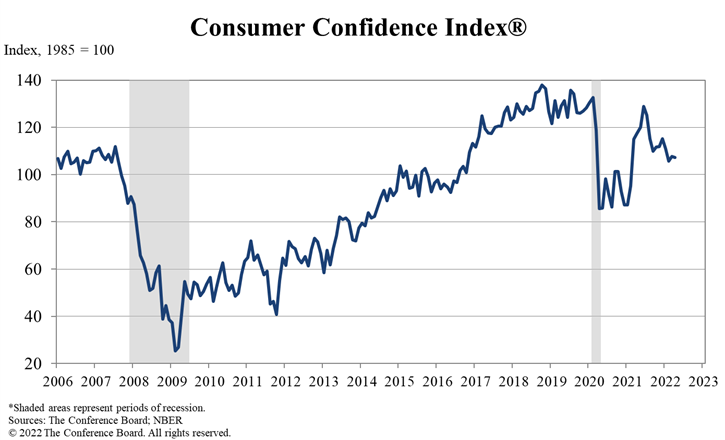
The Conference Board Consumer Confidence Index dipped from 107.6 in March to 107.3, compared to forecasts of a rise ot 108.2.
US CB Consumer Confidence Apr: 107.3 (est 108.2; prev R 107.6)
- Present Situation: 152.6 (prev R 153.8)
- Expectations: 77.2 (prev R 76.7)
— LiveSquawk (@LiveSquawk) April 26, 2022
“Consumer confidence fell slightly in April, after a modest increase in March,” said Lynn Franco, senior director of economic indicators at the Conference Board. “The Present Situation Index declined, but remains quite high, suggesting the economy continued to expand in early second quarter.
"Expectations, while still weak, did not deteriorate further amid high prices, especially at the gas pump, and the war in Ukraine. Vacation intentions cooled but intentions to buy big-ticket items like automobiles and many appliances rose somewhat.
“Still, purchasing intentions are down overall from recent levels as interest rates have begun rising. Meanwhile, concerns about inflation retreated from an all-time high in March but remained elevated. Looking ahead, inflation and the war in Ukraine will continue to pose downside risks to confidence and may further curb consumer spending this year.”
2.58pm: US markets off to a bad start
US shares slumped at the open to continue April's stock sell-off.
The Dow Jones Industrial Average slipped 164 points at 33,884. The S&P 500 lost 29 points at 4,266.
The tech-heavy Nasdaq exchange lost 167 points to stand at 12,836.
It comes as durable goods orders in the US rose 0.8% last month, according to official data.
"Overall, these data indicate that the trend in orders is still quite strong, despite the downshift in some of the survey evidence. The latest problems in China aren’t helping, but domestic demand for durable goods is robust, so the recovery in manufacturing output is set to continue," said Ian Shepherdson, chief economist at Pantheon Macroeconomics.
"The whole sector will be boosted over the next few months by rising well-drilling activity, which needs to rise very substantially in order to catch up with the surge in oil prices," he added.
In the UK, the FTSE 100 has come off its best levels after the US decline, and is now up 43.89 points at 7424.43.
2.50pm: Soaring energy and food prices could last until 2024 - World Bank
The war in Ukraine has dealt a major shock to commodity markets and will keep prices at historically high levels until end of 2024, according to the World Bank.
It said the increase in energy prices over the past two years has been the largest since the 1973 oil crisis. Price increases for food commodities—of which Russia and Ukraine are large producers—and fertilizers, which rely on natural gas as a production input, have been the largest since 2008.
“Overall, this amounts to the largest commodity shock we’ve experienced since the 1970s. As was the case then, the shock is being aggravated by a surge in restrictions in trade of food, fuel and fertilizers,” said Indermit Gill, the World Bank’s Vice President for Equitable Growth, Finance, and Institutions. “These developments have started to raise the specter of stagflation. Policymakers should take every opportunity to increase economic growth at home and avoid actions that will bring harm to the global economy."
The war in Ukraine has dealt a major shock to commodity markets, altering global patterns of trade, production, and consumption in ways that will keep prices at historically high levels through the end of 2024. https://t.co/zth9o7XvWi #CMO2022 pic.twitter.com/ASOzYi2HIc
— World Bank (@WorldBank) April 26, 2022
In its latest Commodity Markets Outlook report, it said energy prices are expected to rise more than 50 percent in 2022 before easing in 2023 and 2024. Non-energy prices, including agriculture and metals, are projected to increase almost 20 percent in 2022 and will also moderate in the following years. Nevertheless, commodity prices are expected to remain well above the most recent five-year average. In the event of a prolonged war, or additional sanctions on Russia, prices could be even higher and more volatile than currently projected.
1.51pm: US durable goods orders recover
Ahead of the Wall Street open and the US consumer confidence figures, the country's durable goods orders have seen a recovery, but not by as much as expected.
Orders for long lasting goods such as cars and major electrical appliances rose by 0.8% in March, up from a revised fall of 1.7% in February but lower than the forecast increase of 1%.
US Durable Goods Orders Mar P: 0.8% (est 1.0%; prev -2.1%; prevR -1.7%)
- US Durables Ex Transportation Mar P: 1.1% (est 0.6%; prev -0.6%; prevR -0.5%)
— LiveSquawk (@LiveSquawk) April 26, 2022
11.58am: US investors remain unsettled
US stocks were expected to open lower on Tuesday with the focus firmly on corporate earnings, especially in the technology and consumer sectors, even though recent share price falls brought out some bargain hunters by the close on Monday.
The recovery was helped by excitement caused by Elon Musk's planned takeover of Twitter.
But the war in Ukraine and its impact on commodity prices also continue to worry investors alongside fears that economic growth in China may be starting to slow amid the country’s tough measures on COVID-19.
Futures for the Dow Jones Industrial Average shed 0.3% in pre-market trading, while those for the broader S&P 500 index were down 0.2%, and contracts for the tech-heavy Nasdaq 100 lost 0.2%.
“The focus continues on mega tech stocks and their earnings, and if any of them miss the estimates like Netflix, pessimism will likely take control of the price action,” said Naeem Aslam, chief market analyst at avatrade.com.
“Nearly 160 S&P 500 companies will report their earnings this week, but the earnings results from Amazon, Meta, Microsoft, Alphabet, and Apple will set the tone for trading,” he added.
Companies due to release results today include PepsiCo (NASDAQ:PEP) (PepsiCo (NASDAQ:PEP)), United Parcel Service (NYSE:UPS) (United Parcel Service (NYSE:UPS)), General Electric (NYSE:GE) (General Electric (NYSE:GE)) and Visa before the bell, which will go some way to show how consumers are reacting to the recent spate of worrying global developments, while tech giants Microsoft Inc and Google owner Alphabet Inc (NASDAQ:GOOG) will report after the New York close.
On the economic news front, US Consumer Confidence data is due today and will be closely watched for signs that levels of optimism may be falling.
11.39am: Mid-cap index lifted by National Express
The FTSE 250 is also moving higher, albeit not as much as the Footsie.
The mid-cap index has added 0.68% to 20,739, helped by a 10.76% rise in National Express Group PLC (LSE:NEX) as the transport group said first quarter revenues climbed 30% as travel continued to recover from the pandemic.
Meanwhile the FTSE 100 remains buoyant, up 61.06 points or 0.83% at 7441.6.
10.16am: Airtel lifted by Nigeria news
Footsie member Airtel Africa PLC (LSE:AAF), the telecoms and mobile money specialist, has been awarded a full "super agent" licence from the Central Bank of Nigeria.
The company said the licence allows it to create an agency network to service the customers of licenced Nigerian banks, payment service banks and licenced mobile money operators in Nigeria.
Its shares are up 2.71% on the news, helping support the rise in the leading index.
At the moment that rise amounts to 56.49 points or 0.77% to 7437.03 as the index benefits from an overnight revival on Wall Street and shrugs off falls in HSBC Holdings PLC (LSE:HSBA) and Associated British Foods PLC (LSE:ABF).

9.44am: UK investors remain in positive mood
The FTSE 100 is holding on to its gains despite the falls in HSBC Holdings PLC (LSE:HSBA) and Associated British Foods PLC (LSE:ABF) following their latest updates.
The blue chip index is up 41.37 points or 0.56% at 7421.91, helped by a 3.16% rise in Taylor Wimpey PLC (LSE:TW.) after positive trading news.
Russ Mould, investment director at AJ Bell, said: "Taylor Wimpey helped lay the foundations for gains across the housebuilding sector as it flagged persistent high demand in the market despite the cost of living crisis and the recent increase in interest rates."
Also up 3.16% are NatWest Group PLC (LSE:NWG) and Lloyds Banking Group PLC (LSE:LLOY).
In contrast HSBC is down 2.33%.
Mould said: “The bank’s share price fell despite beating expectations as investors focused on slowing growth in Hong Kong and a hike in expected losses associated with bad debts linked to the war in Ukraine and mounting inflation.
“This represents a reversal from the situation a year ago when the promise of a Covid recovery meant the banking sector was able to release some of the cash buffers built up to withstand the pandemic.
“HSBC has also been affected by the slowdown in investment banking – a year ago buoyant markets and surging M&A generated plenty of commission.
“Investors’ interest in HSBC is heavily linked to increased penetration of banking in less mature markets in Asia. With the impact of increased restrictions that growth outlook is clouded which negatively impacts sentiment towards the stock.
“Its decision to maintain operations in Russia may come under increasing scrutiny despite a robust defence alongside today’s update."
As for ABF, its shares remain under pressure, down 4.79%.
And after its sales fall in the latest Kantar supermarket figures, J Sainsbury PLC (LSE:SBRY) has lost 1.44%.
8.45am: Grocery sales fall as household budgets are squeezed.
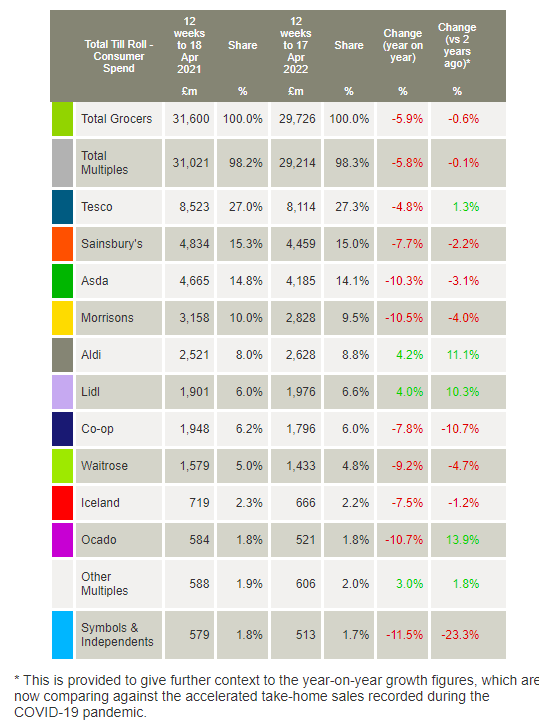
Supermarket sales fell by 5.9% in the last three months as grocery price inflation hit its highest level for more than ten years.
But there were also signs of shoppers stockpiling - notably cooking oil - amid supply shortages following the invasion of Ukraine.
The latest figures from Kantar also show that for the first time since the pandemic began, sales were down compared to two years ago, dipping by 0.6%.
On inflation, Fraser McKevitt, head of retail and consumer insight at Kantar, said: “The average household will now be exposed to a potential price increase of £271 per year. A lot of this is going on non-discretionary, everyday essentials which will prove difficult to cut back on as budgets are squeezed.
"We’re seeing a clear flight to value as shoppers watch their pennies. The level of products bought on promotion, currently at 27.3%, has decreased 2.7 percentage points as everyday low price strategies come to the fore.
"The major retailers are listening to shoppers’ concerns, with Asda launching its Just Essentials line, Morrisons announcing that it is cutting the price of many everyday goods, and Tesco locking in savings through its Clubcard strategy.”
Meanwhile stockpiling appears to be back. McKevitt said: “Last weekend several supermarkets introduced restrictions on cooking oil purchases as concerned consumers filled up their cupboards. The combination of rising prices and increased demand saw the cooking oil market grow by 17% over April. Sunflower oil, Britain’s most popular choice for frying, and vegetable oil grew even faster, up by 27% and 40% respectively.”
Only discounters Aldi and Lidl saw sales grow in the 12 weeks to 17 April, up 4.2% and 4% respectively.
Ocado Group PLC (LSE:OCDO) sales fell 10.7%, Morrisons - now owned by private equity - was down 10.5% while J Sainsbury PLC (LSE:SBRY) dropped 7.7% and Tesco PLC (LSE:TSCO) 4.8%.
8.26am: Taylor Wimpey helps give market a lift
Leading shares have recovered some lost ground after the downbeat start to the week, helped by a revival on Wall Street.
The FTSE 100 is up 41.52 points or 0.56% at 7422.06, with housebuilder Taylor Wimpey PLC (LSE:TW.) leading the way, up 3.9% after its latest update.
But there are a couple of big names proving a drag on the market.
Primark owner Associated British Foods PLC (LSE:ABF) has fallen 2.48% despite half year profits more than doubling from £275mln to £635mln, as it said growing cost pressures meant it would have to raise pricies.
Susannah Streeter, senior investment and markets analyst at Hargreaves Lansdown, said: "Cost pressures are mounting for retailers and the fashion behemoth that is Primark is no exception. For the six months to March 5th it has proved resilient, particularly in the UK and Ireland with sales increasing 59% as customers have snapped up new styles to satisfy pent up demand for socialising and holidays...
"But parent company ABF has warned that it can’t offset soaring input costs with savings alone, so prices will increase on some Autumn Winter ranges. This is a tricky manoeuvre to get right given that fans flock to Primark’s for high fashion at cheap prices and instead of piling clothes high in baskets they may be more cautious which could hit volumes."
HSBC Holdings PLC (LSE:HSBA) is down 2.16% after the bank reported a 28% fall in first quarter profits, after impairment charges.
Richard Hunter, head of markets at interactive investor, said “HSBC has opened the banks’ reporting season in unspectacular fashion, with the return of loss provisions an unfortunate highlight....
"In the corresponding quarter last year and after the effects of the pandemic had been less severe than forecast, HSBC released $435 million of impairments. This year the bank has taken a charge of $642 million, with this $1 billion swing being the major factor for lower profits. The charge largely relates to deteriorating economic situations in both Russia and China, with general inflationary pressures leading the bank to caution on the likelihood of defaults."
8.05am: Mixed picture for UK government finances
The UK goverment borrowed less than expected in March, according to the latest official figures.
Public sector net borrowing came in at £17.3bn, up from £9,9bn in February, itself revised down from £12.3bn.
But this was less than the £19.2bn analysts had been forecasting.
Higher tax receipts were offset by an increase in debt interest payments, following the recent rate rises.
For the year the public sector borrowed £151.8bn, less than half the £317.6bn borrowed a year ago.
But it was the third highest full year borrowing since records began in 1947 and £24bn more than the £127.8bn forecast by the Office for Budget Responsibility.
UK PSNB Ex Banking Groups (GBP) Mar: 18.1Bln (est 19.8Bln; prev 13.1Bln; prevR 10.6Bln)
- UK Public Sector Net Borrowing (GBP) Mar: 17.3Bln (est 19.2Bln; prev 12.3Bln; prevR 9.9Bln)
— LiveSquawk (@LiveSquawk) April 26, 2022
But public sector net debt excluding banks was £2,343.8bn in March or around 96.2% of GDP.
This was up £209.4bn compared with the same time last year, and reached levels not seen since the early 1960s.
6.50am: US revival set to lift UK market
The FTSE 100 is expected to bounce back strongly on Tuesday from yesterday’s one-month low, picking up optimism from the seemingly never-ending source across the Atlantic.
London’s gauge of blue-chip shares is seeing opening 75 points higher, which would offset only some of the 141 points lost at the start of the week to finish at 7,380.54.
While Wall Street started on the back foot, the Nasdaq led a recovery, finishing 1.3% higher, with the Dow Jones closing up 0.7% and the S&P 500 up 0.6%.
“Tech shares rallied strongly ahead on optimism over upcoming earnings numbers, starting later today with the release of Microsoft’s Q3 numbers and Alphabet’s Q1 numbers,” said market analyst Michael Hewson at CMC Markets.
READ: Big tech earnings will dictate direction of 'white-knuckle' market ride
Elon Musk’s agreed takeover of Twitter seemed to help the mood, with a US$44bn offer enough to persuade the social media group’s board not to swallow their poison pill.
Those Microsoft and Alphabet earnings are due after the closing bell in New York, while in London there are numbers from HSBC Holdings PLC (LSE:HSBA), Primark owner Associated British Foods PLC (LSE:ABF) and housebuilder Taylor Wimpey, among others (read more here).
In macroeconomic news, final public sector borrowing numbers for March are expected to show the UK government borrowed £19bn in the final month of the last fiscal year, a £7bn increase from February’s £12bn.
“Today’s March numbers, even if they come in on the high side, are still expected to come in well below the total forecast of £183bn as predicted by the [Office for Budget Responsibility],” said Hewson.
“This is the tightrope being navigated by the Chancellor as he tries to balance the risks of increasing the tax take, against the rising costs of servicing the existing debt.
“Despite these better-than-expected numbers Sunak wasn’t persuaded to roll back the tax increases that kicked in this month, and while he has taken some steps to alleviate the impact, the measures he’s imposed could have the unintended consequence of reducing tax revenues as people cut back on spending.”
Around the markets
Pound up 0.2% to US$1.2760
Oil up 1.4% to US$103.73
Gold up 0.5% to US$1906.9
Bitcoin up 4.2% over 24 hours to US$40,635
6.50am: Early Markets - Asia / Australia
Asian shares were mixed on Tuesday as Sri Lanka started discussions with China about refinancing its debt, a cabinet spokesman said, as the country struggles with its worst financial crisis in decades.
The Shanghai Composite in China declined 0.43% while Hong Kong’s Hang Seng index surged 0.97%.
Japan's Nikkei 225 rose 0.61% and South Korea’s Kospi gained 0.52%.
Australia’s S&P/ASX200 tumbled 2.08% following a broad-based sell-off with heavy losses across the energy and materials sectors.