
Buru Energy Ltd (ASX:BRU) welcomes an independent resources review of the Rafael convention wet gas discovery onshore in the Canning Basin of northwest Western Australia that confirms the potential for a major gas resource.
Adding further confidence for Buru of the commercialisation potential of the Rafael joint venture is that the review by independent resources evaluator ERCE Australia Pty Ltd (ERCE) also points to “a very significant light oil discovery”.
Large gas column
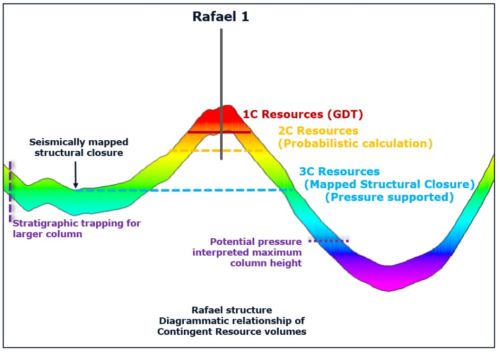
ERCE assesses that the Ungani Dolomite reservoir in the Rafael 1 well contains Gross 3C Contingent Resources of some 1.02 TCF of recoverable gas and 20.5 million barrels of condensate.
This 3C Resources assessment is constrained by the mapped structural closure of the accumulation with a gas column assessed by ERCE to be some 634 metres.
Buru believes that the pressure data in the well not only supports this interpretation of the height of the gas column but also suggests it could be significantly larger.
Gross 1C Contingent Resources of 59 BCF of recoverable gas and 1.2 million barrels of condensate have been assessed, constrained by the “gas down to” in the Rafael 1 discovery well with 2C resources of 260 BCF from a probabilistic calculation.

“Regionally significant”
Buru’s executive chairman Eric Streitberg said: “This independent assessment by ERCE has confirmed Buru’s view that the Rafael structure contains a large condensate rich conventional gas accumulation that has the potential to be regionally significant for both the Kimberley region and for the State of Western Australia.
"The potential size, if proven by successful appraisal of the discovery, could be sufficient to support a major commercialisation project.”
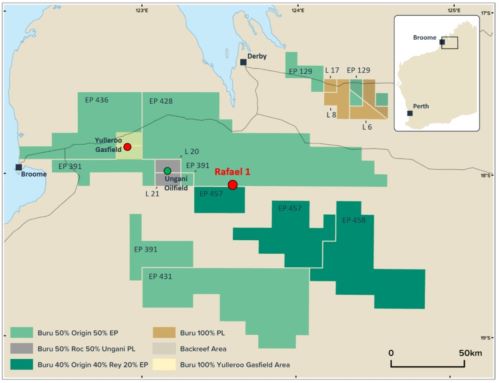
Rafael 1 location.
Route to increase resources
Prospective Resources have also been assessed for the Upper Laurel Carbonate zone where encouraging gas shows and wireline log interpretation indicated a wet gas accumulation, with the planned Rafael 1 testing program aimed at converting these Prospective Resources to Contingent Resources.
A clear route has also been established to increase 1C resources through additional appraisal activity commencing with the planned recompletion and test of additional zones in the Rafael 1 well.
As expected at this early stage of the evaluation of the discovery, a wide resources range has been identified by the independent evaluator.
Additional appraisal activity under consideration by the joint venture includes the acquisition of 3D seismic data and the drilling of appraisal wells which have the potential to convert the 3C resources to 1C resources.
Market options
Streitberg said: "Options for these projects could include export of gas out of the basin to the North West Shelf LNG processing infrastructure to access high-value international LNG markets, or local usage providing feedstock for a low carbon methanol or ammonia project in the Kimberley.
"The relatively high levels of condensate in the gas means that Rafael 1 is also a very significant light oil discovery, with the condensate providing the potential for a substantial light oil production project as part of any development.
"The conventional gas volumes estimated to be in the immediate vicinity of the well at the 1C level are a major economic benefit in themselves as they alone would be sufficient to supply the current gas needs of the Kimberley region with a much-reduced carbon footprint compared to the current energy supply system.
"We look forward to quickly advancing the project to bring forward the benefits that a development will bring to Kimberley communities, Traditional Owners and the State of Western Australia.”
About Rafael 1
The Rafael 1 well was drilled in late 2021 and defined a significant conventional gas and condensate resource in the Ungani Dolomite equivalent reservoir and in the dolomitized Upper Laurel Carbonate reservoir.
Subsequent to the recent successful flow test of the well, ERCE, a specialist resource assessment consulting group, was commissioned to undertake an independent assessment of the gas and liquids resources of the Rafael 1 discovery.
ERCE’s evaluation assessed both the Contingent Resources in the Ungani Dolomite equivalent section and the Prospective Resources identified within the Upper Laurel Carbonate.
The assessment incorporated the technical evaluation of the Rafael 1 well results and the subsequent flow test of a limited part of the interpreted hydrocarbon column in the well.
Defining initial Contingent Resources is a very important step forward in the route to commercialisation of the Rafael accumulation. There is a well-defined pathway of increasing certainty from Contingent Resources to Petroleum Reserves, and from Prospective Resources to Contingent Resources, and this independent review is a significant step forward in that process.
Buru also notes that in its opinion the early stage of definition of the resources appropriately incorporates a conservative approach to a number of the parameters in the assessment, and in particular to the recovery factor used for the conversion of gas in place to recoverable gas.
Areas of uncertainty in the resource calculation for the Ungani Dolomite section are the height of the hydrocarbon column and the permeability of the reservoir.
The JV’s forward appraisal program will address these parameters through the proposed well recompletion and test, a 3D seismic survey and subsequent appraisal wells.
Commercialisation implications
Local hydrocarbon infrastructure is limited and includes Buru’s current oil production and transport operations. The existing and proposed local market for gas is relatively small and the currently defined 1C Contingent Resources alone could be sufficient to supply a lower emissions solution for the existing Kimberley power generation systems currently provided by trucked LNG from the North West Shelf area.
This local energy market may also include future industrial users and will form an important part of the domestic gas supply of any future development.
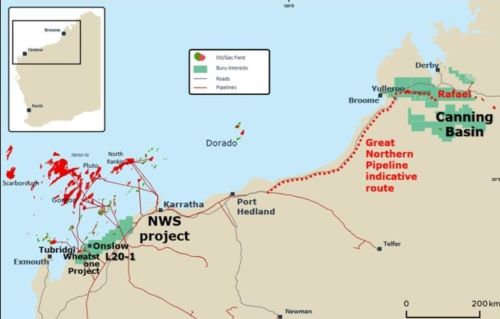
Rafael commercialisation infrastructure.
Development of the larger resource base will require the establishment of export infrastructure from the Canning Basin similar to Buru’s previously planned Great Northern Pipeline to the Pilbara markets and the Northwest Shelf LNG processing facilities, or the establishment of a local petrochemical industry to produce methanol or ammonia.
Any project that is developed would be supported by Geovault, Buru’s Carbon Capture and Storage (CCS) subsidiary that has the expertise to ensure that the development has low carbon intensity.
The conventional gas discovery at Rafael has the potential to capture a current window of opportunity for gas/LNG export from the Northwest Shelf and for ‘green’ petrochemical manufacture in association with Geovault, and Buru together with its joint venture partners will be moving as quickly as possible to capture those opportunities.