
Marmota Ltd (ASX:MEU), which is prospecting for rare earth elements (REEs) in the Gawler Craton in South Australia, is buoyed by neighbouring prospector Petratherm Ltd's (ASX:PTR)’s announcement of a major high-value REE discovery on Marmota’s doorstep.
There are several reasons Marmota shareholders should take note of this announcement, including that the REE discovery is directly on the border with Marmota's considerable holdings in the region.
Investors responded positively, sending shares as much as 25% higher to $0.06 intraday, a new 12-month high.
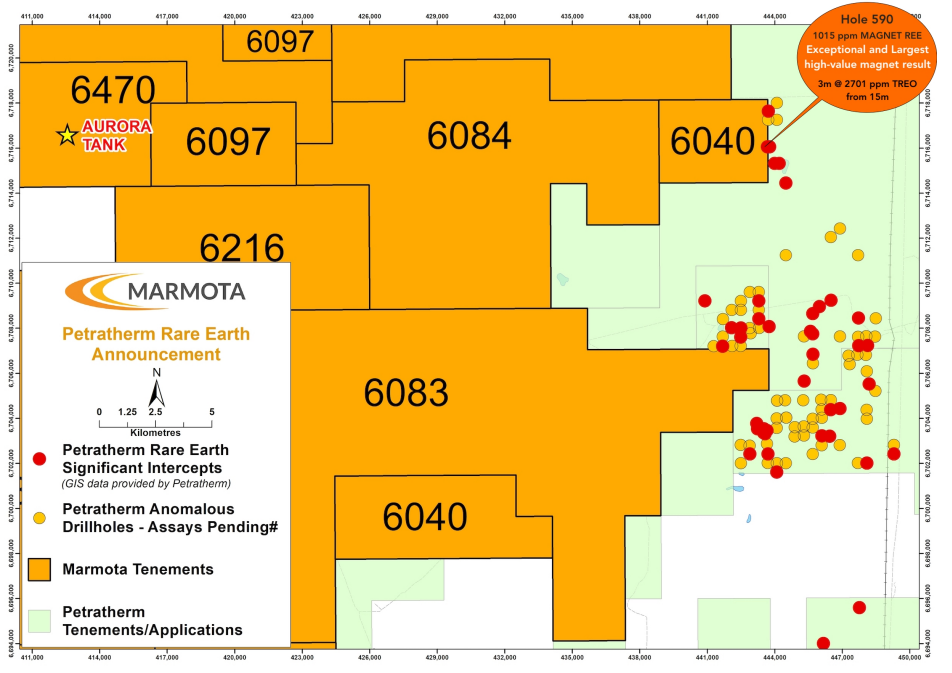
New Petratherm (ASX:PTR) Rare Earth significant assays adjacent to Marmota tenements.
Sampling stopped at boundary – mineralisation wouldn’t
Marmota considers it geologically “highly improbable” for the mineralisation in an ionic clay system to suddenly stop at the tenement boundary.
Indeed, it is geologically highly probable that the mineralisation continues across the tenement boundary.
Petratherm (ASX:PTR) samples returned high-value magnet REE grades, and the most impressive of the finds – 1,015 parts per million (ppm) magnet RRE – is right on the Marmota boundary. Marmota is by far the largest tenure holder in the Northern Gawler Craton.
The neighbouring tenement holder noted in its announcement that the discovery redefines the mineral prospectivity of the Northern Gawler Craton and that the newly defined REE areas have been shown to be regionally extensive, extending several kilometres.
It added that “there is substantial upside potential for additional new REE discoveries to be made in the surrounding un-explored tenure”.
Discovery prompts excitement
Petratherm (ASX:PTR) carried out a program of 993 shallow holes (typically only 15 metres deep), of which 44 were subjected to full-suite REE analysis and returned highly anomalous values.
Some of the highest REE intersections occurred on the Marmota tenement boundary – hole 590: 3 metres at 2,701 ppm TREO.
This hole at the boundary also yielded the highest of the high-value magnet results.
Marmota plans to start a new exploration program for REE mineralisation with immediate targets starting at the discovery on Marmota’s tenement boundary.
The company is seeking to put in place the necessary approvals to have this work carried out.
Obvious drill targets for Marmota
The significant rare earth intersections are remarkably close to the surface, just 12 metres from surface in ionic clays.
This means that exploration costs are low, that large areas of ground can be tested quickly, and any deposits defined would potentially have low mining costs.
There are already two areas where significant intersections have been made along and/or on the boundary of Marmota tenements, including Petratherm’s Hole 590 area on the boundary of Marmota EL 6040, and Petratherm’s Area 2 adjacent to Marmota EL 6083.
Broader implications
This is the first time that significant REEs have been discovered in the Northern Gawler Craton.
Petratherm says that the “results provide strong evidence that the Northern Gawler Craton of South Australia is fertile for ionic clay hosted rare earth mineralisation”.
It goes on to note that REE discoveries in clays show similarities and comparable grades to the ion-absorption REE deposits found in China, which is currently the world’s major supplier.
Marmota’s examination of the Petratherm results tells it that all the anomalism and mineralisation to date is hosted by the Archaean to early Paleoproterozoic Mulgathing Complex, which is also the host to the most significant gold mineralisation in the region.
Marmota is fortunate to hold tenure for the majority of the large area of the Mulgathing Complex metamorphic rocks, which extends about 120 kilometres to the west of the new discoveries.