
Rumble Resources Ltd (ASX:RTR) has started a 7,000-metre aircore and reverse circulation (RC) drill campaign over a series of newly defined battery metals targets at the Wardawarra Project, 100 kilometres northeast of Mt Magnet in the Murchison Goldfields of Western Australia.
New nickel, copper, cobalt, platinum group, lithium, tantalum and niobium targets were generated from a detailed historic exploration review, regional grab sampling conducted by the company, shallow regolith drilling and pulp re-assays from potential nickel-bearing rocks at the Cranes gold prospect.
The company has picked out the newly named Yinga ultramafic sequence as highly prospective for nickel, copper, cobalt and platinum group element (PGE) mineralisation, with a large strike of 20 kilometres by 2 kilometres.
Potential for sulphide mineralisation
Rumble has used the results of the limited historic drilling in the area and its own shallow aircore drilling to piece together the potential for sulphide mineralisation, including, at Yinga:
- 16.8 metres at 1.01% nickel from 7.6 metres;
- 13.7 metres at 1.10% nickel from 13.7 metres; and
- 12.2 metres at 1.04% nickel from 15.2 metres.
Meanwhile, recent regolith aircore drilling and pulp re-assaying of samples reveals the following results at the Cranes prospect:
- 8 metres at 0.80% nickel from 26 metres;
- 9 metres at 0.67% nickel and 0.11% cobalt from 17 metres;
- 8 metres at 0.69% nickel and 0.13% cobalt from 6 metres;
- 7 metres at 0.64% nickel and copper to 720 parts per million (ppm) from 15 metres; and
- Elevated platinum and palladium to 165 parts per billion (ppb).
Lithium-tantalum-niobium targets
Substantial lithium, tantalum and niobium prospectivity is expected at the Eastern Gneiss pegmatite swarm prospects, where numerous fertile pegmatite swarms have been identified over 12 kilometres of strike.
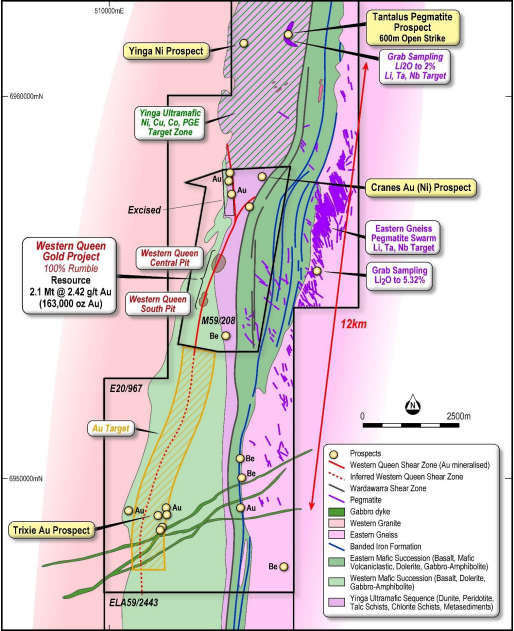
First-pass grab-sampling of the pegmatites has highlighted geochemistry that includes:
- Lithium to 5.32%;
- Rubidium to 3.35% (average 5,000 ppm – amazonite/microcline); and
- Caesium to 0.84%
Over at the Tantalus pegmatite prospect, a large 600-metre by 60-metre-wide pegmatite was previously explored for alluvial tantalum, niobium and tin, with no historic assaying for lithium.
Rumble ran a small first-pass grab-sampling campaign (six grab samples) to ascertain lithium potential and discovered results that include lithium values of up to 2%, rubidium to 1.02% and caesium to 0.2%.