
- FTSE 100 ends 15 points lower
- IMF downgrades global outlooks
- Energy stocks get a boost
4.50pm: Footsie flops on Easter return
The FTSE 100 index ended slightly weaker on Tuesday after the IMF followed the World Bank yesterday in downgrading its outlook for the global economy, although strong early gains on Wall Street helped assuage London’s losses.
The UK blue-chip index closed 15.10 points, or 0.2% lower at 7,601.28, albeit nearer the session peak of 7,624.90 than the day’s low of 7,565.81.
Michael Hewson, chief market analyst at CMC Markets (UK) commented: “The IMF reduced its global GDP outlook to 3.6%, from 4.4%, while upgrading its inflation outlook to 5.7% in advanced economies.
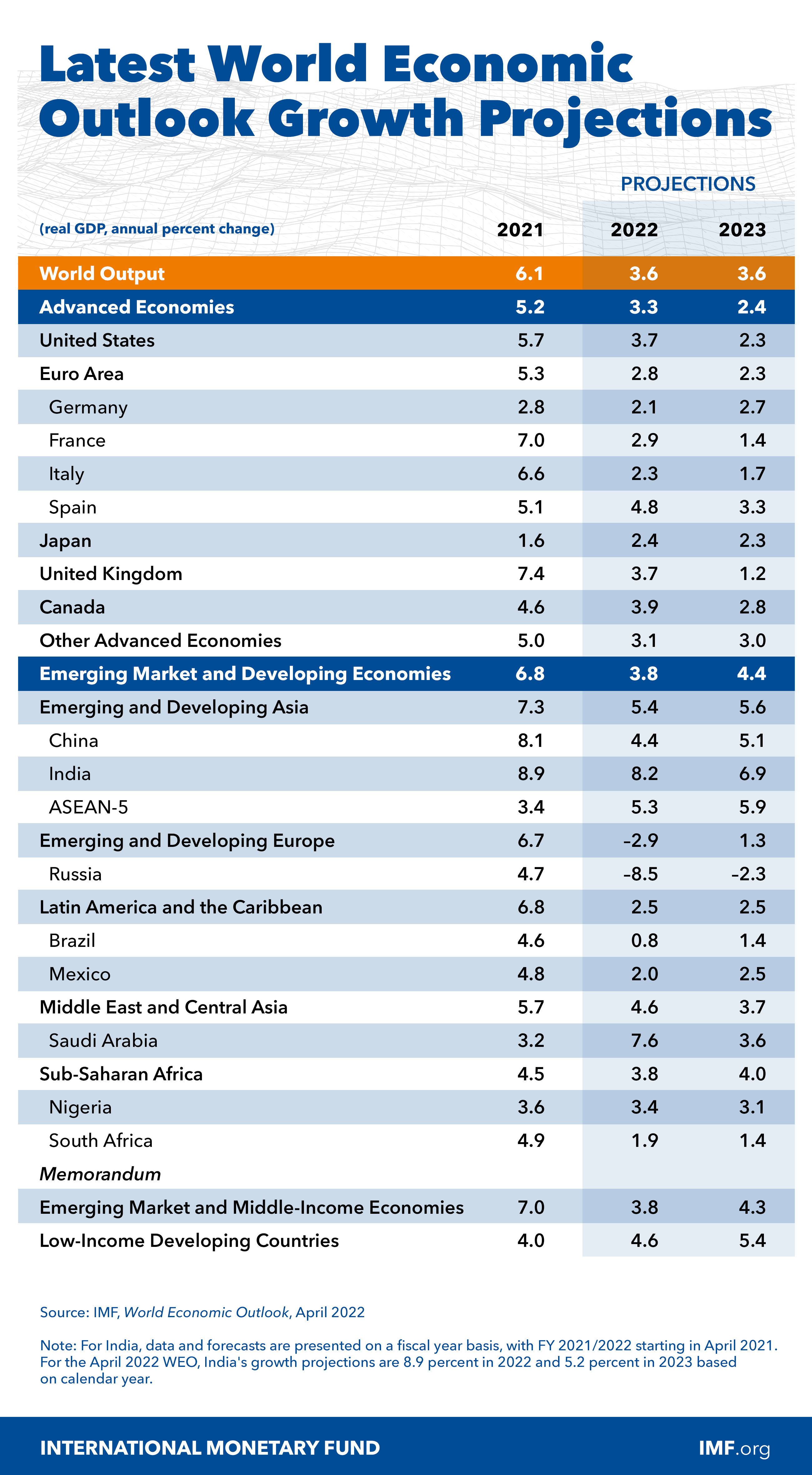
“The war in Ukraine is expected to impact the eurozone quite heavily, the IMF reducing the 2022 outlook here to 2.8%, from 3.9%, with Germany taking the biggest hit. The outlook for the US is much more positive, with its GDP estimate getting cut by 0.3% to 3.7%, while the UK has been cut from 4.7% to 3.7%.
However, he added: “This morning’s initial weakness has given way to a slightly more resilient tone, as today’s sharp decline in oil prices offsets concerns that the start of a renewed Russian offensive on the Donbass region could increase the pressure on the EU to look at a complete embargo on Russian oil and gas.
"The FTSE100 has been helped by the resilience of the energy sector despite a sharp fall in oil prices, with brent crude down over 4%. The uplift has been helped by a solid performance from BP and Shell, largely down to JPMorgan who upgraded its price targets for both.”
4.00pm: Market up despite UK growth expected to be worst in G7 next year
A bright start on Wall Street, with all three main indices now in positive territory, has seen leading UK shares tiptoe into the green as we approach the market close.
The FTSE 100 is now up 5.79 points or 0.07% at 7622.17, having earlier fallen as low as 7565.
The recovery, marginal though it is, comes as the IMF cut its forecasts for 2022 global growth from the 4.4% it expected in January to 3.6%, thanks to the war in Ukraine, rising prices and a slowdown in China.
The UK is one of the better performing advanced economies this year, despite growth being reduced from 4.7% to 3.7%.
But it is a different story in 2023. The UK is expected to grow by just 1.2%, the worse performance in the G7.
Commodity companies are providing support for the market, despite the mixed economic outlook for the UK.
Shell PLC (LSE:SHEL, NYSE:SHEL) is up 2.99% while BP PLC (LSE:BP.) is 1.9% better.
Michael Hewson at CMC Markets UK said: "The FTSE100 has been helped by the resilience of the energy sector despite a sharp fall in oil prices, with brent crude down over 4%. The uplift has been helped by a solid performance from BP and Shell, largely down to JPMorgan who upgraded its price targets for both."
Among the miners, Antofagasta PLC (LSE:ANTO) has added 1.43%.
But ITV PLC (LSE:ITV) is down 3.19% after a downgrade from analysts at Berenberg.
2.57pm: Dow and S&P start higher but Nasdaq dips
US stocks started mixed on Tuesday as traders braced for a deluge of corporate earnings and digested the news that the International Monetary Fund (IMF) had cut global growth forecasts due to the Ukraine/Russia conflict.
The Dow Jones Industrial Average added around 101 points at 34,513 in early trades in New York. The S&P 500 added around six points at 4,398.
The tech laden Nasdaq index lost around five points at 13,327.
The IMF has reduced its estimate for global growth for 2022 to 3.6% from 4.4%.
On the corporate front, traders await Netflix and IBM numbers after the New York bell, while consumer goods and pharma titan Johnson & Johnson (NYSE:JNJ) shares added almost 3% in New York after its earnings per share (EPS) beat expectations while revenue missed analyst estimates.
Toys and games giant Hasbro (NASDAQ:HAS) slipped over 1% as it reported a weaker-than-expected quarterly profit, while revenue was in line with estimates.
Back in the UK, the FTSE 100 is looking a little better after the brighter than expected start on Wall Street, and is now down 15.6 points or 0,2% at 7600.78.
2pm: Ukraine crisis hits recovery prospects, says IMF
After the World Bank cut its growth forecasts on Monday, the IMF has followed suit today, saying the war in Ukraine is slowing recovery.
Its world economic outlook now sees global growth of 3.6% in 2022, down from its previous figure of 4.4% from January due to the effects of the Russian attacks, a slowdown in China and higher prices for food and energy.
For the UK, it is now forecasting 3.7%, down from 4.7% but still one of the highest in the advanced economies.
However, in 2023 the UK is expected to show the slowest growth in the G7, with the forecast cut from 2.3% to 1.2%.
The IMF said: "The war in Ukraine has triggered a costly humanitarian crisis that demands a peaceful resolution. At the same time, economic damage from the conflict will contribute to a significant slowdown in global growth in 2022 and add to inflation. Fuel and food prices have increased rapidly, hitting vulnerable populations in low-income countries hardest.
"Global growth is projected to slow from an estimated 6.1 percent in 2021 to 3.6 percent in 2022 and 2023. This is 0.8 and 0.2 percentage points lower for 2022 and 2023 than projected in January.
"Beyond 2023, global growth is forecast to decline to about 3.3 percent over the medium term. War-induced commodity price increases and broadening price pressures have led to 2022 inflation projections of 5.7 percent in advanced economies and 8.7 percent in emerging market and developing economies—1.8 and 2.8 percentage points higher than projected last January. Multilateral efforts to respond to the humanitarian crisis, prevent further economic fragmentation, maintain global liquidity, manage debt distress, tackle climate change, and end the pandemic are essential."
Pierre-Olivier Gourinchas, IMF’s Chief Economist, listed the three main reasons for the downgrade: "First, the war invasion of Ukraine by Russia, which is increasing energy and commodity prices around the world and is leading to less output and more inflation. Inflation is higher in most countries and is expected to persist longer. In addition, we have a slowdown of the Chinese economy with more frequent lockdowns due to Omicron that is weighing down and then also elevated price pressures in many parts of the world or leading central banks to tighten monetary policy controls.”
12.53pm: Mid-cap index underperforms FTSE 100
Leading shares show little sign of pulling out of the red.
The FTSE 100 is currently down 28.43 points or 0.37% at 7587.95, with consumer facing stocks among the fallers on concerns about the cost of living crisis.
JD Sports Fashion PLC (LSE:JD.) has fallen 4.14% while Reckitt Benckiser Group PLC (LSE:RKT, ETR:3RB) has lost 3.42%.
But the biggest faller is investment firm Intermediate Capital Group (LSE:ICP), off 6.18% on worries about an economic slowdown.
The mid-cap index has fallen further than the main market.
The FTSE 250 is down 0.86% at 20,939, with professional services group JTC PLC (LSE:JTC) the biggest faller in the index, down 6.29% despite more than doubled full year profits and the prospect of acquisitions.
Broker downgrades have left SSP Group plc (LSE:SSPG) 6.01% lower and Wizz Air Holdings PLC (AIM:WIZZ) down 6.07%.
11.42am: Growth worries and Ukraine war unsettle US investors
US stocks are expected to open lower as the first-quarter earnings season progresses amid escalating tensions between Russia and Ukraine and a downgrade to global growth forecasts.
Futures for the Dow Jones Industrial Average declined 0.09% in Tuesday's pre-market trading, while those for the broader S&P 500 index shed 0.18% and the tech-heavy Nasdaq fell 0.28%.
“There is a cocktail of headwinds facing markets this week. Ukraine-Russia tensions have escalated once more, with a Russian offensive underway in the crucial Donbas region,” commented Sophie Lund-Yates, lead equity analyst at Hargreaves Lansdown. “Any suggestion that tensions are going to be prolonged, or more violent, is enough to mute sentiment in western markets.”
Lund-Yates said earnings will be the biggest catalyst for big moves this week on US markets, where stocks ended in the red on Monday as investors returned from the holiday weekend and geared up for another busy week of corporate earnings from the likes of Netflix, Tesla, American Express and United Airlines.
The Dow fell 40 points, or 0.11% to 34,412, while the S&P 500 eased a single point to 4,392 and the tech-heavy Nasdaq slipped 19 points to 13,332.
“First up is Netflix, which should give some indication of how global discretionary spending is faring in a high-inflationary environment,” Lund-Yates added. “The group’s strong brand and established market share dominance should hold it in better stead than newer incumbents, but this is far from guaranteed and the market reaction is likely to be severe if it fails to reach its lowered subscriber targets.”
Meanwhile the cut in the World Bank's growth forecasts - to be followed shortly by a similar move from the IMF - is also unsettling investors.
“There are growing concerns of recession,” Lund-Yates said. “Rising interest rates at a time when economic activity is slowing down makes for very difficult conditions, which aren’t lost on the financial world.
Back in the UK, the FTSE 100 is off its worst level but still down 27.7 points or 0.36% at 7588.68.

10.55am: Funky Pigeon hit by cyber attack
Shares in WH Smith PLC (LSE:SMWH) are down 1.68% after its online greetings card business Funky Pigeon was hit by a cyber attack last Thursday.
Smith said: "The company has temporarily suspended orders from the website and is currently investigating the detail of the incident with external IT specialists.
"No customer payment data, such as bank account or credit card details, has been placed at risk - all of this data is processed securely via accredited third-parties and is securely encrypted. We are currently investigating the extent to which any personal data, specifically names, addresses, e-mail addresses and personalised card and gift designs has been accessed."
It said the attack was not expected to have a material impact on its financial position, and results for the year to be reported next week are in line with market concensus.
10.05am: Nagging worries leave shares lagging
Leading shares continue to head lower as investors worry about the prospects for the global economy.
Apart from surging inflation and prospect of further interest rate rises, the war in Ukraine appears to be escalating as Russia reportedly begins large scale military action to seize the east of the country.
The FTSE 100 is currently down 34.72 points or 0.46% at 7581.66, its low for the day so far.
AJ Bell investment director Russ Mould said: “There was a muted return to trading after the Easter break in London with little to excite investors and plenty of nagging worries bubbling away in the background.
“Energy levels may pick up through the course of the week as the quarterly results season in the US gets into full swing.
“All eyes will turn to Netflix tonight to see if cost of living pressures are leading to subscribers leaving the platform in what remains a highly competitive market.
“Can Netflix be one of the survivors if households cull their streaming services and just what impact will the company’s exit from Russia have?
“Tesla’s numbers later in the week will inevitably bring focus back to its founder Elon Musk’s bid for social media site Twitter.
“A typically cryptic hint from Musk over the weekend – referencing an Elvis song – suggested he might circumvent Twitter’s board if it rejects what he has described as a final bid and go directly to shareholders with a tender offer...
“Later in the week attention may turn back towards macroeconomics amid a series of meetings at the International Monetary Fund. There is much for central banks and finance ministers to discuss given the continuing high levels of inflation in the economy and the impact of war in Ukraine.
“Some of the upward pressure on commodity prices has eased, though that could change if the EU pushes ahead with an embargo of Russian oil.”
9.29am: Pearson off worst levels but still down
More on Pearson PLC (LSE:PSON), which is down 1.35% but has recovered from its worst levels after announcing the end of its online program management partnership with Arizona State University.
Analysts at UBS said: "We think the end of this contract could therefore mean that the Virtual Learning segment within Pearson may not grow in 2023-24 (current forecasts for underlying growth of 6% in both years).
"[The contract end] will, we think, make investors more cautious on placing value on these revenues within Pearson. It is a reminder that under an online program management contract, the intellectual property sits with the university partner with the [manager] operating as a service provider
"It is also a concern that one of Pearson's largest contracts in this area was only minimally profitable given no change to guidance. Pearson may need to invest more aggressively in online degree lead generation in order generate meaningful profits from its online program management business, for example by building its own Pearson branded consumer destination for online degree programs."
9.00am: Miners provide support
Despite the downbeat start, the leading index is still showing some resilience compared to its peers.
Richard Hunter, head of markets at interactive investor, said: "With a cut to global growth expectations from the World Bank running alongside some disappointment that China’s reaction to its slowing economy could be insufficient, stocks were generally under negative pressure...
"The FTSE100 remains relatively in vogue as investors search for some pockets of prospective growth. Stocks providing some sort of inflation hedge as well as defensive sectors have seen some buying interest and, in terms of the availability of such requirements, the UK’s premier index has much to offer.
"Even so, the index is not immune to the pervading sentiment and has made a lacklustre start in early trade, despite the best efforts of the miners and the oils on elevated commodity prices. The FTSE 100 nonetheless remains ahead by 3% in the year to date, which in relative terms is a strong outperformance compared to many other leading global indexes.”
The Footsie is off its worst levels but still down 7.89 points or 0.1% at 7608.49.
Commodity companies are indeed dominating the risers, with Antofagasta PLC (LSE:ANTO) adding 3.34%, Anglo American PLC (LSE:AAL) up 2.48% and Glencore PLC (LSE:GLEN) up 1.7%.
Despite a dip in oil prices this morning, Shell PLC (LSE:SHEL, NYSE:SHEL) has climbed 1.64% and BP PLC (LSE:BP.) is 1.3% better. Both have been helped by overweight ratings from JP Morgan.
8.16am: Cautious start as growth forecasts cut
Markets made a cautious start after the Easter break, with another shortened trading week ahead.
The FTSE 100 is down 14.7 points or 0.19% at 7601.68, as investors continue to worry about the effect on the global economy of the war in Ukraine as well as surging inflation.
After the World Bank cut its growth forecasts yesterday, the IMF is expected to follow suit later today.
Michael Hewson, chief market analyst at CMC Markets UK, said: "Unsurprisingly the weak economic outlook, uncertain geopolitical situation and rising inflationary environment has prompted the World Bank to cut its 2022 global growth outlook to 3.2% from 4.1% yesterday.
"This move is likely to be followed by the IMF ..as it gets set to meet in Washington. Its current estimate for 2022 is 4.4% which it set in January, with Europe and Central Asia likely to take the brunt, due to the Russian war in Ukraine, and COVID-19 restrictions, respectively."
The IMF is likely to cut the UK forecast sharply lower from 4.7% but - along with the US - it is still expected to be one of the fastest growing G7 countries.
Among the fallers, ITV PLC (LSE:ITV) has lost 3.9% to 74p after analysts at Berenberg moved from hold to sell and slashed their price target for the broadcaster from 128p to 64p.
Pearson PLC (LSE:PSON) is down 2.85% after the education specialist said its online program management partnership with Arizona State University would end in June 2023.
It said the profit impact would be modest and said there was no change to its financial guidance for 2022, but this has done little to limit the share price damage.
6.50am: Flat start expected after Easter break
London’s blue-chip shares are predicted to make a sleepy start after the four-day Easter weekend as investors catch up with news of downgrades to global growth forecasts.
The FTSE 100 was called flat by spread-betters on the CMC Markets spread-betting platform, after finishing up slightly at 7616.38 last week.
Wall Street finished slightly in the red overnight, and Asian shares are mostly in the red this morning.
This follows two weeks in the red for European and US stock markets, which traders said was over concerns about central banks tightening into a slowing global economy.
Yesterday the World Bank cut its 2022 global growth outlook to 3.2% from 4.1% and is expected to be followed by the IMF later.
Economists see a growing risk the UK will slip into a recession in the summer as the surging cost of living hits consumer spending.
“Investors and traders are fully back to their desks after a long Easter holiday break and are adjusting quickly to all news that was released during this time,” said market analyst Naeem Aslam at Avatrade.
“This week it is primarily going to be about US earnings,” he added, with Netflix Inc, Johnson & Johnson, IBM, Halliburton, Hasbro and Harley-Davidson today.
“Overall, investors would like to know two things: firstly, how well are the US companies positioned to face the soaring inflation situation, which is likely to become a bit worse due to the increasing interest rate environment. Secondly, are they finding some relief with their supply chain issues?”
Later in the week we have Tesla Inc, Philip Morris, Snap, Verizon, American Express, Honeywell and Schlumberger.
In London, today there is an annual meeting for Anglo American PLC, which is one of several big miners updating on production through the week, along with results from the likes of Benzl, CRH, Rentokil Initial and Foxtons.
6.50am: Early Markets - Asia / Australia
In Asian markets, Chinese tech stocks listed in Hong Kong tumbled after Chinese authorities banned the live streaming of unauthorized video games.
The Shanghai Composite in China declined 0.42% while Hong Kong’s Hang Seng index slumped 2.41%.
Japan's Nikkei 225 gained 0.81% and South Korea’s Kospi surged 0.97%.
Australia’s S&P/ASX200 closed 0.54% higher, even as the Reserve Bank of Australia inched closer to joining the monetary tightening club.