
Strickland Metals Ltd (ASX:STK) has yielded initial gold results described as “outstanding” from its 2022 drill program at the Millrose Gold Project in Western Australia.
The precious metals explorer hit a standout 55 metres at 2.4 g/t gold from 86 metres in one of the reverse circulation (RC) holes — a result management says is one of the best assays to date out of all historic Millrose drilling.
Other strong gold hits include:
- 31 metres at 1.8 g/t gold from 93 metres; and
- 35.1 metres at 1.94 g/t from 136 metres.

Bigger picture
Visible gold was also reported in one of Millrose’s diamond drill holes, roughly 700 metres south of the assays handed in today.
While results are still pending, it seems that RC and diamond drilling across the central and northern extension targets indicates the ore zone’s continuity.
Strickland says there’s growing confidence in Millrose’s potential as “a very substantial gold system”, and investors are excited, too.
STK shares were up as much as 25.5% in morning trade, to 7.9 cents each.
Some of the best results to date
Speaking to the findings, Strickland CEO Andrew Bray said it was very exciting that assays were beginning to flow from the company’s 2022 drilling campaign.
“Even more exciting is the fact we are intersecting such wide, consistent zones of gold,” he said.
“The 55 metres at 2.4 g/t gold result is one of the most impressive assays to date out of all historic Millrose drilling.
“We also think there is strong potential for higher-grade zones of mineralisation closer to surface.”
The findings so far
The Millrose Project lies 30 kilometres due east of Northern Star Resources Ltd (ASX:NST)’s Jundee gold operation and hosts a JORC-compliant mineral resource of 6 million tonnes at 1.8 g/t gold for 346,000 ounces.
To date, around 44 RC holes — 22 with diamond tails — and two diamond holes have been completed at Millrose.
The first 16 were drilled in and around the northern section of the gold resource, designed to:
- Enhance understanding of the mineralisation controls;
- Reduce the drill density, specifically within zones of elevated mineralisation;
- Allow for the modelling of structural and weathering controls on mineralisation distribution; and
- Assess historical data quality with twinned drill holes.
Results from the first six holes have come back from the lab, and highlights include:
- 31 metres at 1.8 g/t gold from 93 metres, including 3 metres at 6.8 g/t from 93 metres, 6 metres at 3.2 g/t from 117 metres and 4 metres at 2.1 g/t from 120 metres;
- 17 metres at 1.8 g/t from 149 metres and 4.8 metres at 4.1g/t from 219.8 metres, including 1.8 metres at 9.9 g/t;
- 7 metres at 3.3 g/t from 101 metres; and
- 5.2 metres at 1.8 g/t from 170 metres and 18.9 metres at 1.3 g/t from 193.2 metres.
Next chapter
Following these initial 16 holes, both rigs were re-located to the northern and central Millrose areas, away from the existing Millrose resource.
In total, eight RC holes were completed as part of the northern extension, with 19 RC and diamond holes executed in the central portion.
Strickland says drilling is proceeding very well in these areas, with most holes to date intersecting the shear zone with varying widths and intensity of alteration.
While assays have not been received for any of these holes, the continuity of the gold-bearing structures — including the visible gold logged in MRDD011 — is building confidence that Millrose represents a very substantial gold system.
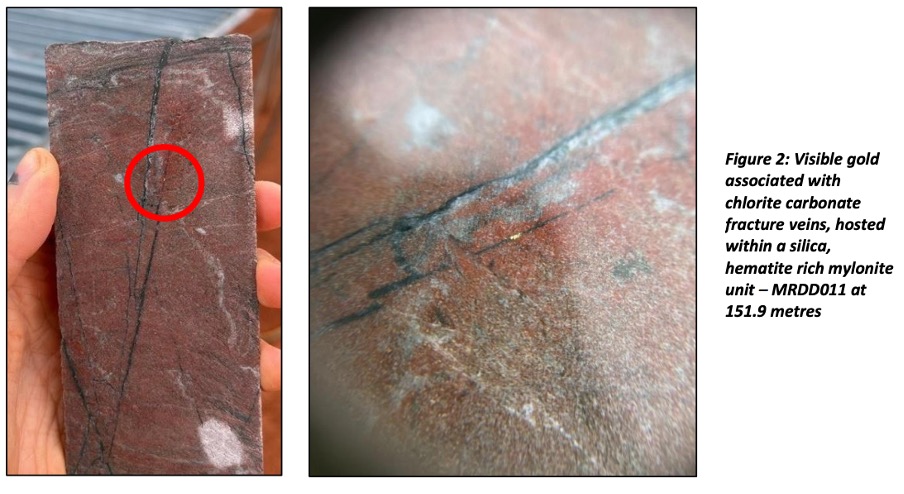
Bray continued: “Of more significance for the broader project is the fact that the gold-bearing structures appear to continue for at least 700 metres south of the assays reported today, as per the visual sighting of gold in MRDD011 and visual observations from RC drill chips and diamond core (assays pending).
“Additionally, RC drilling to the north of the existing resource appears to also show continuity of the gold bearing structures.
“These areas lie outside current resource calculations. The drilling we’ve conducted over the past couple of months has contributed enormously to our geological understanding of Millrose, to the point where the exploration team is growing increasingly confident about targeting and intersecting further ore zone extensions along strike.
“It’s going to be a very exciting few months for shareholders as assays continue to flow in from Millrose.”