
If a central bank believes the economy is lagging, it can cut interest rates to make borrowing money cheaper for individuals and businesses.
This move typically pushes up stock and home prices, rewarding investors and homeowners with better returns.
The first year or so of the COVID-19 pandemic provides the most recent example of this dynamic.
In early 2020, the outbreak of the pandemic drove a rapid decline in economic activity around the world, along with stock market crashes.
However, economies and stock prices rebounded as governments responded by cutting interest rates as low as possible.
In this article:
What happens to stocks when interest rates are hiked?
Stock market moves during past rate hike cycles
Sectors that benefit from rate hikes
Will home prices in Australia start falling?
Interest rates and bond prices
What happens to stocks when interest rates are hiked?
When inflation runs too hot or asset bubbles get out of hand, governments raise interest rates to bring these under control.
Higher interest rates can ripple throughout the economy with mortgages, car loans and business loans becoming more expensive, slowing down cash flows.
The high-interest rate environment can lead businesses to pause investments and growth plans.
In the financial markets, higher rates incentivise investors to sell assets and book profits, especially in times like now when there have been a few years of double-digit percentage growth on stocks and other assets.
This can lead to lower stock prices across market sectors.
Stock sell-off may intensify as conservative savings instruments like bonds and certificates of deposit (CDs) start looking more attractive to investors during times of rising interest rates.
Stock market moves during past rate hike cycles
If you look for data showing a correlation between rising interest rates and falling stock prices, you might be disappointed.
Dow Jones Market Data recently collated data from the five most recent rate hike cycles in the US to analyse stock market returns in these periods.
Surprisingly, the analysis shows that during these five cycles, the three leading stock market indexes in the US only declined during one rate hike cycle.
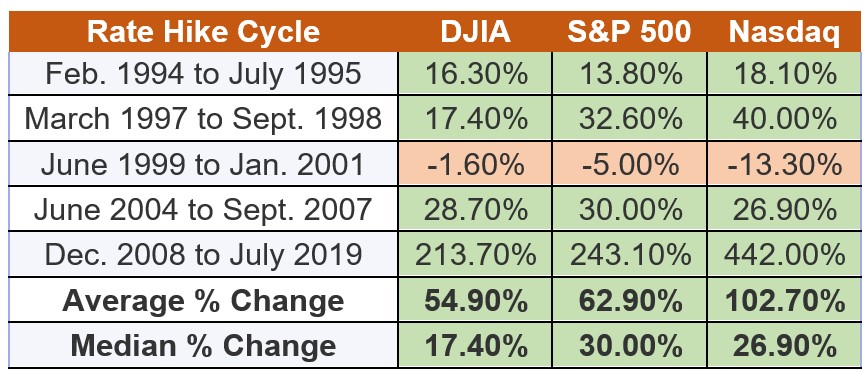
Source: Dow Jones Market Data.
The S&P 500 delivered a median gain across all five cycles of 30%, while the Nasdaq saw a median rise of about 27% and the Dow Jones Industrial Average (DJIA) delivered a median increase of 17.4%.
Although the federal funds rate surged from 1.0% to 5.25% during the series of interest rate hikes from June 2004 to Sept 2007, the DJIA ended up gaining 28.7%.
Data from recent history also challenges the idea that rising rates lead to falling stock prices - the S&P 500 climbed more than 18% when the Fed raised rates three times in 2017.
Sectors that benefit from rate hikes
Rate hikes don’t impact all sectors equally. They can help certain sectors, like financial stocks, as higher rates mean higher margins in the business of lending money.
Rising interest rates tend to hurt growth stocks, like tech startups as investors tend to look for stable companies in uncertain markets.
The difficult market conditions can favour investors who can pick the right companies and industries to invest in as market conditions change.
But it’s tricky to get the timing right, because not only are you guessing any actions the central bank makes but also the moves of other investors as well, many of whom have already priced rate hikes into their investment decisions.
Will home prices in Australia start falling?
According to CoreLogic, the average price of a house in Australia has increased by 192% over the past two decades, making the country one of the strongest performing property markets in the world alongside New Zealand, the US and UK.
Despite strict lockdowns and border closures amidst the COVID-19 pandemic, 2021 was the best year to be an Australian homeowner since the mid-1980s as prices surged 22%.
However, the possibility of interest rate hikes in 2022 and 2023 may reverse the trend with the housing market expected to slow along with the rate hikes.
The National Australia Bank has predicted a 10% decline in house prices next year with a sharper fall of ~12% in Sydney and Melbourne.
The upside from falling house prices is that it could make housing more affordable and help narrow a disparity at the entry-level of the market.
Australia’s wage price index rose 2.3% in 2021 compared with a 22% rise in property values, which has made buying a property unaffordable for many Australians.
Demographia’s International Housing Affordability 2022 Edition revealed Sydney was the second least affordable city to buy a house (after Hong Kong), with the median price 15 times more than the average household income in 2021.
22nd Demographia housing affordability survey: Congratulations Australia on utter policy failure.
Affordable: 3.0 median house price / HH income
Moderately affordable: 3.1-4.0
Seriously unaffordable: 4.1-5.0
Severely unaffordable: 5.1+
Sydney: 15.3x
Worst in world ex-HK #auspol pic.twitter.com/WmyK0QWlhV
— Matt Barrie (@matt_barrie) March 16, 2022
Many Australians have bought houses at high prices in recent years, increasing the overall household debt in the country.
Household debt, as a percentage of Australia’s GDP has increased to 120%, second only to Switzerland.
This could leave many mortgage holders in danger when interest rates rise, although default rates on mortgages in Australia are relatively low compared with other countries.
Last month, Reserve Bank of Australia governor Philip Lowe warned those heavily indebted households that now is the time to save money in anticipation of a rate increase, if they had not already.
He said: "Interest rates will go up, and the stronger the economy, the better progress on unemployment, the faster and the sooner the increase in interest rates will be.”
Interest rates and bond prices
When interest rates rise, bond prices typically decline. Conversely, bond prices rise after a fall in interest rates.
For example, let’s say an investor holds a 10-year $1,000 bond paying a 3% coupon. If market interest rates rise to 4% in one year, the asset will still pay 3%, but the bond’s value may drop to $925.
The reason for the fall in price is that new bonds may be issued with the higher 4% coupon, making the original 3% bond less attractive unless someone can buy it at a discount.
With higher yields elsewhere, investors tend to sell their current bonds to purchase the higher-paying ones, and the selling causes bond prices to slide.