
Natural Resources
4 April 2021
Comment
Houston, we have a problem.
Last week members of the copper world gathered in Santiago for CRU’s 2022 World Copper Conference. For consumers of copper, and ultimately that’s pretty much everyone, the headlines don’t look good.
According to CRU the annual copper supply deficit will be 6 million tonnes per annum for the next decade. Put simply we need around eight more Escondidas to fill the gap, and we need them to come to full production capacity in the immediate future. According to CRU, an investment of over$100bn is required if the world is going to meet demand requirements.
S&P Global Intelligence recently identified just 22 copper projects scheduled to be in production before 2026. They will contribute 1.5Mt pa of copper at capacity.
Despite the additional planned capacity potentially coming onstream in the next four years, consensus forecast numbers point to a structural deficit in copper supply of approximately five million tonnes by 2030. An additional 20% of current global production coming from greenfield projects implies more than 75 new mines coming into production in the next eight years. That looks like a tall order.
Copper prices are already at decade highs but in Santiago analysts from Goldman Sachs (NYSE:GS) suggested prices need to go much higher to stimulate a significant supply response. An indication perhaps of the quality of the current copper project pipeline.
Nevertheless, with copper prices at ~200% above the 90th percentile of the copper cash cost curve, clearly the industry is looking healthy and in a good position to ponder growth options.
Unfortunately it isn’t quite that simple. Freeport McMoran’s CEO and Chairman Richard Adkerson captured it well with his reported response to those views on current pricing and growth options … “it is far beyond a price issue”.
The point he was highlighting is that although current prices mean copper companies are making heaps of cash they simply cannot significantly accelerate their current project pipelines given the lack of historic exploration spend, development timelines, ESG considerations and ultimately the quality and quantum of the pipeline that exists. He concluded that “the market is going to need it faster than companies like ours can produce it”. Coming from the head of one of the largest copper producers globally, this is a pretty stark warning.
Most large copper companies’ growth options over the last decade have been focussed on expansion of existing mines rather than M&A. Given the impending supply crunch and the current cash generation in the industry, casting the inorganic growth net wider surely can’t be far away.
The paucity of the copper project pipeline is something we have been highlighting for some time through our series of publications on Copper M&A and analysis of the existing project pipeline. In our December update we found that there are 65 development and exploration projects with resources of more than 2.0Mt contained copper, enough to sustain ~ 100kt pa copper production.
Based on our assessment and ranking of a number of project factors, including the potential size, economics, exploration progress, permitting risks, location and geopolitical risk, resource quality, the existing shareholder structure, we believe that only 23 of these have the potential to involve third party M&A activity.
Change on the way?
Recent months have seen an uptick in activity with Lundin Mining’s US$485m acquisition of the Josemaria project, BHP investing C$100m in Filo Mining’s exciting South American exploration project and Barrick having just reached agreement with the Pakistan government on a restart of work at Reko Diq - despite Balochistan not exactly being the most salubrious of addresses.
One explorer’s response.
One of the five projects we concluded had a ‘High’ possibility of a third-party involvement is the Santo Tomas project in Mexico owned by TSXV listed Oroco Resources*.
Hot on the heels of the completion of a C$18.1m capital raise last month this week the company have announced the appointment of Richard Lock as the company’s new CEO. Mr Lock has led the construction and development of several large mining projects around the world, including at Rio Tinto’s Resolution and Keystone copper projects in the USA.
Executive Chairman Craig Dalziel said the appointment “completes the assembly of a highly skilled cohesive team of industry professionals that is fully capable of delivering this world class mining opportunity to the project acquisition market-place”.
Hopes are high that the now fully funded current drilling campaign will turn the historic resource of 2.6mt contained copper into multiples of that. In a world with a looming copper supply deficit and relatively few ‘independent’ copper projects of size and scaleability, continued work to confirm and expand the resource will almost certainly increase Santo Tomás’s attraction for any suitor.
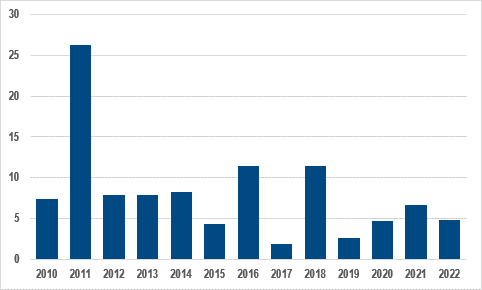
Global Copper M&A US$bn (Source: S&P Global, RFC Ambrian)
Copper M&A activity has been pretty limited over the last decade but has begun to accelerate over recent years. We’ve got some way to go to develop the copper resource pipeline required to meet climate change related demand but there are signs that the market is belatedly deciding to shift gear – could we be on the cusp of a significant copper M&A wave?
Charlie Cryer
Head RFC Ambrian London
+44 (0)20 3440 6834
charlie.cryer@rfcambrian.com
*RFC Ambrian acts as Financial Adviser to this company and holds an interest.
This document has been approved under section 21(1) of the FMSA 2000 by RFC Ambrian Limited ("RFC Ambrian") for communication only to eligible counterparties and professional clients as those terms are defined by the rules of Financial Conduct Authority. Its contents are not directed at retail clients as RFC Ambrian does not provide investment advisory services to retail clients.
RFC Ambrian publishes this document as non-independent research which is a marketing communication under the Conduct of Business rules. It has not been prepared in accordance with the regulatory rules relating to independent research, nor is it subject to the prohibition on dealing ahead of the dissemination of investment research. It does not constitute a personal recommendation and does not constitute an offer or a solicitation to buy or sell any security. Neither RFC Ambrian nor any of its directors, officers, employees or agents shall have any liability, howsoever arising, for any error or incompleteness of fact or opinion in it or lack of care in its preparation or publication; provided that this shall not exclude liability to the extent that this is impermissible under the law relating to financial services. All statements and opinions are made as of the date on the face of this document and are not held out as applicable thereafter. This document is intended for distribution only in those jurisdictions where RFC Ambrian is permitted to distribute its research. In particular, it is not intended for distribution in and is not directed as persons in the United States.
On the date of this document, RFC Ambrian, RFC Ambrian's holding company, persons connected with it and their respective directors may have a long or short position in any of the investments mentioned in this document. RFC Ambrian is a member of the London Stock Exchange and is regulated and authorised by the Financial Conduct Authority. RFC Ambrian is registered in England and Wales no. 4236075. Its registered office is at Octagon Point, 5 Cheapside, London EC2V 6AA.
NOTICE: The information in this e-mail message is confidential and may also be privileged. It is only intended for the above-named addressee/s. If you are not a named addressee, you must not disclose, copy or take any action in reliance on this e-mail and should delete it from your system. If you have received this e-mail in error, please contact the sender by return e-mail or by telephone +44 (0)20 3440 6800. We believe, but do not warrant that this e-mail and any attachments are virus free. You should take full responsibility for virus checking.