
The price of a loaf of bread is higher than it was 12 months ago. As is the cost of a litre of milk (although government representatives may not know the exact cost). And unless you ride a bike or walk everywhere, you can’t escape the skyrocketing price of petrol.
The rising cost of goods and services, corresponding with a decrease in money is known as inflation and it can cause all sorts of burdens on those who can ill afford a rise in essential services.
However, despite rising costs, inflation is not as bad as it is cracked up to be. In fact, if managed properly, it is a sign of a healthy, growing economy.
Part of the management strategy for inflation corresponds to interest rates. Essentially, when inflation rises, monetary policy shifts.
Why?
Put simply, rising interest rates can help drive down the cost of goods and services.
Let’s break this down.
In this article:
- What is inflation?
- Why is inflation good for the economy?
- How can interest rates help curb inflation?
- Australia’s inflation target
- What other measures are used to curb inflation?
What is inflation?
Inflation is the sustained upward movement in the overall price of goods and services that corresponds with a loss of purchasing power. Put simply, over time you need more money to buy your loaf of bread.
That is inflation at its most simplistic.
However, it’s a mistake to define inflation as only a rise in the price of a few key goods or services. Inflation is present when the overall price of goods and services rises.

There are two main forces that drive inflation: demand-pull inflation and cost-push inflation.
1. Demand-pull inflation
Demand-pull inflation occurs when demand for goods and services exceeds supply. This places upward pressure on prices and gives rise to inflation.
2. Cost-push inflation
Cost-push inflation happens when the rising price of input goods and services (that is the resources used to produce a product or service) increases, which means the final price of the product must increase also.
We can see this in the price of oil now. Generally, any oil crisis causes a supply crunch and thus a rise in oil price. This also has a knock-on effect as any increase in the oil price puts upward pressure on other goods and services, leading to inflation.
Why is inflation good for the economy?
An increase in the cost of living doesn’t sound like positive news, but if inflation is managed correctly, it is exactly what the economy needs.
Over the long term, increasing inflation is a sign that an economy is growing. It enables investors to feel confident about investing. It is the opposite of deflation, which is economically bad. It allows for real wages growth. It encourages people to spend – which in turn stimulates the economy.
The following table offers the case for and against.

Source: economicshelp.org
Looking at the positives, when inflation coincides with higher wages, borrowers can repay debts with money that is worth less than it was previously.
Moderate inflation is also good for wages, as relative wages are easier to adjust. For instance, an increase in the average wage is easier to justify for productive workers in times of moderate inflation. Unproductive workers may have their wages frozen, which effectively becomes a real wage cut.
In the opposite case, if it does not correspond with wage increases, consumers may face strong pressure to borrow money to afford the things they need.
At the extreme of the inflation scale is hyperinflation, which if it spirals out of control can make a currency completely worthless.
Going back to the table above, note, in the advantages column, the use of the word moderate.
Moderate inflation is what governments aim for, with a focus on containing high inflation which can slow economic growth.
There has been a lot of talk about interest rates over the past few months as inflation has risen. Interest rates enable governments to control inflationary surges. We’ll get to that shortly.
How can interest rates help curb inflation?
Using interest rates can have two effects, depending on which way the interest rates are moving.
When interest rates are raised, this acts to decrease spending. When they are lowered, spending is increased.
Although decentralised, banks will generally pass on any interest rate changes. When interest rates are increased, the cost of borrowing for commercial banks also increases, hence higher interest rates for consumers. In this case, businesses and consumers will see higher returns on savings, but borrowing becomes expensive.
As a result, spending decreases, slowing down economic growth.
When less cash is being spent, money supply tightens and demand for goods drops. Lower demand tends to decrease the price of goods, making them cheaper and lowering inflation.
Lowering the base interest rate does the opposite and increases inflation.
Further to this, a country’s central bank may face a low inflation environment, but can’t lower interest rates. In this case, the central bank will turn to quantative easing, which is a way for the bank to lower interest rates while increasing money supply, which is what happened during lockdowns.
QE is generally required to stimulate an economy when conventional forms of monetary policy are no longer effective: when interest rates are at or near zero.
Looking at the relationship between interest rates and inflation: when inflation is rising faster than a central bank wants, an interest rate hike can be used to curb it. If inflation drops below the target rate, the governing board might lower interest rates accordingly.
Different central banks act differently depending on economic policy and the state of the economy. They are also well aware of the dangers: trying to anticipate inflation trends risks making a policy error by needlessly stoking inflation with rates that are too low, or stifling growth by raising them.
Australia’s inflation target
Australia's inflation target is to keep annual consumer price inflation between an average of 2 and 3%.
According to the Reserve Bank of Australia: “The particular measure of consumer price inflation is the percentage change in the Consumer Price Index (CPI).
“This is a suitable measure of inflation to target because it captures price changes for the goods and services that households buy, is independently produced by the Australian Bureau of Statistics, is publicly available and historical data for this series does not get revised.”
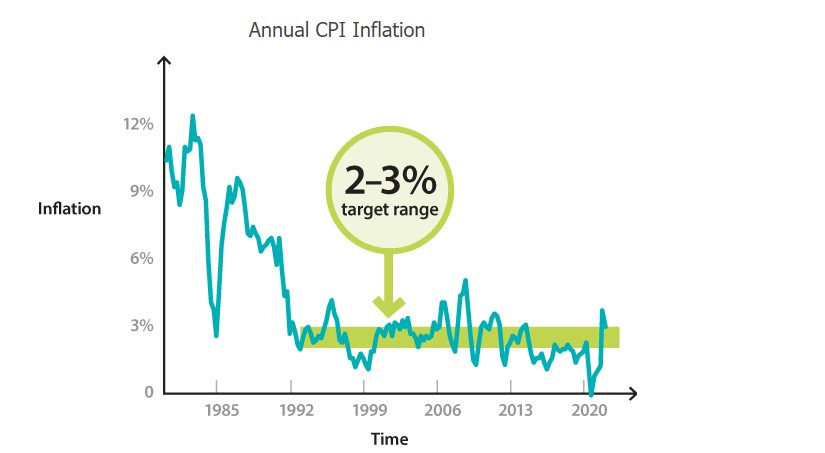
Source: RBA
The RBA uses an inflation target to help achieve its goals of price stability, full employment and promote the prosperity and welfare of the Australian people. Price stability, that is, stable inflation, contributes to sustainable economic growth.
What other measures are used to curb inflation?
Interest rates are not the only policy tool used to curb high inflation.
The following are examples of other ways the government can act:
- Control of money supply – There is a link between money supply and inflation, and thus controlling money supply may control inflation.
- Supply-side policies – The government may use policies to fuel the competitiveness and efficiency of the economy, putting downward pressure on long-term costs.
- Fiscal policy – a higher rate of income tax could reduce spending, demand and inflationary pressures.
- Wage controls – This is rarely used, but controlling wages could, in theory, help to reduce inflationary pressures.