
Core Lithium Ltd (ASX:CXO) has demonstrated encouraging thickness and grade in first assays from Bilatos Prospect within the Finniss Lithium Project near Darwin in the Northern Territory of Australia with shares hitting a new record high.
Assay results have been received from reverse circulation (RC) drilling at Bilatos in the southern part of the company's holding with best intersections of:
- 24 metres at 2.24% lithium oxide (Li20);
- 30 metres at 1.11% Li2O;
- 12 metres at 1.09% Li20; and
- 15 metres at 0.80% Li20.
These results indicate the potential to further expand the existing Finniss resource and with the wet season out of the way, Core is planning an active exploration program in the area.
Active exploration imminent
Core managing director Stephen Biggins said: “The latest results confirm our view of the prospects drilled at the Finniss Project, and we look forward to reporting the new results as they come to hand.
“With the wet season nearly behind us, we are planning an active exploration drilling program at Finniss over the coming months.”
Shares have been as much as 9.89% higher at A$1.39, a new record high for the company that has a market cap of approximately A$2.2 billion.
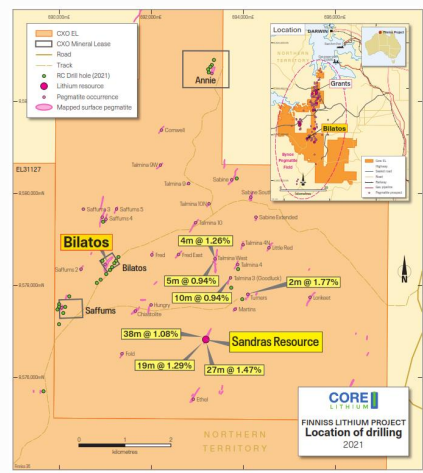
Location of Core's prospects in the southern part of Finniss.
Drilling results
Core has completed 10 reverse circulation (RC) drill holes at Bilatos within and adjacent to newly acquired MLN813 and surrounding EL30012.
Promisingly, most holes intersected significant lithium grades and consistent thicknesses of pegmatite in the first drilling undertaken by Core at Bilatos.
An initial interpretation of the Bilatos pegmatite is that it is a very large single body over 800 metres in length that remains open to the north, south and at depth.
Although spodumene has been positively identified, a complex association of lithium-bearing minerals is likely present, based on assay results and visual inspection of the RC chips
Forward plan
Further Finniss lithium exploration and resource drilling updates expected are over the coming weeks as results are received.
At present, work is underway to determine the range of lithium-bearing minerals present in the RC chips at Bilatos.
Looking ahead, the Finniss Project aims to provide high-grade and high-quality lithium suitable for lithium batteries used to power electric vehicles and renewable energy storage across the world.