
Archer Materials Ltd (ASX:AXE, OTC:ARRXF) is trading higher after achieving electronic transport in atom-thin graphene integrated with silicon electronics.
The electronic transport results confirm that the atom-thin graphene electronic properties were retained post-processing and integration with silicon.
This work fundamentally links to using graphene transistor technology in the future operation of Archer’s biochip.
The materials technology company intends to use graphene in its biochip technology to enable ultrasensitive detection and analysis of diseases.
Shares have been as much as 19.55% higher this morning to A$1.04 while the company's market cap is approximately A$250.04 million.
Future biosensing operations
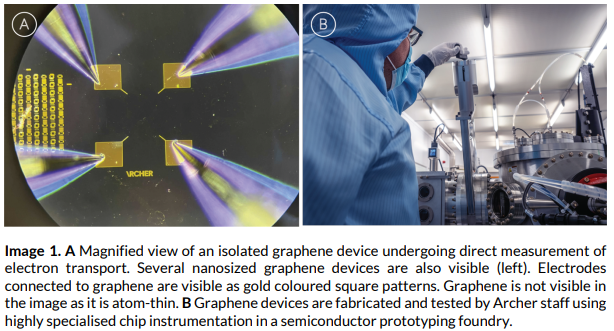
Archer's CEO Dr Mohammad Choucair said: “Prior to this latest work, Archer had achieved the integration of graphene in silicon electronics.
“Archer has now successfully performed complex post-integration lithography and atom-thick materials’ device processing that preserve graphene’s advanced electronic properties.
“The electronic transport measurements performed by the Archer team are the fundamental link with respect to using graphene in transistor technology intended for future biosensing operations in Archer’s biochip devices.”
Technical progress
In January 2022, Archer successfully integrated a single-atom-‘thick’ sheet of graphene with silicon electronics. The ‘thickness’ of graphene is around 0.35 nanometres, with 1 nanometre being a billionth of a metre.
State-of-the-art semiconductor chip fabrication instruments were used to repeatably and reproducibly fabricate integrated graphene patterns and devices.
The latest results represent a significant technical achievement as the advanced, post-integration semiconductor foundry fabrication processes are complex, requiring the precision engineering of atomically thin graphene and devices to confirm the advantageous intrinsic materials’ properties, which are fundamental to the scalability, biosensing functionality, and operation of Archer’s biochip.
Archer's team performed current-voltage traces on the integrated devices, that were repeatedly and reproducibly recorded over various voltage ranges.
Building graphene-based transistors
The outcomes of the electronic transport measurements provide the necessary data and component level validation of the electronic parameters required to build graphene-based transistors integrated with silicon electronics.
Results of the direct electronic measurements performed on graphene pave the way for building graphene-based transistors (the core biosensing elements), which are required for the operation of Archer’s biochip technology.
Archer’s ‘lab-on-a-chip’ technology
The company is developing a biochip that would allow droplets of biological specimens to be analysed and processed using graphene-based sensors.
The biochip requires graphene materials in electronic circuits (the micro-and nanofabrication of graphene-based transistors), that would form miniaturised devices that act as ultrasensitive sensors for detecting and analysing biochemical targets like identifying viruses or bacteria.
Graphene is an advanced material with electronic properties on the nanoscale that make its use for biosensing highly advantageous.
It has unparalleled properties like high electron mobility and chemical stability in biologically relevant liquids that allow it to be used as an electrical conduit for sensing the activity of biological molecules.
The electronic properties of graphene have been well studied scientifically in the field for more than 15 years.
Archer’s biochip design principles include the micro-and nano-fabrication of integrated sensing devices in regions of a chip that work alongside other fabricated functional regions on the same chip to process, detect and analyse biological specimens.
The work done by Archer to perform and confirm electronic transport in silicon-integrated, atom-thin graphene, is an important step in the potential future operation of Archer’s biochip.