
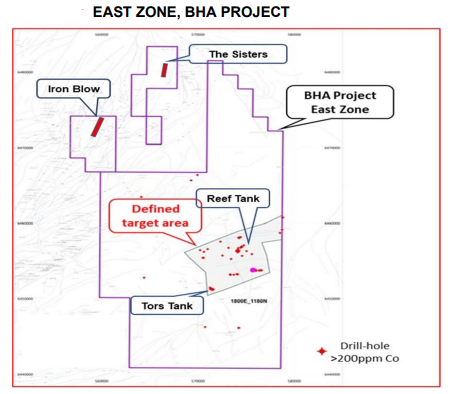
Castillo Copper Ltd (LSE:CCZ, ASX:CCZ)’s ongoing work on the geological model has uncovered new cobalt assay results for 20 shallow drill holes within the defined target area that hosts the Tors & Reef Tank prospects at the Broken Hill Alliance (BHA) Project in New South Wales.
The new results will be codified and then added to the 6,380 drill holes, which are being factored into the geological model.
Holistically, the assays demonstrate a significant cobalt system could be apparent within the defined target area.
Discovering the high-quality incremental data sets further builds a compelling case that there is ample geological data within the area to prove up a primary cobalt JORC 2012-compliant mineral resource estimate (MRE).
Ample data for primary cobalt MRE
Castillo Copper CEO Dr Dennis Jensen said: “Discovering the new assay results is positive news, as it reinforces there is potentially significant cobalt mineralisation apparent within the defined target area.
“More than ever, the board is optimistic there is ample data to model up a primary cobalt mineral resource estimate that complies with the JORC (2012) Code.”
Not in database
These uncovered new cobalt assay results were not in the geological survey of the New South Wales database.
The drilling campaign was undertaken in the mid-to-late 1990s by Normandy Exploration Pty Ltd within the defined target area, which hosts the Tors & Reef Tank prospects.
At the time, Normandy was searching for copper-gold, however, the assay results returned anomalous cobalt, with the best intercepts:
➢ 5 metres at 1,200ppm cobalt from 15 metres; and
➢ 10 metres at 510ppm cobalt from 5 metres including 5 metres at 690ppm from 10 metres.
These and the remaining laboratory results will be codified and factored into the geological model, along with data from 6,380 drill holes that CCZ’s geology team is compiling.
A key highlight is that the Normandy results are consistent with other assays stemming from various drilling campaigns undertaken by different explorer groups over the years.
The best laboratory assay intercepts from other explorers include:
➢ 7 metres at 1,600ppm cobalt from 30 metres;
➢ 15 metres at 760ppm cobalt from 67 metres;
➢ 10 metres at 520ppm cobalt from surface; and
➢ 5 metres at 520ppm cobalt from 45 metres.
Sufficient data
Whilst work on codifying the data and building up the geological model is still underway, the board remains optimistic there is sufficient data covering the defined target area to prove up a primary cobalt JORC 2012 compliant MRE.
Further, the board noted the BHA Project is very accessible when the inaugural drilling campaign commences.
There is excellent mining infrastructure and talented labour pool to draw on in the traditional mining centre of Broken Hill.
Next steps
The next steps for the company include:
In NSW:
➢ JORC 2012 compliant mineral resource estimate for the BHA Project East Zone.
In Queensland:
➢ Assay results for Arya Prospect; and
➢ Big One Deposit – formalising timing for next drilling campaign.
In Zambia:
➢ Complete geophysical report on the Mkushi Project; and
➢ Complete work on the inaugural drilling campaign for the Luanshya Project.