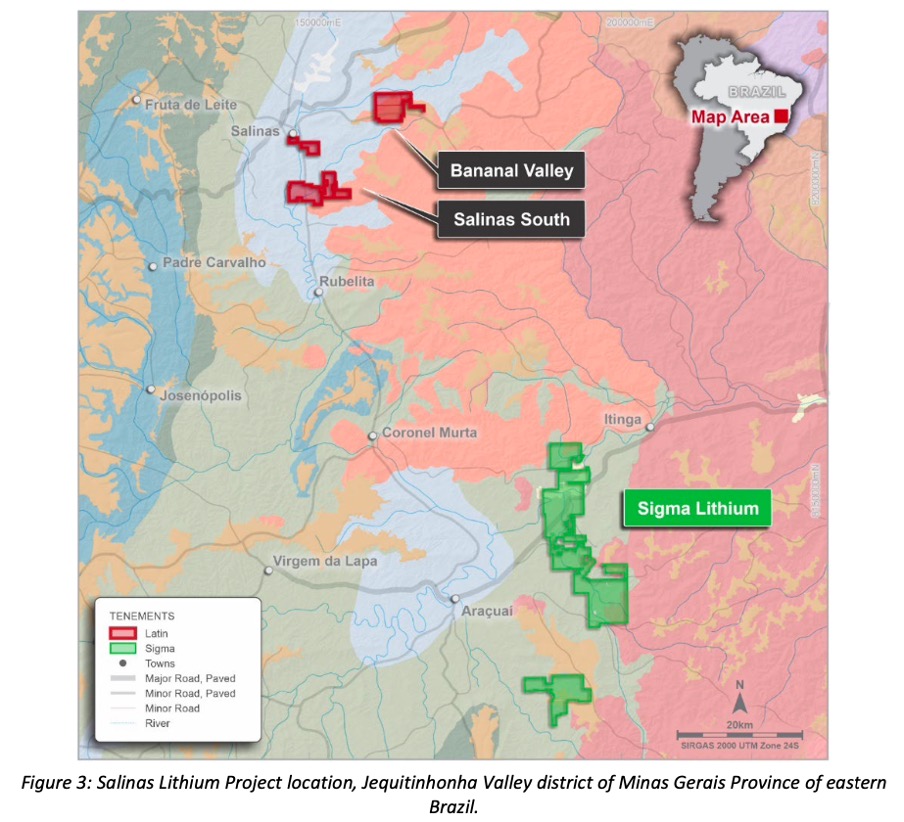
Latin Resources Ltd (ASX:LRS) has confirmed high-grade lithium pegmatites in the first two holes at the Southern Target area of its Salinas Lithium Project in Brazil with shares trading higher.
The explorer fielded “excellent” recoveries in the first assays from its diamond drilling campaign, which continues to ratify what could be a new, high-grade lithium discovery at Salinas.
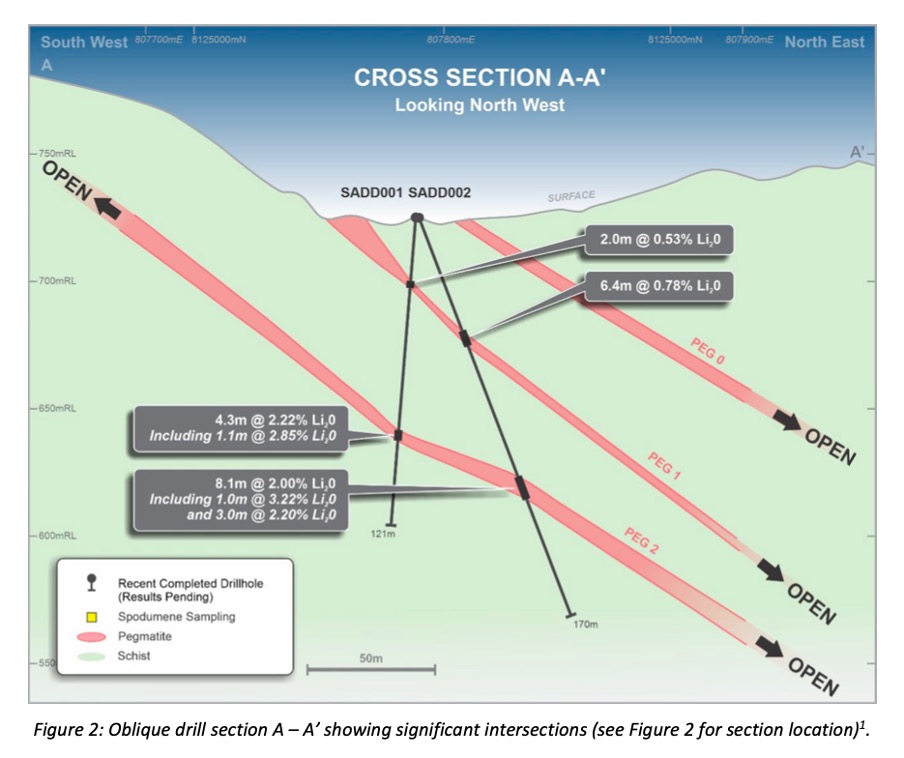
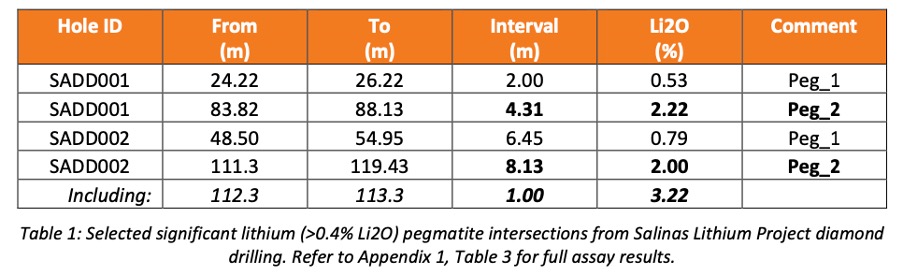
Assays peaked at 3.22% lithium oxide and showcased consistent, down-hole grade profiles in both holes, indicating a strong grade correlation down-dip between the individual pegmatites in each hole.
What’s more, the pegmatites are generally increasing in thickness along strike to the south, where assay results from the company’s next four holes are pending.
Shares higher
Investors responded strongly to the results, driving shares up as much as 38.16% to A$0.105, a new high of more than three years, with almost 315 million shares changing hands during the day.
Latin’s drilling campaign will continue to focus on the Southern Target, where the company intends to soon commence infill and step-out drilling.
Overall, Latin plans to drill 14 diamond holes, spanning 2,000 metres, in its first phase of drilling at the Salinas property.
“Eagerly awaiting further assays”
Speaking to the fresh assays, Latin Resources managing director Chris Gale said results from the first two holes were “extremely pleasing”.
“These results continue to give us confidence that we may be onto a potentially major new lithium discovery in one of the best mining jurisdictions in the world.
“Lithium grades over 2% are not common, with most operations in Australia running between 1% to 1.5% lithium.
“Our pegmatite Peg_2 is running grades of around 2% lithium, with a peak of more than 3% over one metre, which is very high.
“The team on the ground will now focus the drilling on these much thicker pegmatites to the south to infill our existing sections and extend our drill coverage to the southwest where the pegmatites remain open.
“These assay results are only for the first two holes, we have another four holes that had thicker intersections with abundant spodumene as well.
“We are eagerly awaiting further assay results for these holes, which we expect to come through over the next few weeks.”
The results are in
Some of the best results from Salinas to date include:
- 4.31 metres at 2.22% lithium oxide, from 83.82 metres, including 1.13 metres at 2.85% from 87 metres;
- 8.13 metres at 2.00% from 111.3 metres, including 1-metre at 3.22% from 112.3 metres; and
- 3 metres at 2.20% from 115.3 metres.
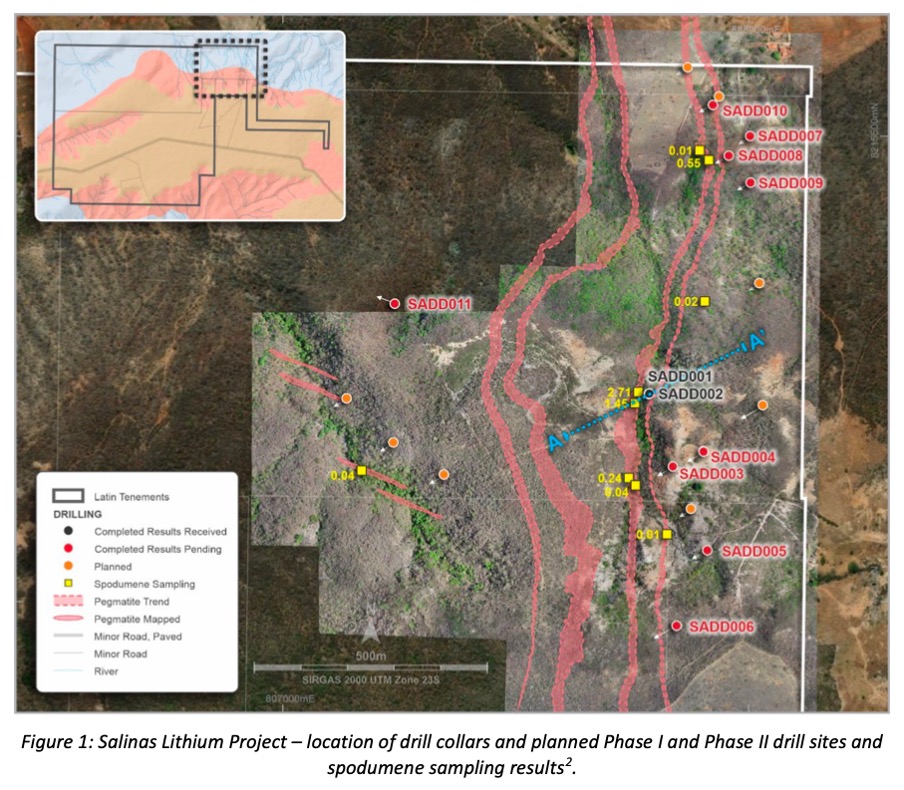
Importantly, logging of all holes drilled to date indicates the consistent development of the separate pegmatites across a 500-metre strike length, which remains open along strike.
So far, Latin has drilled six phase one priority drill holes across the Southern Target area, all of which intersected a series of stacked, spodumene-rich pegmatites.
Logging confirms the individual pegmatites range in true thickness to a maximum of 21.1 metres, with a clear trend to increase in thickness to the south.
Simultaneously, drilling holes in the Northern Target area has confirmed that the intersected pegmatites are narrower in this direction, suggesting the system may be closing out to the northeast.
All logging and sampling has been completed from these holes, with assay results pending.
Taking these findings into account, Latin has returned its drilling focus to the south, where it intends to continue unlocking the project’s potential with infill and step-out drilling.
The explorer will keep the market updated on further developments in this iconic lithium province.