
Alligator Energy Ltd (ASX:AGE) is trading higher today, encouraged by strong results returned from resource infill drilling, a down-hole prompt fission neutron (PFN) logging program and further sonic core assays.
A rotary mud (infill) drilling program in the high-grade area of Blackbush deposit at the Samphire Uranium Project in South Australia has concluded ahead of schedule with all holes successfully logged with PFN, three-arm caliper, resistivity, neutron porosity and natural gamma.
Investors have responded positively, driving shares as much as 14.6% higher to $0.11, approaching the 12-month high of $0.115.
Expansion of a known high-grade area
Alligator Energy CEO Greg Hall said: “These exceptional PFN and further assay results are expanding the known high-grade area within the Blackbush deposit.
“The visual inspection of core, combined with the downhole geophysical data from PFN holes, is showing that Blackbush mineralisation is hosted in lithologies with permeability amenable to ISR, and with an apparent consistency of mineralisation that Alligator believes bodes well for our planned resource confidence update and scoping study.”
Some of the pU3O8 1 grades and grade thicknesses (GTs) intersected include:
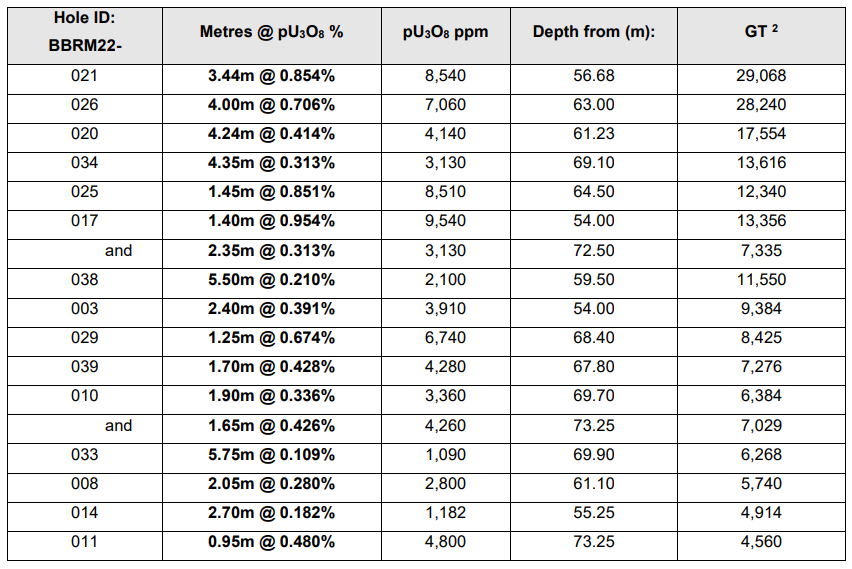
These results include significant uranium intersections from PFN logging of the rotary mud drilling program, selected within a 250-parts-per-million (ppm) cut-off, and a GT above 4,000.
The company estimates a minimum GT 2,000 would be targeted for future project studies, but it will review this cut off as part of a planned scoping study to be delivered late in the second quarter or early in the third quarter, and the minimum may be lowered due to the shallow nature of the deposit.
The company is also pleased with results from three sonic cored holes with U3O8 and GT highlights including:

The company awaits further results for the remaining 10 holes.
Alligator has logged PFN data for uranium grade (pU3O8) in sonic cored holes and is conducting comparisons with assays as results come in.
So far PFN data for all core holes correlate well with assays with exception of BBS21-003 which is currently under review.
Quality assurance and control
The quality assurance and control (QAQC) of the PFN data has been overseen by internal and external independent expertise to ensure accurate conversion of the direct downhole readings (epithermal and thermal neutron counts) to pU3O8 grades.
“I thank our COO and team for their ongoing rapid advance of drilling, and the very diligent QAQC work to ensure the calibration and PFN calculations for grade conversion are accurate and of the right quality for upcoming resource re-estimation work,” Hall said.
“These results combined with the ongoing correlations with historical information are aimed to achieve our objective of increasing confidence levels in our Blackbush JORC resource.”
An estimated 88% of completed rotary mud holes provided pU3O8 results greater than the cut-off grade of 250ppm.
The rotary mud drilling and PFN results in particular have highlighted the presence of a consistent north-south high-grade zone trending to the west where historical drilling is relatively sparse.
Work is continuing to correlate these results with historical drilling, both PFN and gamma, and Alligator will release these comparative results when completed.
The overall aim remains to elicit increased confidence in the re-estimation of a JORC compliant resource at Blackbush.
Predictability and reduced wellfield installation costs
Initial observations from the sonic core and the rotary-mud programs show that Blackbush mineralisation is hosted within lithologies with permeability amenable to ISR, and potentially economic grades of mineralisation that are laterally consistent with some predictability in orientation.
The depth of these sands is consistently from 55 to 80 metres below surface, a very shallow depth for potential in-situ recovery (ISR) extraction, which AGE believes could result in relatively lower wellfield installation costs.
The company has observed up to three horizons of mineralisation, depending on the location within the Samphire channel.
Detailed interpretation and well-log correlations of the downhole wireline geophysics between rotary mud, sonic core and historical drilling results are now underway to map the mineralisation and permeable host rocks in detail.