
Natural Resources
28 March 2022
Comment
Minerals Exploration Technology – undoubtedly useful but not the silver bullet
RFC Ambrian are firm believers in the positive impact that truly disruptive technology will have on the mining, heavy industrial and energy sectors. As many of you will know we have been working with Australia’s national science agency, CSIRO, to develop and commercialise technologies that have meaningful impacts on operational efficiencies and contribute to reducing the environmental footprint of these industries. (See www.chrysos.com.au and www.nextore.com.au)
During 2019 we published a series of six papers which attempted to look at what new technology is available to the industry, what is being developed and the aspirations of the Mine of the Future (Available on our website for those who would like a refresher).
We concluded then that the mining industry is only at the early stages of digital transformation and we expected to see continued new developments towards the goal of a digital mine. In some areas these will be step changes that change the business model, such as we are seeing in vehicle autonomy, pre-concentration, assaying, and the use of drones, while in other areas they will more likely be incremental developments, such as we are seeing in mineral processing and exploration.
The mining industry is famous for its slow adoption and implementation of technology. It is a truism but perhaps sometimes a harsh judgement given the level of implicit uncertainties and cyclical nature of the sector. Nevertheless, the imperative to deliver on climate change goals both for itself and its capacity to deliver the growth in output of the minerals that will be required to achieve those goals means the industry is taking on board new innovative technology solutions at an increasing rate.
One area of the industry which is garnering a lot of interest recently is that of big data-driven exploration technology. It is well understood that the industry will need to become much more efficient not only in terms of how existing and developing mines are operated, but also how the ore deposits of the future are found and brought into production. Minerals exploration technology is, it’s fair to say, an area where incremental advances rather than step changes are the norm. For example, modern drilling rigs, while vastly more efficient and safer now than they were even 30 years ago, still operate in essentially the same way they always have.
Recently, there has been a significant amount of investor interest in technology companies proffering a technological edge in minerals exploration – the proposition being that Artificial Intelligence and Machine Learning IP will give them an advantage in identifying prospective ground and thus a faster and more likely route to discovery
Most mines that exist today have been found where mineralised rocks have been exposed at or near to the surface. Declining discovery rates over the last decade suggest the low hanging fruit has already been picked. Exploring for ore deposits under significant cover, “blind deposits” is the next frontier in minerals exploration. Undoubtedly many significant ore deposits lie in areas which have been overlooked in the past, or which have simply not had the depth of drilling necessary to discover and delineate them.
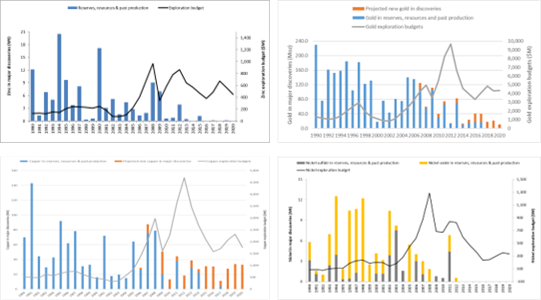
Exploration budgets and discovery rates for various commodities (Source: S&P Global)
Given the lack of meaningful discoveries in recent years and concerns over lack of quality projects in the exploration and development pipeline, it would appear that exploration efforts could do with a helping hand.
Big data surely has a role to play here…but it is only one small part of the equation. Investors need to truly understand how deposits are discovered.
Decades of minerals exploration has produced vast quantities of written, digital and physical exploration data in the form of exploration reports, core photos, core samples and so on. However, by the nature of the genesis of the global exploration industry, and with the data being in the hands of private individuals, companies, governments, national agencies etc, it is very fragmented.
Intuitively aggregating that data and utilising historical exploration and discovery information of known deposits must help to better understand surface expressions of deeper deposits and ultimately reveal insights that are helpful to pinpointing the best places to search.
However, data is only one part of the equation. Minerals exploration, in contrast to almost all other end-uses of big data in the modern world, fundamentally and inescapably relies on the physical implementation of programs, on the ground, in often remote and inhospitable parts of the world.
It is, as of yet, unclear to us how these technology companies, utilising an AI driven approach to minerals exploration, absent owning mineral rights to large tracts of land, and absent a willingness to do the dirty work of actually putting boots and drills on the ground, are going to create real value for their investors or are going to discover the critical metals vital to our future.
Neither is it clear whether there is any exclusivity over the technology that any one particular group has, and therefore whether it confers any long-term competitive advantage. Nothing wrong with a better tape measure, but while a better tape measure will no doubt save you time and therefore probably some money in the long run, everyone is likely to get one and it does not necessarily improve your chances of building a better house.
To paraphrase an old exploration truism – “all of the IQ in the world will get you close, but only NQ will get you to the finish line”.
The pointy end of a minerals exploration program is a team of sweaty, swarthy drillers, a lumbering, noisy, dusty, dangerous drill rig and the fine art of intersecting a favourable ore horizon hundreds of meters below the ground with a drill rod the width of a pringles can.
Without the “truth machine”, nothing will be discovered. All of the data and machine learning on earth cannot get around that.
It’s great to see substantial investment being poured into big data and AI-driven exploration technologies. Ultimately however, to call it a successful deployment of technology, we shouldn’t forget that someone still needs to feed and pay those drilling crews, keep the drilling mud stocked up and the drill rigs fuelled.
Charlie Cryer
Head RFC Ambrian London
+44 (0)20 3440 6834
charlie.cryer@rfcambrian.com
This document has been approved under section 21(1) of the FMSA 2000 by RFC Ambrian Limited ("RFC Ambrian") for communication only to eligible counterparties and professional clients as those terms are defined by the rules of Financial Conduct Authority. Its contents are not directed at retail clients as RFC Ambrian does not provide investment advisory services to retail clients.
RFC Ambrian publishes this document as non-independent research which is a marketing communication under the Conduct of Business rules. It has not been prepared in accordance with the regulatory rules relating to independent research, nor is it subject to the prohibition on dealing ahead of the dissemination of investment research. It does not constitute a personal recommendation and does not constitute an offer or a solicitation to buy or sell any security. Neither RFC Ambrian nor any of its directors, officers, employees or agents shall have any liability, howsoever arising, for any error or incompleteness of fact or opinion in it or lack of care in its preparation or publication; provided that this shall not exclude liability to the extent that this is impermissible under the law relating to financial services. All statements and opinions are made as of the date on the face of this document and are not held out as applicable thereafter. This document is intended for distribution only in those jurisdictions where RFC Ambrian is permitted to distribute its research. In particular, it is not intended for distribution in and is not directed as persons in the United States.
On the date of this document, RFC Ambrian, RFC Ambrian's holding company, persons connected with it and their respective directors may have a long or short position in any of the investments mentioned in this document. RFC Ambrian is a member of the London Stock Exchange and is regulated and authorised by the Financial Conduct Authority. RFC Ambrian is registered in England and Wales no. 4236075. Its registered office is at Octagon Point, 5 Cheapside, London EC2V 6AA.
NOTICE: The information in this e-mail message is confidential and may also be privileged. It is only intended for the above-named addressee/s. If you are not a named addressee, you must not disclose, copy or take any action in reliance on this e-mail and should delete it from your system. If you have received this e-mail in error, please contact the sender by return e-mail or by telephone +44 (0)20 3440 6800. We believe, but do not warrant that this e-mail and any attachments are virus free. You should take full responsibility for virus checking.