
The main points of Rishi Sunak's spring mini-Budget were a 5p cut to fuel duty, a 1p cut (in 2024) to the basic rate of income tax, and reduced the VAT on spending for energy-saving home improvements.
Overall the measures were seen as having a small effect on the impact of the surging costs of living for households, and very little for those at the poorest end of the scale.
Sunak's Spring Statement "had less of the feel of a Chancellor responding to crises, and more of one delivering a vision", says Chris Sanger, EY's head of tax policy.
“The question now will be whether the UK economy allows the Chancellor to stick to his course, or whether crises will continue to beset his plans.”
Laura Suter, head of personal finance at AJ Bell, commented that Sunak's big rabbit out the hat of a cut to income tax rates from 2024, offers "precisely zero help to families struggling with the cost-of-living crisis now – or indeed for the next two years".
She says: “The announcement today, which clearly could have waited until the full Budget later this year, appears to be the Chancellor’s way of coming through on his promise to deliver a low-tax nation without actually handing the tax cut to the nation now.
"Opposition MPs and his own peers had called on him to do more to help families who are facing rising bills now, but on the basis that those bills can’t be paid with an IOU for two years’ time, many will think he’s fallen short of this task.”
Even for staunch Conservatives, the claims from Sunak that he is lowering the UK tax burden rang hollow, as he unveiled a conservative fiscal plan that will raise the UK tax burden to its highest level since 1949.
Economist Kallum Pickering said the palliative measures were "modest" and "barely offset" sizeable windfall from the OBR's borrowing revisions that tax revenues will increase as a percentage of GDP to 36.2% by 2025 from 33.0% in 2019, with the tax burden only going up now so it can probably come down in the time for the May 2024 polls.
2.25pm: Holding back
Sunak "could have been bolder in the near-term", says economist Samuel Tombs at Pantheon Macroeconomics.
Despite the 1p planned 2024 basic rate tax cut, Sunak has "substantial fiscal headroom", says Tombs, with his main fiscal mandate met with a £27.8bn margin for error and his main supplementary target met with £31.6bn to spare.
This exceeds the headroom that the OBR forecast in October's Budget.
"The Chancellor, therefore, might be able to cut taxes still further in the run-up to the next election, though he understandably was unwilling to commit at this stage, with the war in Ukraine adding to economic uncertainty," Tombs says.
Despite the pledged tax cuts, Ima Sammani, analyst at Monex Europe, noted that the measures announced today "are minimal and suggest that the government is reserving firepower for use ahead of the election in 2024".
"The more prudent spending measures announced today saw the debt management office (DMO) announce a remit to issue £124.7bn in Gilts in the fiscal year 2022/23.
"This sits at the very bottom of the range that analysts have forecasted and largely explains the rise in Gilt prices, which due to the inverse relationship is weighing on yields.
"As things stand, we don’t expect fiscal policy to be supportive of the pound. Instead, GBP bulls will have to rely on the UK consumer to prop up expectations of BoE policy tightening, in terms of both supporting UK economic activity and also raising inflation expectations, at a time when the OBR expects households’ real disposable incomes to drop by 2% in 2022-23."
2.15pm: No oil windall tax
One of Sunak's omissions was for a windfall tax on North Sea oil and gas companies to help raise money to further support families with mounting energy bills, which had overwhelming support in a new poll for the Independent.
"Sunak says he can’t tax them or they won’t invest in the UK. Really?" wonders Richard Smith, partner at Sandstone law.
"Meanwhile the PM’s special advisers are polishing the words for his new energy strategy statement, due imminently, which will include renewed drilling for fossil fuels in the North Sea and more nuclear power stations.
"Are we in 1985? Luckily, it will also include the encouragement of more offshore wind projects but even today the Cabinet is arguing about whether to relax planning rules on new onshore wind farms, because some Conservative voters don’t like the ‘look’ of them."
He adds "The government’s commitment to backing its COP26 climate change promises through legislative and economic measures seems to be waning already.”
2.09pm: Giveth and taketh
Sunak's statement was characterised by how he gave with one hand and took away with the other, for example raising the NI threshold then announcing a planned 1p cut to the basic rate of income tax.
The OBR said that over, the net tax cuts announced in this statement "offset around a sixth of the net tax rises introduced by this Chancellor since he took over the role" back in February 2020.
How much will the #SpringStatement cushion the blow from higher inflation?
Energy rebates, fuel duty cut and lower NICs offset around half the rise in energy bills and around a third of the fall in living standards households would have faced. pic.twitter.com/y24tg8VQTE
— Office for Budget Responsibility (@OBR_UK) March 23, 2022
The OBR said it will take two years for real living standards to regain pre-pandemic levels.
Even though inflation was already running high before the invasion of Ukraine, public finances were emerging from the pandemic in better shape than expected the OBR says.
"Russia’s invasion of Ukraine will push inflation to a 40-year high of almost 9%, and living standards are set for a historic fall over the next 12 months."
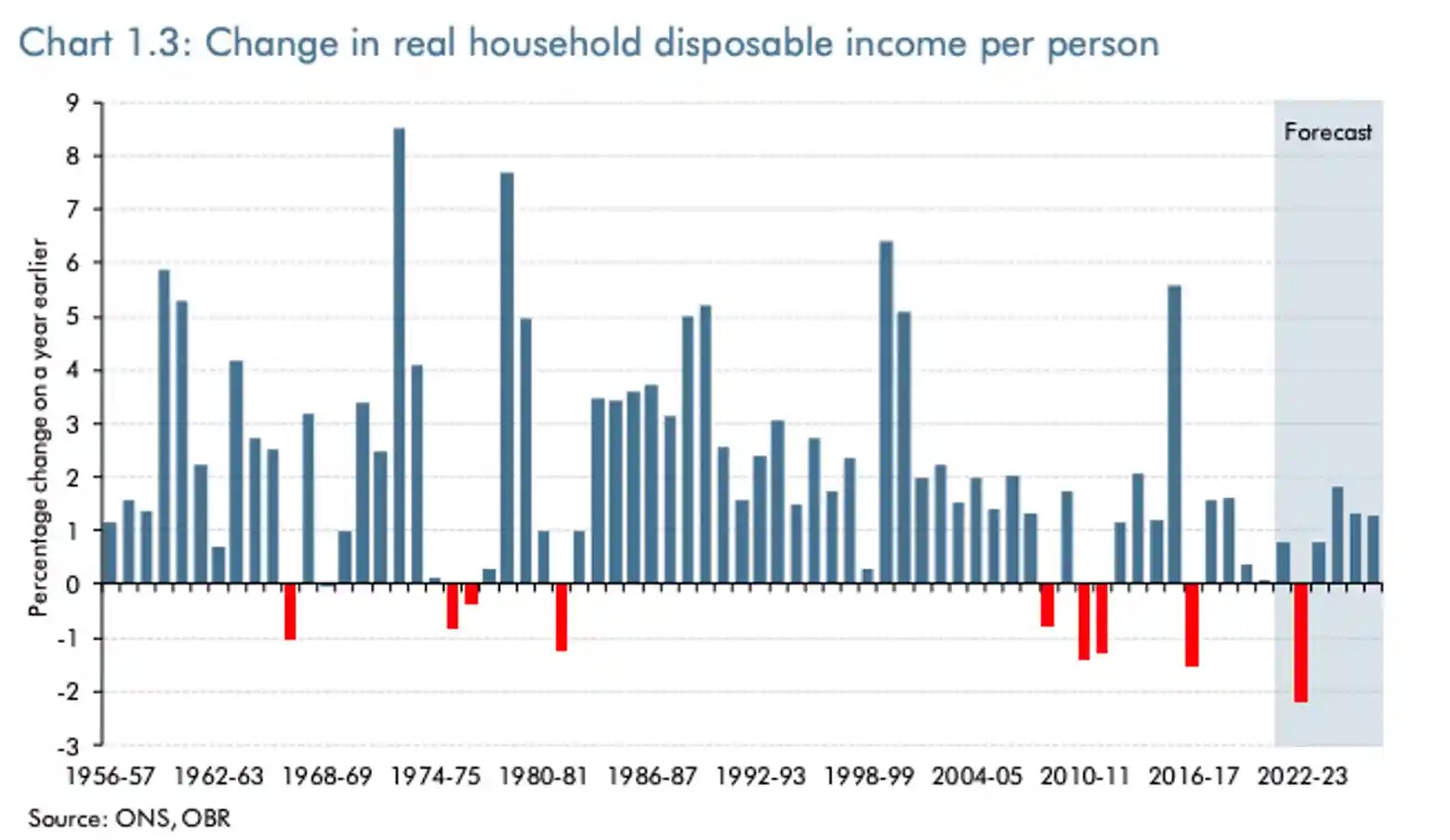
This higher inflation will erode real incomes and consumption, with the OBR cutting its forecast for the UK's GDP growth this year down to 3.8%, from its 6% estimate made in the autumn.
“With inflation outpacing growth in nominal earnings and net taxes due to rise in April, real livings standards are set to fall by 2.2% in 2022-23 – their largest financial year fall on record – and not recover their pre-pandemic level until 2024-25."
I really can’t believe this package does next to nothing for those getting hardest hit by rising prices - those who are disabled and not working just got told they are on their own (after losing £1000 income in the Autumn)
— Torsten Bell (@TorstenBell) March 23, 2022
1.41pm: Is that it?
Sunak's announcements directed at helping households hit by the surging cost of living were greeted in the House of Commons to calls from the gallery of “is that it?”.
Indeed the raising of the threshold for NI contributions will save lower income earners up to £330 per year, which is significantly less than the £1,300 that the average energy bill is expected to rise by this year, but, says Jason Mountford, financial planning expert at Irwin Mitchell, "it is at least a measure that is aimed towards the lowest income earners in the UK".
There was no extra assistance for households dealing the rapidly increasing cost of energy, just the removal of VAT for energy-efficient additions made by homeowners, such as solar panels and heat pumps.
"Sunak announced that this would save homeowners £1,000 on average, however given that the average cost to install home solar panels is £4,800, it is another measure that is unlikely to impact the hardest hit by the energy crisis," Mountford points out.
"The broad takeaway for individuals is that these measures may take the edge off the financial pain of the cost of living squeeze, but it will be a long way off removing the pain entirely. Most households will notice little difference to their monthly outgoings as a result of the measure released today."
Myron Jobson, personal finance analyst at Interactive Investor, agreed that shouts of ‘of is that it’ are "likely to be the overarching sentiment shared by those struggling to stay financial afloat amid the cost-of-living squeeze".
The removal of VAT on solar panels "does nothing to help alleviate the crushing cost of living pressures the nation’s most vulnerable individuals", Jobson says, adding that the policy "completed ignores the plight of the almost 40% of UK households living in rented accommodation and feeling the full brunt of the hikes to energy bills".
While the extra £1bn of support for low-income households via the Household Support Fund will provide some respite, he concluded: “The bottom line for consumers is strap in for a heightened inflation that is expected to last until 2024 according to official estimates. The cost-of-living crisis is set to get worse before it gets better,” he said.
1.33pm: Cost of living will only get worse
Shona Lowe, financial planning expert at Abrdn, said Sunak's measures may "alleviate some" of the financial strain households and small businesses are facing, "but the cost of living crisis is likely to get worse in the months to come so we will have to wait and see".
More supportive is Les Cameron, saving expert at M&G Wealth, says: “The National Insurance hike was widely criticised as it would have a disproportionate effect on lower earners. The Chancellor has more than made up for the hike in rates with the increased threshold - seeing most low and middle earners having an effective tax cut - meaning more money for those struggling with the cost of living crisis.”
The March 2022 forecast at a glance #SpringStatement pic.twitter.com/tQKbAz2Qx4
— Office for Budget Responsibility (@OBR_UK) March 23, 2022
1.28pm: "Better than a poke in the eye"
The reaction to Sunak's statement is starting to flood in.
“The Chancellor’s announcements today go some way to addressing the very real challenges being faced in households across the UK but are unlikely to go far enough," says Nathan Wallis, at specialist financial services mutual Wesleyan.
"Some of our customers are lying awake at night, worried about the impacts of the cost-of-living crisis and today’s announcement may ease the burden but won’t make it go away.”
On the 5p fuel duty cut, Sarah Coles, senior personal finance analyst at Hargreaves Lansdown, says this is "better than a poke in the eye with a sharp stick, but it’s hardly going to be lifechanging for hard-pressed motorists.
"Currently fuel duty costs around 58p a litre, and VAT almost 28p per litre. On a 55-litre tank, £47.30 is tax. The cut would mean this drops by just £2.75," she notes.
"With the cost of unleaded petrol now almost £1.67 a litre on average it’s still going to mean we need to make some horribly difficult decisions about how and where we travel in future. It’s also going to continue inflating the cost of transporting anything to stores, which will gradually feed into the price of everything on the shelves. Life is going to keep getting more expensive, and this cut isn’t going to change that.”
Also, Ian Plummer, director at Auto Trader, says a recent survey showed four in ten drivers planning to drive less in response to rising prices and “drivers may struggle to register the Chancellor’s giveaway".
1.21pm: No windfall tax on oilers
Shadow chancellor Rachel Reeves points out that Sunak could have imposed a windfall on oil and gas producers, “but he didn’t”, that he could have properly revoked his 1.25 percentage points National Insurance hike, “but he didn’t”.
With inflation at its highest level for 30 years, with “people are worried sick – for all his words it is clear that the chancellor does not understand the scale of the challenge”.
“But his choices are making the cost of living crisis worse not better,” she says, which she says pre-dates the Ukraine invasion, with inflation already back at the time of the Budget forecast to be double the Bank of England’s 2% target.
“Pensioners and those on social security will see a real cut in their incomes,” Reeves notes.
She noted that BP described the crisis as a “cash machine”, with Labour estimating a windfall tax would raise over £3bn.
The Conservatives have become the party of high taxation because they are the party of low growth. He is Ted Heath with an Instagram account says @RachelReevesMP
— PARLY (@PARLYapp) March 23, 2022
1.15pm: Political statement
The big picture on the spring statement, says Torsten Bell, chief executive of the Resolution Foundation, is that the Chancellor was given a "fiscal windfall" from higher tax takings that allowed lower borrowing, and he spends it "burnishing hit credentials as a tax cutter NOT on prioritising help for low and middle income households".
1.12pm: Basic rate of income tax cut in 2024
The second part of his tax plan sets out tax cuts for business, with final measures to be confirmed in the autumn Budget after consultation with industry.
Sunak promised a full review of the tax system in his main Budget, including reforming more than 1000 tax reliefs and allowances in the system, notably R&D allowances and changes to capital allowances to try and encourage businesses to invest more.
Then, Sunak looking very pleased with himself, whips out another giveaway - though it will not come until 2024 (just a month before the general election, wouldn't you know).
Based on the expectation that inflation will be back under control later this year, he say the basic rate of income tax will be cut from 20p in the pound to 19p in the pound, costing £5bn.
1pm: Tax plan, NI threshold
Here is the second document that had been rumoured earlier, Rishi Sunak announces his 'tax plan', setting out the principles for cutting taxes over the rest of this Parliament.
The plan has three principles: committing to addressing cost of living, putting in place conditions for higher growth and sharing proceeds fairly.
Then his big rabbit out of the hat: the threshold for National Insurance is brought into line with that for income tax.
He says this is going to increase it by the full £3,000 all in one go, from July.
“People will be able to earn £12,570 without paying a single penny of income tax or NI.”
This is worth £6bn personal tax cut and “the largest increase in a basic rate threshold ever,” Sunak says.
12.52pm: Three new policies
Three immediate measures: a 5p per litre cut on fuel duty, in place from 6pm this evening and until next March. This will cost £5bn.
The Treasury will also abolish 5% VAT on insulation, solar panels, heat pumps and other home energy efficiency measures.
Sunak also announced a £500mln increase in Household Support Fund for families struggling hardest.
If that's all he's doing on energy - it is limited and won't impact the majority of households who will see a likely £1,300 average increase in year-on-year bills by October.
My head has sunk. I just hope there's a rabbit to come out of the hat. #SpringStatement2022
— Martin Lewis (@MartinSLewis) March 23, 2022
12.49pm: Impact of Ukraine invasion
He says the invasion of Ukraine presents a risk to our economy, with the OBR having said "there is unusually high uncertainty around the outlook".
The OBR now forecast growth this year of 3.8%.
The UK economy is then forecast to grow by 1.8% in 2023, and 2.1%, 1.8% and 1.7% in the following three years.
The OBR now expects inflation to rise to an average of 7.4% this year.
12.46pm: Words on Ukraine
The chancellor begins with some words on Ukraine, saying what underpins our relative security compared to those facing Russia’s invasion “is our economy”.
He says strengthening our economy at home is a response to the uncertainty sown by Russia.
“Today’s statement builds a stronger more security economy for the UK.”
“We have a moral responsibility to use our economic support Ukraine and working with interantiaojnl partners to impose severver costs on Putin’s regime,” he says, going on to mention defence and humanitarian aid, financial guarantees, the new Homes for Ukraine scheme, and sanctions on Russian businesses and central bank.
12.43: About to start
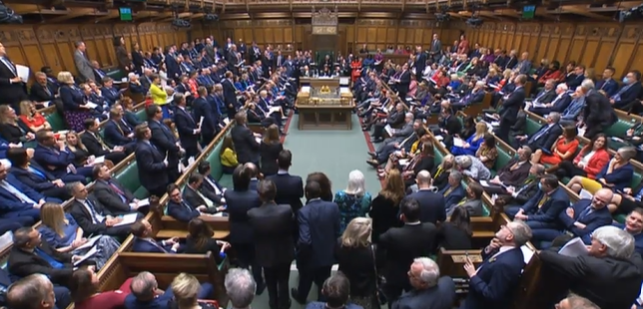
PMQs is running a little long today but the Speaker has got everyone ready for the chancellor's speech and Sunak's palms are sweatily shuffling his papers.
12.20pm: Westminster whispers
Rishi Sunak is currently alternating between nodding his head as he sits behind Boris Johnson during PMQs.
There are rumours circulating that the chancellor will unveil a separate "economic plan or strategy" alongside his Spring Statement, according to Westminster journalists.
Look carefully, Sunak is holding 2 documents - whispers he'll unveil a separate economic plan or strategy alongside the statement... https://t.co/LLfMATzTEr via @BBCNews
— Laura Kuenssberg (@bbclaurak) March 23, 2022
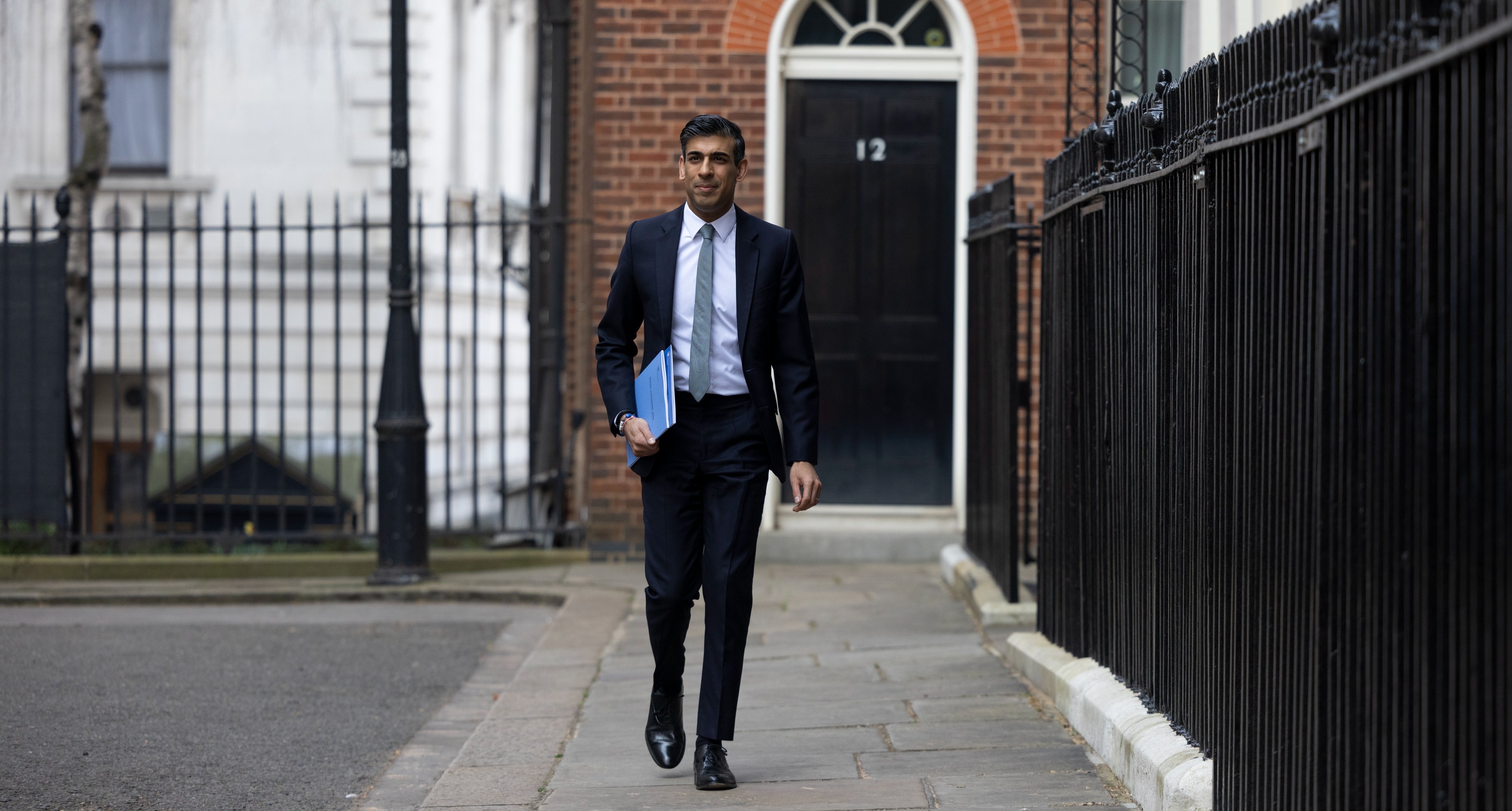
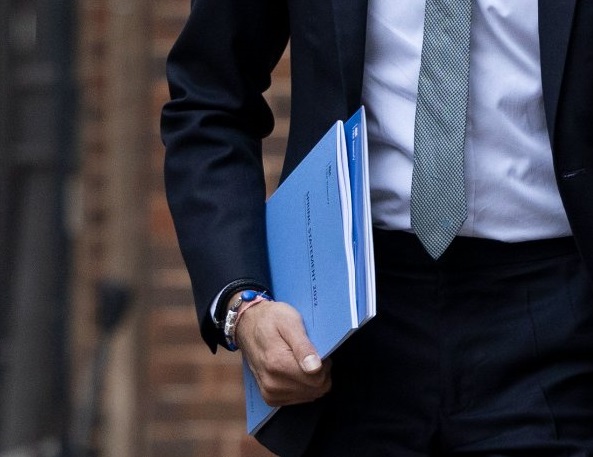
One of these could simply be the OBR forecasts, however.
If he is carrying an extra surprise, this could change how long the chancellor does stand at the Commons despatch box, with bets as usual being placed on how long his speech will last.
A speech of between 40 and 45 minutes is being offered at 6/1 by bookmaker Star Sports, making it shorter than the current record of 45 minutes set in 1867 - thought that was a full Budget statement (see below).
William Kedjanyi, political betting analyst at Star Sports, said: “It’s going to be a tough speech for the Chancellor to make today and we think that he may want to get it over with as quickly as possible and make the 40:00 – 44:59 minutes length the 6/1 favourite."
11.11am: Inflation pressure piling
Ahead of the Spring Statement speech in the House of Commons later Rishi Sunak had a few extra notes to scribble down as the latest inflation data showed inflation hit 6.2% last month, the fastest pace in 30 years.
With prices for the likes of petrol, energy bills, food and clothing all rising ahead of wages, the chancellor of the exchequer may be forced to bypass his urge to keep all the Treasury's powder dry until the autumn or before the next general election.
READ: Inflation rises to 30-year high of 6.2%
"Chancellor Rishi Sunak is unlikely to make many new spending proposals, if any," says Marshall Gittler at BDSwiss. "He may just tinker with existing budgets to make a few changes in four key areas: energy independence, defense, leveling-up, and the cost of living crisis (thanks to inflation)."
But with the extra £23bn to play with thanks to better tax receipts that have required lower borrowing, as mentioned below, reports suggest he could follow other European countries by cutting fuel duty to cushion the blow from soaring energy prices, and may also raise the thresholds on income tax or national insurance contributions.
10.45am: Today's timings
Before chancellor Rishi Sunak's Spring Statement, the House of Commons will convene to bursting for Prime Minister's Questions.
This means the MP for Richmond will be expecting to stand up at around 12:30.
Spring used to be the time for the official government's annual Budget, but former chancellor Philip Hammond switched it around in 2016, moving the Budget to the autumn.
But as the law still requires the Office for Budget Responsibility (OBR) to produce two forecasts for borrowing and growth every year, the Spring Statement has remained.
As Sunak will probably remind MPs, the statement is not designed to include any changes in tax or spending, and is normally just used to update on how Budget policies are going, though during the pandemic Sunak used opportunity to introduce new spending pledges and extend existing support measures, turning it into a mini-Budget.
This has given hope that he will announce measures to help households cope with what's being called the current cost of living crisis, with the Treasury Committee earlier today publishing report on how the "invasion of Ukraine will have a significant economic impact on the cost of living in the UK".
He certainly has enough spare powder to provide some significant help, as yesterday's government borrowing figures showed.
Our latest forecasts for the economy and public finances will be published later this afternoon after the Chancellor’s #SpringStatement speech ????
Follow us later for charts and highlights ???? pic.twitter.com/4KclmRVa0d
— Office for Budget Responsibility (@OBR_UK) March 23, 2022