
The rush to safe-haven investments due to ongoing market volatility triggered by the Russia-Ukraine crisis is expected to push gold prices higher.
Gold prices are also likely to react to the tightening of monetary policy by central banks as they try to control surging inflation.
In this article:
Gold as a hedge against inflation
Safe-haven appeal
Gold prices and interest rates
Demand and supply
Outlook
Gold as a hedge against inflation
Inflation in the US grew worse in February with the escalating crisis in Ukraine leading to price pressures becoming more entrenched.
The consumer price index (CPI), which measures a wide-ranging basket of goods and services, accelerated 7.9% over the last year, hitting a fresh 40-year high.
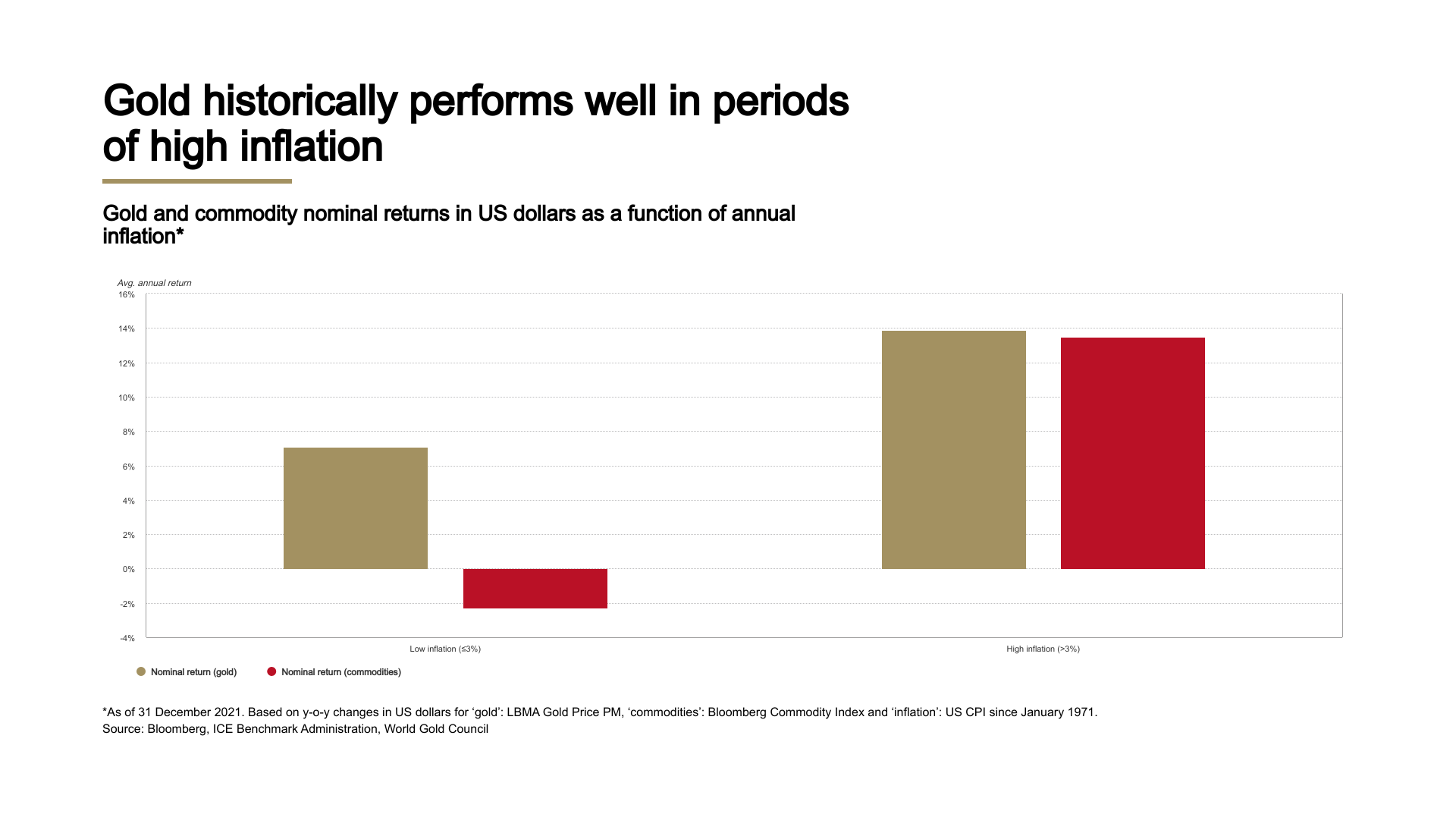
Gold is often used by investors as a hedge against inflation and has historically performed well amid high inflation.
In years when inflation was higher than 3%, gold’s price increased 14% on average.
In the long run, gold has outpaced US inflation and moved closer in pace to the money supply, which has increased significantly in recent years.
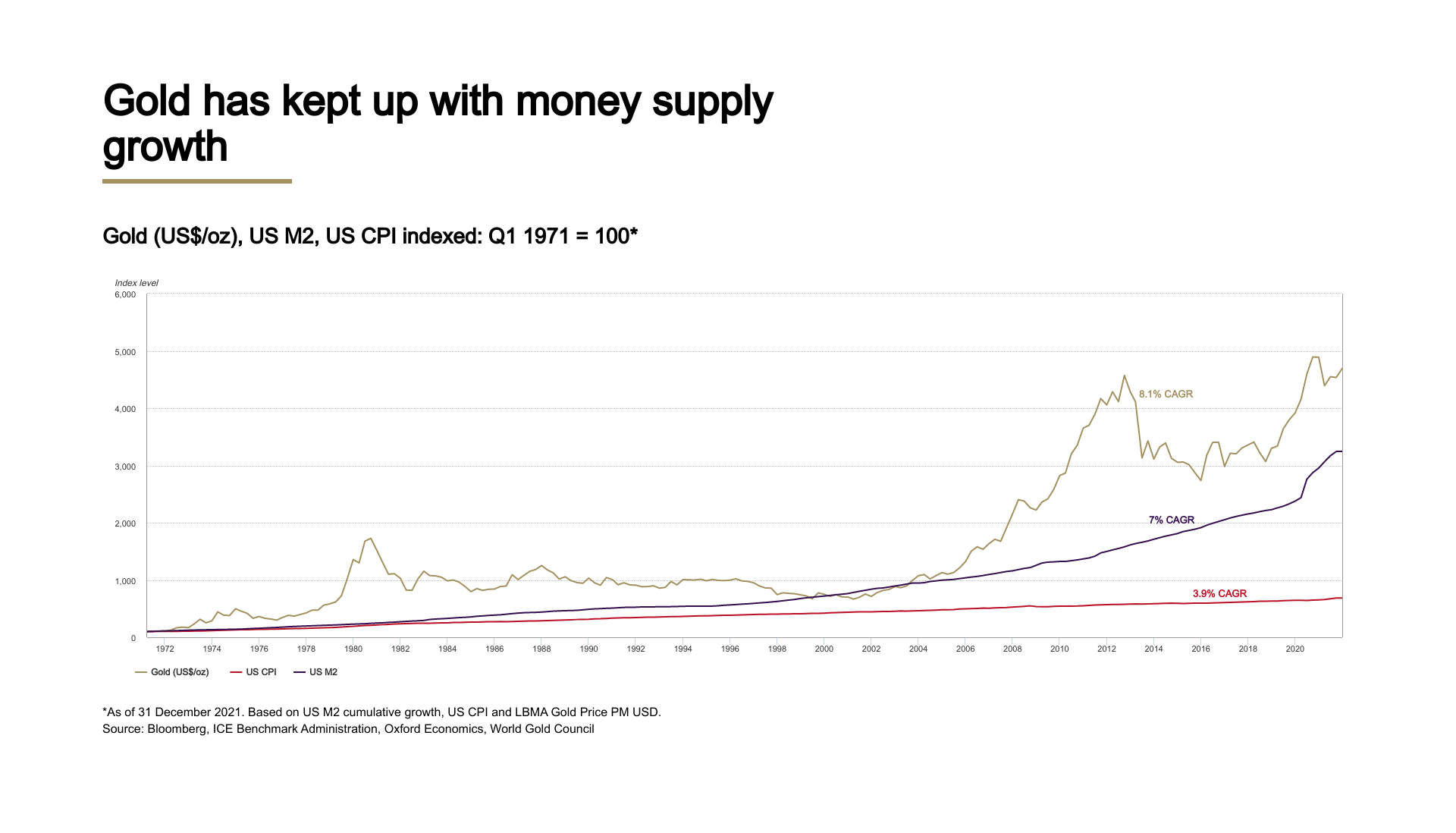
Gold’s ability to protect against inflation suggests that its long-term real returns should be positive – something current long-term portfolios may struggle to achieve.
Safe-haven appeal
Gold prices are expected to rise this year as investors seek a safe haven amid market volatilities worsened by Russia's invasion of Ukraine.
The benchmark gold price in New York rose above US$2,078 per ounce earlier this month, hitting the highest level since August 2020, as the Ukraine-Russia conflict intensified, and Western countries imposed stricter sanctions on Russia.
According to the World Gold Council, demand for bars and coins hit 1,124 tons in 2021, the highest in almost a decade, led by demand from the US and Germany.
The current environment is so uncertain that investors are continuing to hoard gold.
Inflows into gold-backed ETFs are rising globally with gold ETFs drawing net inflows of 35.3 tonnes in February 2022.
Gold prices and interest rates
In mid-March 2022, the US Federal Reserve raised its short-term benchmark interest rate by one-quarter of a percentage point (0.25%).
The Fed has also pencilled in six more increases by year’s end, the most aggressive pace in more than 15 years.
Rates are expected to rise to about 2.75% by the end of 2023, which would be the highest since 2008.
It is worth noting that over the last two decades, gold prices have gone up simultaneously with interest rate increases.
When the Fed raised rates nine times between December 2015 and December 2018, gold prices rose 17%, and when the Fed raised rates 17 times between June 2004 and June 2006, gold prices surged 57%.
Demand and supply
According to the World Gold Council, full-year 2021 gold demand increased to 4,021 tonnes, propelled by Q4 demand which jumped almost 50% to a 10-quarter high.
Demand in 2021 recouped much of the COVID-related losses sustained during 2020.
The demand for gold in the consumer-driven jewellery and technology sectors recovered throughout the year in line with economic growth and sentiment, while central bank buying also far outpaced that of 2020.
Meanwhile, the total gold supply eased marginally in 2021: down 1% at 4,666 tonnes, its lowest level since 2017.
Although mine production recovered 2% over the year, it was counteracted by a sharp 11% drop in recycling.
To sustain mine production at current levels, the industry is probably going to need some new, large mines soon.
Outlook
Goldman Sachs (NYSE:GS) recently raised its 2022 gold target to US$2,500 per ounce, citing a perfect storm of increased investor and central bank demand amid economic and geopolitical uncertainty.
Besides looking for a store of value in times of heightened market volatility, many investors view the coming rate hiking cycle as extremely risky.
The probability of a stagflationary phase (ie, low growth and high/rising inflation) for the world economy is a positive macroeconomic backdrop for gold.
As investors have few other options for diversifying their portfolios, gold could be on its way to becoming the TINA (there is no alternative) safe-haven asset in the near future.