
Krakatoa Resources Ltd (ASX:KTA) continues to progress the Rand Gold and REE Project in southern New South Wales with a second phase soil survey defining new gold targets, including a standout anomaly referred to as TW.
The Bulgandry Phase 2 soil survey on EL9000 has better constrained the initial broad anomalies defined by the Phase 1 survey and has defined TW, a new, large coherent anomaly on a discrete hill in the far south of the survey area.
TW is open to the south and returned a peak assay of 90 parts per billion (ppb) gold while the survey also defined multiple other new gold anomalies.

Delivering new targets
Krakatoa's CEO Mark Major said: “Our systematic exploration approach at Rand continues to deliver new targets and redefine previously identified gold zones.
"The Phase 2 soil survey has better defined the broad anomalies from Phase 1 and has defined a significant new gold zone. This zone is supported by rock-chips of 70 g/t gold from historical workings that have never been explored.”
Ongoing gold exploration is targeting blind, intrusive-related (IRGS) and orogenic gold systems and mature gold systems near surface.
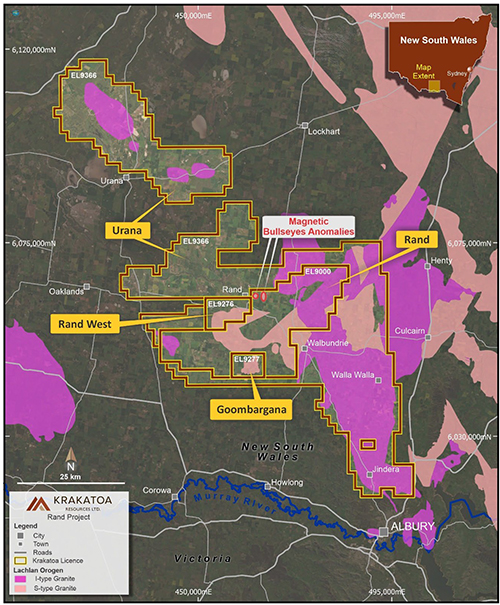
Rand Project tenements map.
In underexplored area
EL9000 is one of four granted tenements that comprise the Rand Project about 60 kilometres NNW of Albury in southern NSW that covers 580 square kilometres of an underexplored part of the Lachlan Fold Belt.
The Phase 2 auger soil geochemical survey infilled and extended the Phase 1 survey that was completed in February 2021 and that defined more than 20 high tenor coherent pathfinder multi-element anomalies that occur within and proximal to the historical Bulgandry Goldfield.
Six rock-chip samples were collected during the Phase 2 survey, which returned grades of up to 70 g/t gold.
Anomalies better defined
Results from closer sample and line spacings have more accurately separated the broader anomalies originally defined by Phase 1 into several more discrete zones and defined new anomalies.
Discrete zones include the newly named Rockingham, and Optux anomalies, Lone Hand and Goodwood anomalies, Grant’s, TW, Middle and KBRC2 anomalies.
The strongest zones of gold anomalism correlate with known workings/structures including Lone Hand and Show Day.
GAIP survey underway
A gradient array induced polarisation survey (GAIP) began on March 11, 2022, with two of the three planned grids covering historical mines within the Bulgandry Goldfield.
It is envisaged that this detailed survey will map potentially gold-bearing structures to aid drill target definition.
"The GAIP survey will map out potentially mineralised structures, complementing the completed soil surveys and field mapping. Ultimately, we will be endeavouring to drill these targets this year," Major added.
Looking ahead, Krakatoa’s next steps involve completing the GAIP surveys, processing then interpreting the data, then synthesising these with all other datasets to define drill targets.