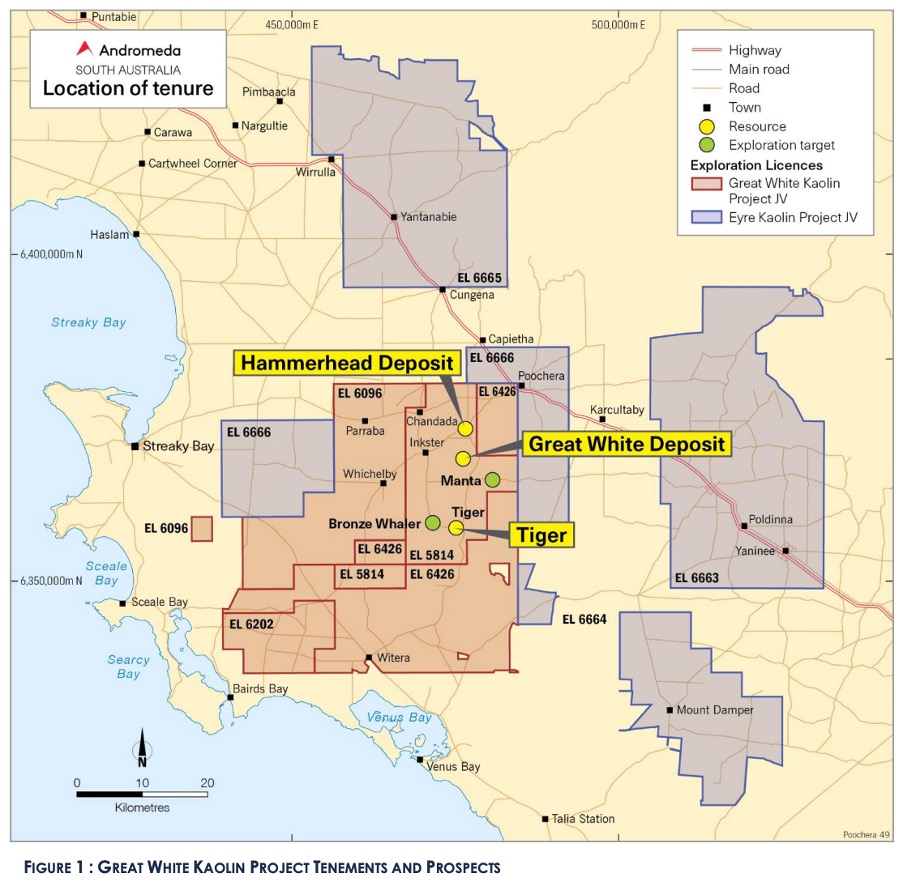
Andromeda Metals Ltd (ASX:ADN) has completed a maiden kaolin resource estimate for the Tiger deposit, part of the cornerstone Great White Kaolin Project in South Australia.
All of Tiger’s mineral resource lies in the indicated category and the deposit hosts 12.1 million tonnes of bright white kaolinized granite.
With an ISO brightness cut-off grade of 75, Tiger is set to yield 7.2 million tonnes of kaolin product in the <45-micron recovered fraction.
The project is also thought to host rare earth element (REE) potential: Andromeda has uncovered a type of mineralisation at Great White that’s rarely seen outside China, and it’s generally considered one of the cheapest and most readily accessible sources of heavy rare earths.
The company will continue to explore the asset’s REE prospects, but its main focus remains delivering the Great White Project’s definitive feasibility study and securing a mining lease permit.
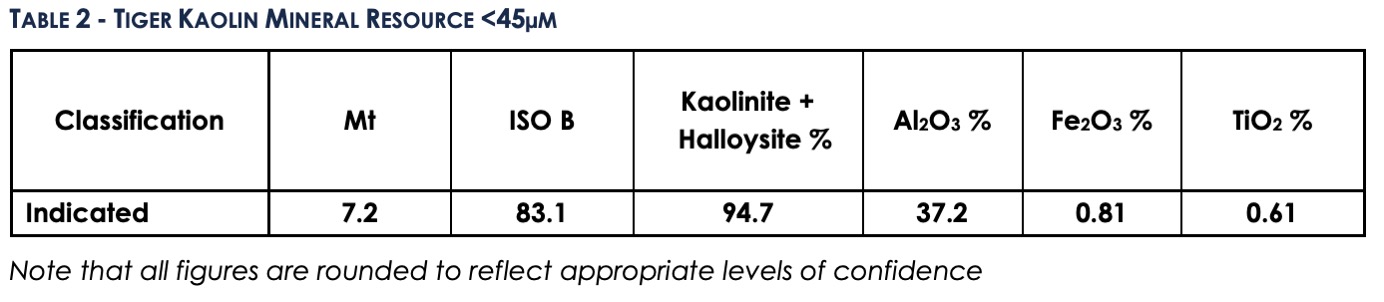
Mineral resource details
Andromeda’s maiden resource at Tiger comes after It analysed drilling data from an exploration program more than a decade ago.
In 2011, 45 aircore drill holes, covering 2,132.5 metres, were drilled vertically at the target to intersect flat-lying mineralisation.
Samples were composited and blunged — a process where clay is mixed with water — but never analysed.
As part of an exploration program, Andromeda submitted the samples for analysis and the certifier’s findings indicate Tiger hosts a medium-grade kaolin product that’s suitable for general industrial use.
Andromeda’s resource estimate covers an area roughly 1 kilometre wide and 700 metres long, over which kaolin ranges between 2 and 32 metres thick.
Next steps
Additional drilling is needed to expand the resource, which remains open in most directions.
Andromeda also hopes to obtain diamond core samples for dry bulk density determinations and undertake hydrogeological studies.
After elevated REEs were identified from handheld xrf results, all samples from Great White’s Bronze Whaler prospect were submitted for REE analysis.
Key total rare earth oxide (TREO) hits include 18 metres at 1,752 parts per million (ppm) TREO from 10 metres, including 5 metres at 2,256ppm TREO from 18 metres in the <45-micron fraction.
Notably, there is potential that these REE results have identified a regolith-hosted ion-adsorption deposit (IAD).
Chinese IADs, which are the world’s primary source for heavy rare earth elements, were formed by subtropical weathering of igneous rocks.
In Chinese IADs the REEs are inferred to be weakly adsorbed onto clay minerals, dominantly kaolinite and halloysite.
Work has begun to better understand what forms of REEs are present at Bronze Whaler and to determine their leachability, obtain whole rock samples for analysis and investigate the REE potential in the broader region, largely through analysis of existing samples.