
The value of mergers and acquisitions deals in Australia in 2021 rose 225% over 2020 levels, reaching an historic high of $305 billion.
While circumstances this year, including inflation and war, may curb the enthusiasm for some deals to get done, the appetite for the mergers and acquisitions market in Australia remains although it is now more reflective.
Pitcher Partners and Mergermarket’s annual outlook report Dealmakers: Mid-market M&A in Australia 2022, highlights the thirst for M&A activity brought on by a lack of offshore competition for Australian targets and the positive sentiment around the destination.
Pitcher Partners partner James Beaumont tells Proactive, “Australia's always been a positive destination, for onshore and for offshore bids. What I think Australia does really well is it has a really vibrant economy of very impressive, good size, middle-market businesses. These are attractive targets and will be defined by technology capability, management teams or well-established customer bases.
"There's a huge amount of opportunities, for both ASX listers or international bids wanting to put a foothold in Australia. There are a lot of good opportunities to acquire strong businesses at affordable prices as well.”
Before we look at what is driving activity in Australia and how the outlook may have changed as the war between Russia and Ukraine gets uglier and inflation rises, let’s have a quick look at what M&A is and some of the biggest deals done in the global market.
In this article:
- Mergers and acquisitions: a brief explainer
- Deal of the century
- Australian M&A activity perks up
- Less activity but higher numbers
- Has the outlook changed due to war and inflation?
Mergers and acquisitions: a brief explainer
Mergers and acquisitions, more commonly known as M&A, are transactions between two companies that will see them combine (merge) or one company cede majority ownership (acquisition). The terms are used interchangeably, however, are different types of deals.
Here’s a simple video explainer looking at the process of buying, selling and combining companies as well as the driving forces behind these types of deals:

There are also different types of transactions including horizontal, vertical, and conglomerate. A horizontal transaction is when a merger happens between companies in similar industries. Companies may or may not be direct competitors, but share certain synergies.
A vertical merger generally happens between one company and its supplier, or another company along the supply chain. A vertical merger usually consolidates and strengthens one company’s position in the market.
Finally, a conglomerate transaction takes place between companies in different industries and is undertaken for diversification purposes.
Three forms of integration
While there are different types of transactions, there are also different ways for companies to integrate.
- Statutory integration is when the acquirer is a great deal larger than its target, including in assets and liabilities. In a statutory integration, the target will generally be swallowed up by the bigger company.
- A subsidiary merger, on the other hand, is where the target becomes a subsidiary of the acquirer and maintains its business.
- A consolidation deal will see both companies merge to form a new company.
Why merge or acquire?
Generally, there are synergies between the two companies that could create one formidable industry leader. Cost reduction, higher revenues, consolidation of goods and services are all driving forces that create economies of scale.
Higher growth is another reason for M&A activity. M&A provides a quicker way to achieve higher revenues than organic growth. Imagine acquiring tech that you don’t have and don’t have to spend the money developing.
Stronger market power, including supply chain control and price influence, is also a factor as is diversification. The acquisition of a company in a non-cyclical industry, allows a company to reduce its market risk.
Two types of acquisition
1. Stock purchase
A stock purchase acquisition sees the acquirer pay shares and or cash for shares of the target company. This model works best for shareholders, who receive compensation. The acquirer then absorbs all assets and liabilities (on the balance sheet or not). This type of deal must be approved by the target company’s shareholders.
2. Asset purchase
This is where the acquirer purchases assets directly and avoids taking on the liabilities. A direct payment bypasses shareholder approval.
Valuation
The most important factor in M&A activity is valuation, which determines how much a target is worth.
Both the target and acquirer will conduct a valuation process. One price will be high, one will be low and the parties will then try and meet somewhere in the middle.
There are three valuation methods to consider:
- DCF (discounted cash flow): Calculates the target’s value based on future cash flows.
- Comparable company analysis: This uses relative valuations for public companies to determine fair value.
- Comparable transaction analysis: This uses valuation metrics – that is a measurement based on past, similar transactions.
Deal of the century
So, with the basics out of the way, what have been some of the biggest-ever M&A deals around the world?
There are plenty of them and the biggest ones are in the hundreds of billions of dollars. Here’s a list (source: dealroom.net)?
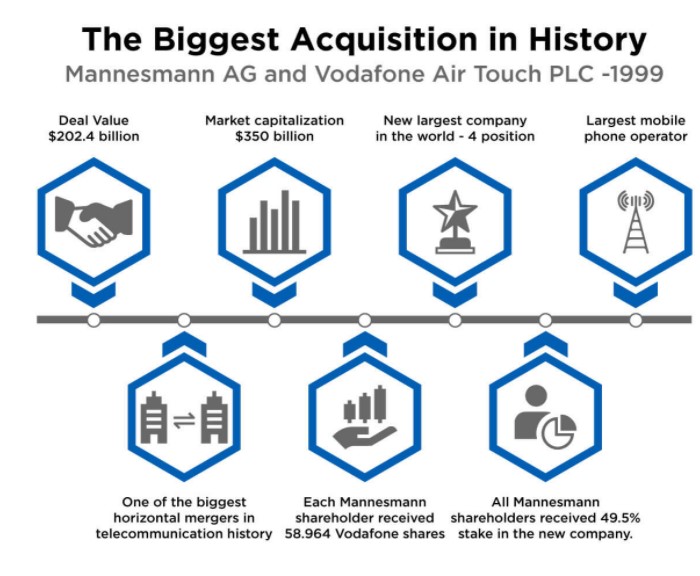
- Vodafone and Mannesmann merger (1999) - $202.8 billion
- AOL (NYSE:AOL) and Time Warner merger (2000) - $182 billion
- Gaz de France and Suez merger (2007) - $182 billion
- Verizon and Vodafone acquisition (2013) - $130 billion
- Dow Chemical and DuPont (NYSE:DD) merger (2015) - $130 billion
- United Technologies and Raytheon merger (2019) - $121 billion
- AT&T and Time Warner merger (2018) - $108 billion
- AB InBev and SABMiller (LSE:SAB) merger (2015) - $107 billion
- Glaxo Wellcome and SmithKline Beecham merger (2000) - $107 billion
- Heinz and Kraft merger (2015) - $100 billion
- Bristol-Myers Squibb and Celgene merger (2019) - $95 billion
- Royal Dutch Petroleum and Shell merger (2004) - $95 billion
- Pfizer and Warner Lambert merger (1999) - $90 billion
As you can see Vodafone is the biggest acquisition currently. The following graphic explains how the deal was done, which puts all of the above explanations into perspective.
These deals have obviously been done outside of Australia. However, here at home, the deals are starting to get bigger.
Australian M&A activity perks up
According to Pitcher Partners and Mergermarket’s annual outlook report Dealmakers: Mid-market M&A in Australia 2022, the total number of deals dipped slightly, from 963 in 2020 to 927 in 2021. However, the size of the deals was larger.
This was in part due to corporates with cash to spend driving activity.
James Beaumont says that while 2020 was restrained by COVID-19 related issues, 2021 saw a reversal of sentiment.
“2020 was a disaster with M&A when COVID first hit. It was very difficult to speak to any of our clients interested in M&A when everyone was worried about their own backyard. Fast forward six months and we really saw a shift.
“The level interest really picked up and from that moment, around November 2020, all the way through 2021, I've never seen M&A conditions like it.
“The corporates really drove the activity during 2021 based on the strength of balance sheets: they had cash to spend, they had access to debt, and they had a market hungry for growth. When organic opportunities for growth are limited, M&A is the obvious choice. And I think that was what really drove the activity in, in 2021.”
Beaumont says that the landscape had been fluctuating prior to 2020, since the GFC between 2007 and 2009, it had had its ups and down. When COVID hit, there was an enormous downturn, but the bounce back last year was a head turner and while we may not see deals the size of Mannesman AG and Vodafone, deal size is certainly increasing.
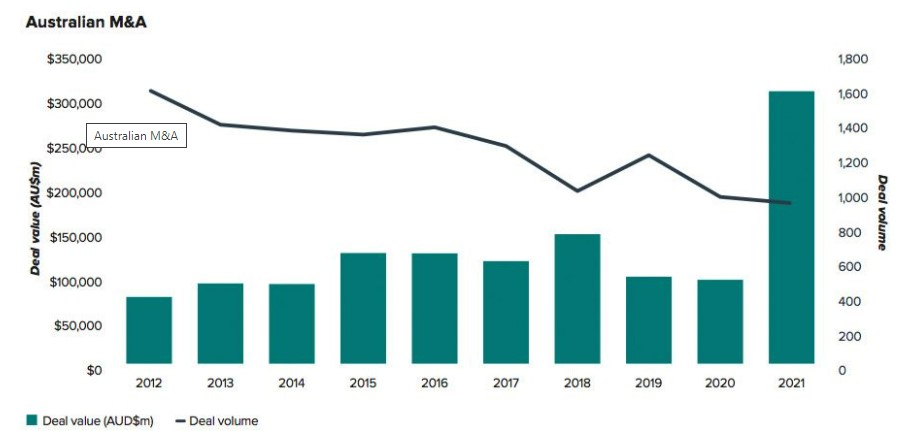
“New volumes were slightly lower in 2021, but values were about 220% above 2020. That’s twice the next record, which was in 2018. Again, corporates were the main ones driving that growth.”
This year has seen that momentum fluctuate due to macro influences beyond anyone’s control, however, Beaumont cites Afterpay as one of the biggest deals done.
In December 2020, shareholders voted unequivocally to approve Afterpay’s acquisition by Block (formerly Square).
The only thing that held up the deal being completed in 2021 was approval from the Spanish central bank.
On February 1, billionaire Jack Dorsey’s Block Inc. completed the $29 billion acquisition.
This was Australia’s largest-ever acquisition and according to Beaumont one of several “relatively enormous deals for Australian standards”.
The next four biggest deals announced in 2021 were:
- Sydney airport acquired by IFM, QSuper, UniSuper and Aus Super for $27.7 billion
- BHP Petroleum merged with Woodside Petroleum for $13.7 billion
- AusNet Services acquired by Brookfield for $13.3 billion
- Vifor Pharma acquired by CSL for $12.3 billion
Less activity but higher numbers
You can see the high numbers by Australian standards, which made up for the lower level of activity.
“There are a couple of things driving the lower volume,” Beaumont says. “The deals took longer to complete in 2021. We still had closed borders and COVID impacting earnings. Buyers were just spending that much more time doing due diligence and getting comfortable over the outlook, before pressing the button.”
Another reason for the lower number of deals, but higher values, was valuations which, according to Beaumont, were high in 2021.
While no one really knows what is going to happen this year, the trend is likely to continue and we could see activity in recovering industries such as hospitality and travel.
The report by Pitch Partners shows that leading the search for fresh M&A opportunities in 2022 are ASX-listed corporates, mid-market dealmakers, private equity investors and strategic buyers, driving expectations that the cyclical peak in market activity has not yet been set.
The survey of 60 leading dealmakers finds 97% of respondents expect to look within Australia for deal opportunities in the immediate future, a far stronger response than the 84% surveyed at the end of 2020.
82% of respondents cited a relative lack of competition as a key driver for the attractiveness of mid-market M&A. A further 77% believe there are excellent deal sourcing opportunities in the mid-market, while favourable tax conditions, valuations and returns, and lower risk in Australian deals when compared to regional markets also have played a role.
Hot mid-market M&A sectors for 2022 include technology, media and telecommunications, where 97% of respondents said they expected an increase in transactions, as well as pharma, medical and biotech, where 92% said they anticipated more deals.
Also expected to be increasingly active are the financial services and consumer sectors, with 85% and 80%, respectively, of respondents saying deal activity would be higher this year than 2021.
Dealmakers were most bearish around mid-market M&A in transportation (7%), defence (12%) and government (17%).
“While Australia is still dealing with the impacts of the COVID-19 pandemic and the Omicron outbreak, dealmakers are confident in their ability to yield value from the Australian M&A market,” Pitcher Partners Melbourne partner Michael Sonego said.
“Positivity in this year’s research once again runs high. Respondents give Australia an 80% confidence score when rating the current environment for M&A, based on the ease of doing deals, sourcing opportunities and other factors crucial to yielding value from these transactions.”
Australia remains most attractive location
Australia will be the investment destination of choice for almost all dealmakers, with 97% reporting they planned to conduct M&A activity in the next 12 months, and the same percentage saying it would have the strongest economic growth in the region.
For mid-market dealmakers, the survey showed new and advanced technology, a relatively subdued competitive environment and strong deal sourcing opportunities underpinned Australia’s attractiveness for investment.
Looking elsewhere in the region, 58% of the dealmakers surveyed said they intended to invest in emerging South-East Asian Countries, 28% said they planned deals in Singapore and 27% anticipated their M&A activity to occur in India.
More than half (51.7%) of those that invested in Australia in 2021 said their deals were opportunistic, while 23.3% said their acquisitions were strategic and had been planned for at least 12 to 24 months. A quarter of respondents said they invested in Australia in reaction to market competitors.
Has the outlook changed due to war and inflation?
Dealmaking is now looking a little more uncertain than it did 12 months ago.
Europe will certainly suffer as there looks to be no end in sight to the conflict between Russia and Ukraine.
Right now, it is too hard to tell what the overarching impact will be.
In January, Goldman Sachs (NYSE:GS) CFO Dennis Coleman said M&A activity was still "elevated across geographies and industry groups, with particular strength in TMT, industrials and healthcare". He said a post-pandemic transformation in certain industries, as well as support from financial sponsors, would keep activity buoyant.
At the same time, Goldman CEO David Solomon said supply chain disruptions were creating a "tailwind" for dealmaking and that uncertainty was helping to spur M&A by, "forcing people to look hard at ways they can strengthen their competitive position".
A lot has happened in two months and Beaumont believes that people seem to be taking stock of what the war (along with inflation and interest rate rises) means. The graph below illustrates the outlook from the Pitcher Partners survey in December when the report was completed:
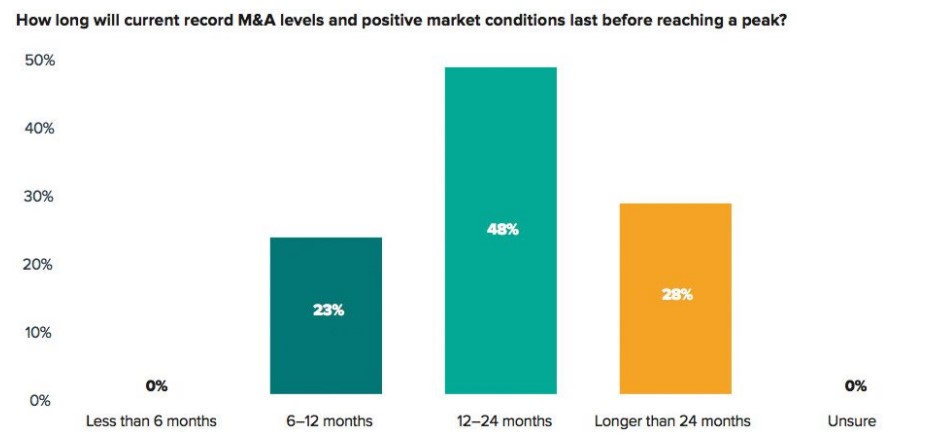
“I think that will play out for the next couple of months, at least and then hopefully there is a return to the bullishness and positive sentiment.
“There's been a lot of publicity around inflation and interest rates, but despite that rates are still cheap and balance sheets are still reasonably strong. So, I’m optimistic for 2022 and beyond.”