
Natural Resources
21 March 2022
Comment
Peak Oil…Still Peaking
The concept of “Peak Oil” was first postulated by Marion King Hubbert in a study published in 1956 as a warning that the supply of a finite resource couldn’t go on forever. These studies essentially tried to model future oil supply on the basis that oil production is likely to follow a symmetrical bell curve where peak oil production is reached when about half the reserves are extracted.
The Hubbert Curve predicted, correctly for three decades as it turned out, that production in the USA would peak around 1970 and globally around 2000. The USA followed the curve until the late 2000’s when the shale revolution started to take hold.
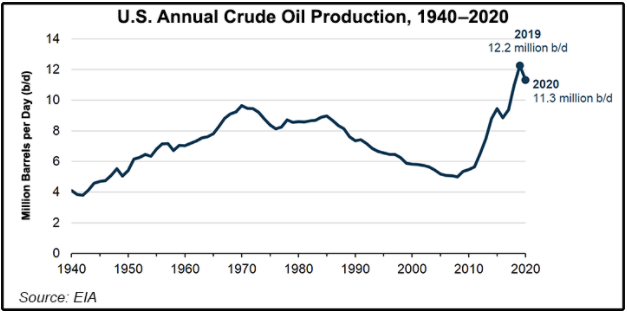
US Historical Crude Production
In 1998 a paper by Campbell and Laherrere titled “The End of Cheap Oil” published in Scientific American updated Hubbert’s work, caused a stir and turned Peak Oil into a colloquialism. The new analysis was pretty consistent with Hubbert and predicted global peak oil production in 2004, before it started an irreversible decline. The success of the paper led Campbell to form the Association for the Study of Peak Oil and Gas (“ASPO”) in 2001. The last update from ASPO, in 2008, pushed the peak out a little further with production at 82mm bbls/d in 2010.
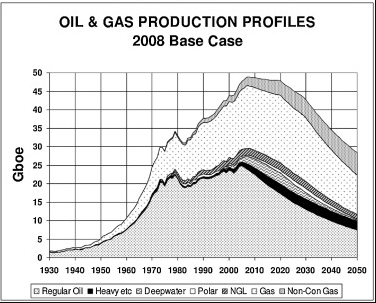
ASPO Forecast Global Peak Oil 2008
Clearly these predictions didn’t come true. Extraction technology advances have allowed new fields to be exploited, particularly deep water, and for better recoveries from existing discoveries. The Bell shaped curve turned out not to be symmetrical.
Notwithstanding the immediate impact of Putin’s war, today the concern is no longer about supply. In 25 years the world has gone from worrying about whether we can get enough of the black stuff to having an existential crisis over how we can get rid of it fast enough.
To the relief and surprise of many in 2020 BP, informed by the economic crash caused by the Covid pandemic and increasing societal pressure for decarbonisation, suggested we may have already seen peak oil demand at around 100mm bbls/d in 2019.
Not so fast…the Peak continues to move further out
BP published its annual Energy Outlook last week. The news isn’t good and “Peak Oil” is delayed again.
According to the report the rapidity of post covid economic recovery (named “new momentum” in the analysis) makes the demand trajectory uncomfortable viewing. Demand won’t peak until after 2030 at similar levels to today, and only slowly decline to 80mm bbls/d by 2050.
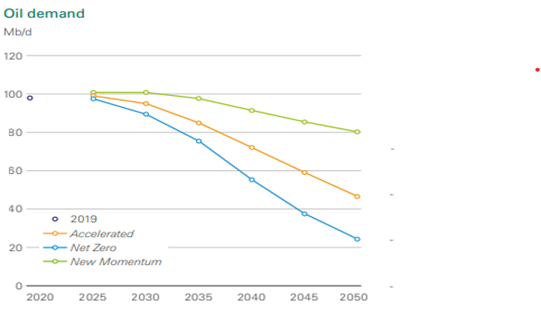
BP Energy Outlook 2022 – Oil production forecasts
The report was too early to include the effects Putin’s Ukrainian war may have on global energy markets and security or indeed the response of Western governments to it. Recent moves have included urging OPEC members to pump more and thoughts of re-engagement with historical pariahs like Venezuela and Iran.
Either way it doesn’t bode well for meeting Climate change goals unless there is an immediate step change in activity. As the chart above shows, to achieve net zero by 2050 oil production needs to be below 80mm bbls/d by mid-2030 and at 20mm bbls/d by 2050. The current path shows we are a long, long way from that.
A Stretch Target
The implications for investment are profound. Even on BP’s most optimistic decarbonisation “net zero” pathway, given natural field decline rates, the industry needs to spend US$375bn annually to keep pumping the required oil and gas. On the current “new momentum” trajectory that rises to US$500bn, a 20% increase on 2020 levels.
If the World is to achieve net zero global targets renewables clearly have an essential substitution role to play far above their current contribution. BP calculates that capital spending on wind and solar needs to triple from current levels to ~ US$800bn a year.
That’s going to involve a lot of copper, lithium, steel, aluminium, rare earths, nickel…
Just sayin’.
Charlie Cryer
Head RFC Ambrian London
+44 (0)20 3440 6834
charlie.cryer@rfcambrian.com
*RFC Ambrian acts as Financial Adviser to this company and holds a significant interest.
This document has been approved under section 21(1) of the FMSA 2000 by RFC Ambrian Limited ("RFC Ambrian") for communication only to eligible counterparties and professional clients as those terms are defined by the rules of Financial Conduct Authority. Its contents are not directed at retail clients as RFC Ambrian does not provide investment advisory services to retail clients.
RFC Ambrian publishes this document as non-independent research which is a marketing communication under the Conduct of Business rules. It has not been prepared in accordance with the regulatory rules relating to independent research, nor is it subject to the prohibition on dealing ahead of the dissemination of investment research. It does not constitute a personal recommendation and does not constitute an offer or a solicitation to buy or sell any security. Neither RFC Ambrian nor any of its directors, officers, employees or agents shall have any liability, howsoever arising, for any error or incompleteness of fact or opinion in it or lack of care in its preparation or publication; provided that this shall not exclude liability to the extent that this is impermissible under the law relating to financial services. All statements and opinions are made as of the date on the face of this document and are not held out as applicable thereafter. This document is intended for distribution only in those jurisdictions where RFC Ambrian is permitted to distribute its research. In particular, it is not intended for distribution in and is not directed as persons in the United States.
On the date of this document, RFC Ambrian, RFC Ambrian's holding company, persons connected with it and their respective directors may have a long or short position in any of the investments mentioned in this document. RFC Ambrian is a member of the London Stock Exchange and is regulated and authorised by the Financial Conduct Authority. RFC Ambrian is registered in England and Wales no. 4236075. Its registered office is at Octagon Point, 5 Cheapside, London EC2V 6AA.
NOTICE: The information in this e-mail message is confidential and may also be privileged. It is only intended for the above-named addressee/s. If you are not a named addressee, you must not disclose, copy or take any action in reliance on this e-mail and should delete it from your system. If you have received this e-mail in error, please contact the sender by return e-mail or by telephone +44 (0)20 3440 6800. We believe, but do not warrant that this e-mail and any attachments are virus free. You should take full responsibility for virus checking.