
Castillo Copper Ltd (LSE:CCZ, ASX:CCZ) has sufficient evidence from geological data across three prospects in the East Zone of the Broken Hill Alliance (BHA) Project in Far West New South Wales to potentially prove up a primary cobalt JORC 2012-compliant mineral resource estimate with additional zinc.
The evidence for The Sisters, Reefs Tank & Tors Tank prospects was gleaned during a visit by the company’s geology team to the extensive core library in the traditional mining centre of Broken Hill.

High cobalt and zinc readings
Diamond core was analysed from holes BH1 and BH2 drilled at The Sisters prospect using a handheld PXRF analyser with readings up to 1,705ppm cobalt and 9.63% zinc recorded.
Several PXRF intervals of 7-9 metres wide were delineated with high-grade cobalt-zinc readings and these identified intervals from the BH1 & BH2 core are being sent to the laboratory for follow up analysis.
“Excellent outcome”
Castillo Copper’s CEO Dr Dennis Jensen said: “The preliminary results from analysing The Sisters Prospect’s diamond core has delivered Castillo Copper an excellent outcome.
“We now have compelling evidence, subject to final assays, there is high-grade cobalt-zinc mineralisation apparent and a prime target for future test drilling.
“Furthermore, the board believes that, once all the assays are in from The Sisters Prospect, there will be sufficient data to potentially prove up a primary global cobalt mineral resource estimate that complies with the JORC 2012 Code.”
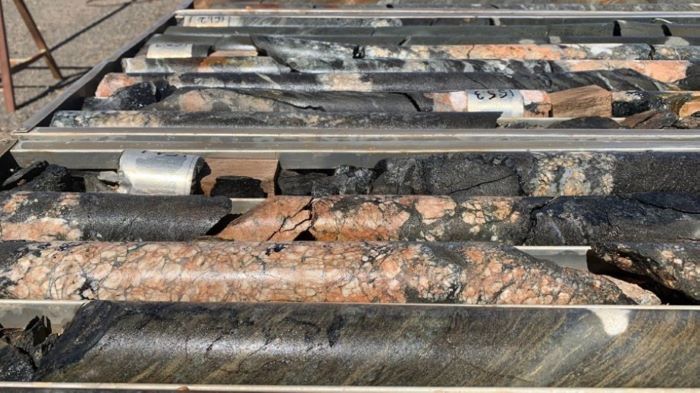
Core from BH1 and BH2 diamond drill holes at The Sisters Prospect.
Consistent with earlier assays
PXRF analysis for BH1 and BH2 is consistent with earlier assayed sections from the same diamond core (over different depths), with the best results of 1.8 metres at 820ppm cobalt from 124.7 metres in BH1 and 1.5 metres at 320ppm cobalt from 138.4 metres in BH2.
As such, when reconciling the historical assays with the recent PXRF results, it provides a relatively high degree of confidence there is significant potential to extend the known cobalt mineralisation once verified by assays.
According to a previous report, there is a primary 1,200-metre synclinal structure at The Sisters, which BH1 intersected, that appears to host high-grade cobalt-zinc mineralisation. This is now a key target for further drill-testing.
These results are an average of two readings taken for 60 seconds and are preliminary. They are being used to identify sections for core re-sampling and subsequent laboratory analyses and are not being used in the block model and do not replace laboratory analyses.
Further cobalt evidence
As well, further forensic work on codifying the 6,380 drill-holes around the Reefs Tank and Tors Tank prospects found evidence of shallow cobalt mineralisation, with the best intercepts: 7 metres at 1,600ppm cobalt from 30 metres, 15 metres at 760ppm cobalt from 67 metres; 10 metres at 520ppm cobalt from surface; and 5 metres at 520ppm cobalt from 45 metres.
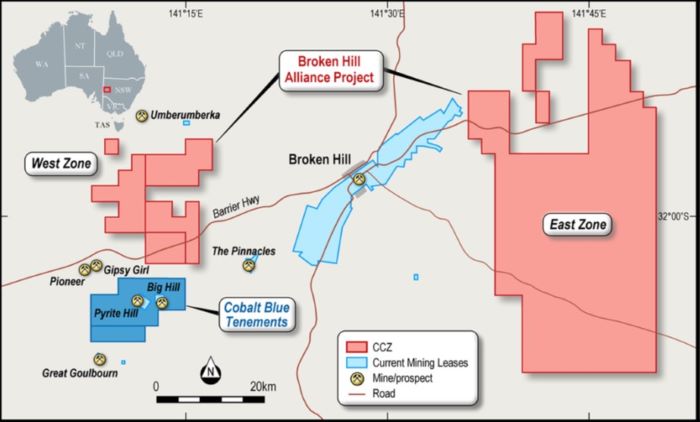
West and East zones at the BHA Project.
The objective of the trip to the core library in Broken Hill was to find incremental evidence by analysing untested diamond core from BH1 and BH2 to demonstrate the presence of cobalt-zinc mineralisation at The Sisters Prospect.
Due to the findings, the identified intervals from the diamond core are being sent to the laboratory for a complete analysis to confirm the results reconcile with the PXRF observations.
Next steps for CCZ
In NSW:
• JORC 2012-compliant mineral resource estimate for the BHA Project East Zone.
In Queensland:
• Assay results for Arya Prospect.
• Big One Deposit – formalising timing for next drilling campaign.
In Zambia:
• Complete geophysical report on the Mkushi Project; and
• Complete work on the inaugural drilling campaign for the Luanshya Project.