
PNX Metals Ltd (ASX:PNX)’s rock chip samples taken during field mapping at Glencoe gold deposit have returned high-grade assay results and identified new gold-bearing quartz veins.
A near-mine and regional reverse circulation (RC) drill program is scheduled to commence post-Northern Territory wet season.
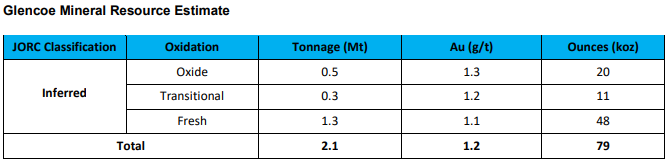
Glencoe hosts a mineral resource estimate (MRE) of 2.1 million tonnes at 1.2 g/t gold for 79,000 ounces in the inferred category and reported in accordance with the 2021 JORC Code.
An updated Glencoe mineral resource is being finalised and is due shortly.
Glencoe represents a ‘bolt-on’ asset that has significantly expanded the proposed Fountain Head development.

Plans for larger RC drill program
PNX managing director James Fox said: “These high-grade gold rock chip samples continue to highlight the importance and potential of the Glencoe gold deposit to support the proposed development at Fountain Head.
“We look forward to providing an updated MRE at Glencoe and having gained further insights into the geometry and controls of gold mineralisation within PNX’s significant NT exploration tenure, are now planning for a larger near-mine and regional RC drill program as soon as the NT wet season concludes.”
Results
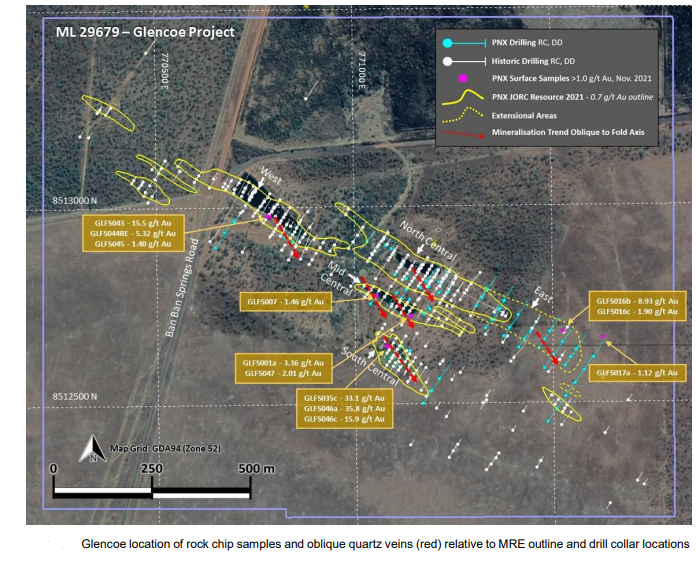
A total of 35 rock chip samples were taken from selected sites at Glencoe during geological mapping to assist with determining the distribution of gold and understanding its geological context.
The orientation of these oblique gold-bearing quartz veins and their structural relationship with the main anticlinal fold zone, which hosts the majority of the currently delineated mineralisation at Glencoe, is similar to that of the high-grade Tally Ho gold lode which cross-cuts the main anticlinal zone at Fountain Head, 3 kilometres to the south.
These observations are potentially significant and highlight a new geometry of gold-hosting structures to target at Glencoe.
These oblique quartz veins have been identified in all four historic starter pits at Glencoe, but are best developed in the South and West pits.
Samples of these quartz veins returned the highest gold assays of the current rock chip sampling program at Glencoe, including:
➢ 33.1 g/t gold in south pit;
➢ 15.5 g/t in west pit;
➢ 35.8 g/t in south pit; and
➢ 15.9 g/t in south pit.
Next steps
The company is finalising the integration of the recent 2021 data with the historic data to update the Glencoe MRE.
At present, the Glencoe MRE is entirely in the inferred category due to a lack of modern QAQC protocols on the historic drillholes and robust density measurements.
These historical shortcomings have been addressed with recent work and it is expected that the MRE confidence will improve materially and also extend to cover most of the newly identified ‘Eastern Extension’.
Diamond drilling of three holes for around 220 metres has been completed with additional rock density and structural information collected from the oxide and transitional zones, and material sourced for confirmatory geotechnical and metallurgical test-work.
An updated MRE is pending and will be used to further refine drill targets for the 2022 field season and update the project mining optimisation.
Subsequent mining optimisation will form the basis for measuring the impact on project economics where an incremental increase in the resource is expected.
The geometry of mineralisation and location near-surface immediately along strike from the current pit optimisation is likely to result in an increased resource utilisation.