Latin Resources Ltd (ASX:LRS) has discovered thick, spodumene-bearing pegmatites during its latest exploration campaign at the Salinas Lithium Project in Brazil with shares trading higher.
The explorer is in the middle of a diamond drilling campaign at the project, where six holes have been completed across 500 metres of strike.
Promisingly, each of the holes has hit multiple spodumene-bearing pegmatites — all of which are open along strike and down dip.
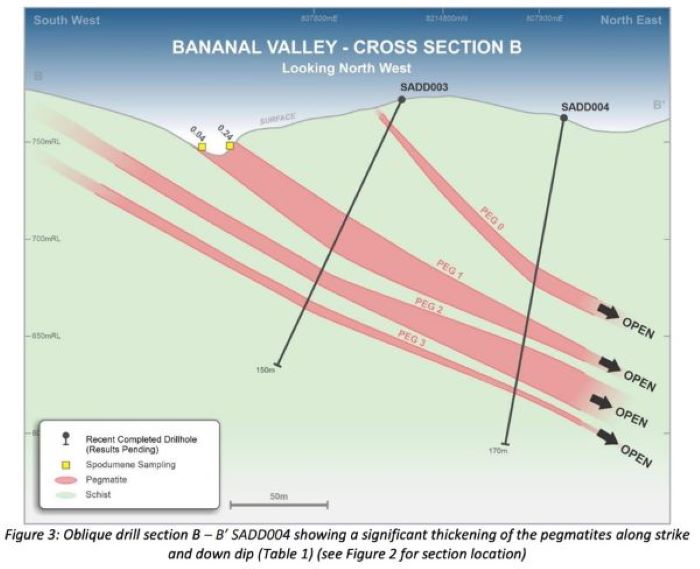
Latin has reported cumulative pegmatite intersections in one hole up to 36.1 metres true thickness, while individual pegmatites have measured up to 21.1 metres true thickness.
Now, samples for the first four holes are off to the lab, with the first lot of results expected in the coming weeks.
Meanwhile, Latin’s drilling focus has shifted 500 metres north to Salinas’ priority one drill targets, located in the lithium project’s northern target area.
“Ecstatic” with drill results
Speaking to the findings at Salinas, Latin managing director Chris Gale said: “The whole team at Latin Resources is ecstatic about the continual positive drilling results from our Salinas Lithium Project.
“The growing thickness along with the rich spodumene pegmatites is further indication that Latin may have a very compelling lithium project on its books.
“We look forward to receiving the assay results from these spodumene pegmatites in the next few weeks.
“The company’s market cap is roughly $60 million, and much lower than our lithium peers, which we expect offers strong potential for re-rating as positive assay results confirm the strength of the Salinas Project.”
This news has been welcomed by investors with shares as much as 29.27% higher intraday to A$0.053. More than 138 million had changed hands shortly before closing.
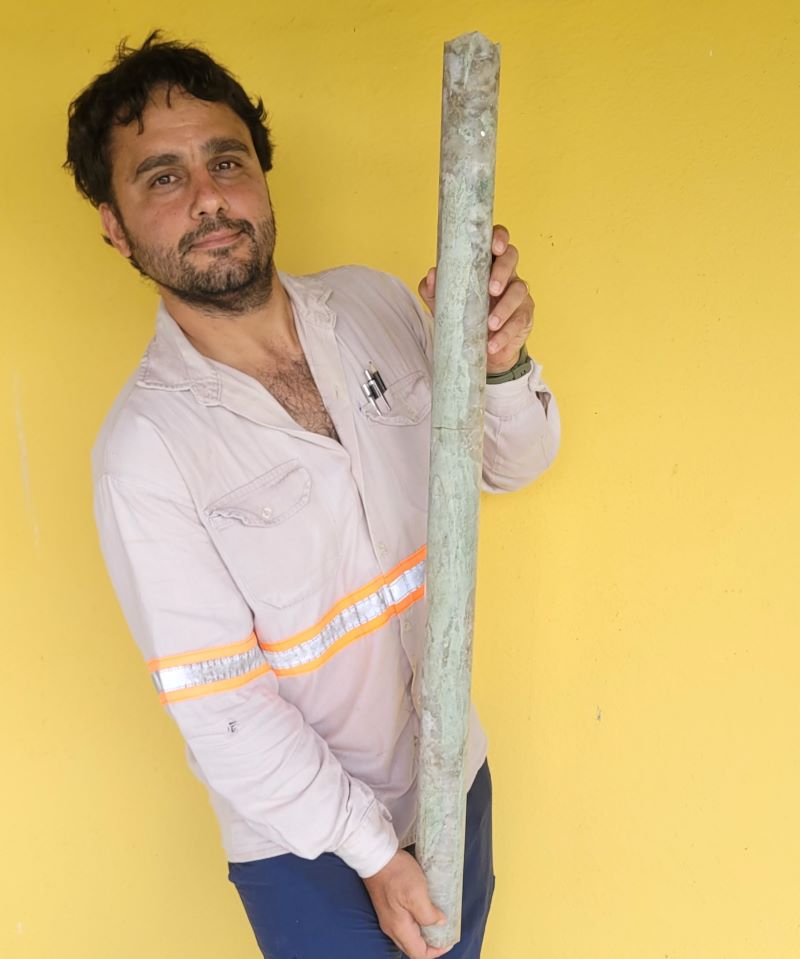
Senior geologist with spodumene-rich pegmatite core.
Work to date
So far, Latin has drilled six priority one holes across four drill sections in Salinas’ southern target area.
Drilling continues to show strong pegmatite continuity — both along strike and down dip —while the emerging pegmatite swarm remaining open in all directions.
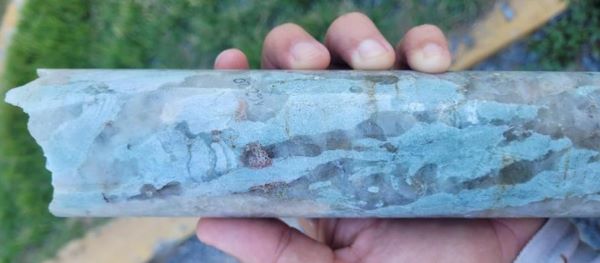
Large, fresh green spodumene crystals in drill core from Salinas.
Detailed logging, core cutting and sampling of the first four drill holes is now complete, with samples dispatched for analysis. Initial results from the first two holes are anticipated in the next few weeks.
With the completion of the final priority one drill hole in the southern target area anticipated this week, drilling will move focus to the next target area, some 500 metres to the north.
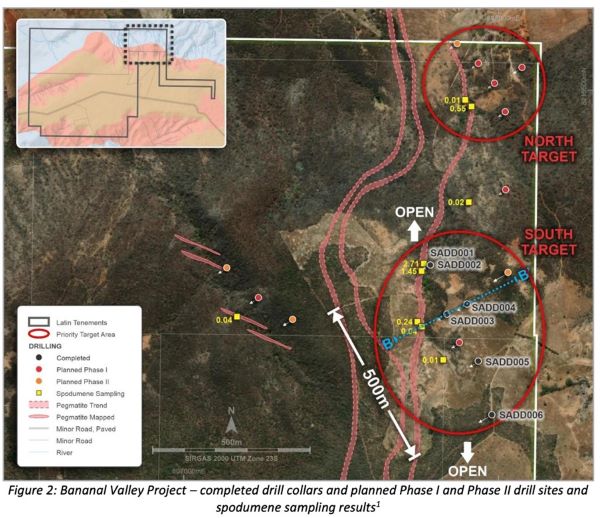
Notably, initial mapping and outcrop sampling has confirmed the extensive pegmatites encountered in the diamond drilling to the south, extend into and through this northern target area.
An initial five priority one drill holes, traversing three drill sections, are planned in the north.
Salinas’ story
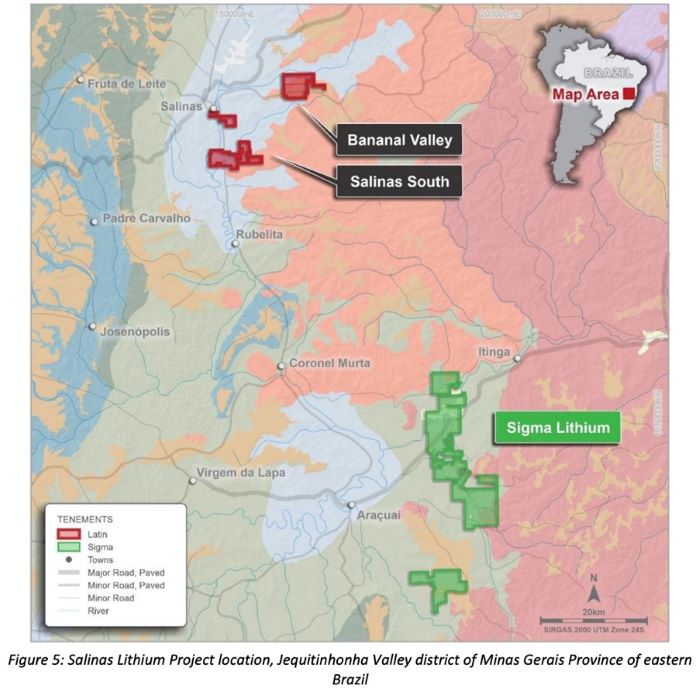
Latin’s current drill program will see it explore one of the world’s most prolific lithium hubs.
The Salinas property lies within the highly prospective Bananal Valley district of the Minas Gerais Province — a rich mining region in Brazil, and home to the Grota do Cirilio Project, which is being developed by billion-dollar stock and TSX-V-lister Sigma Lithium Corp.
Sigma Lithium is the most active lithium explorer in the Minas Gerais region, with a world-class lithium resource base that stands at 45.7 million tonnes at 1.38% lithium oxide.
Sigma is focused on 10 high-grade hard-rock lithium pegmatites, nine of which were past-producing lithium mines, yet have reported more than 200 pegmatites within their tenure.
Sigma is now in pre-construction of its large-scale lithium concentration commercial production plant in Minas Gerais.
Based on the feasibility study, the commercial production plant will contemplate producing 220,000 tonnes of battery-grade 'green' lithium concentrate annually, while Sigma will be among the lowest-cost producers of lithium concentrate globally.
Not far away, CBL is actively mining spodumene pegmatites, producing a spodumene concentrate which is then transferred to a chemical plant in Divisa Alegre, Minas Gerais, where it is transformed into industrial grade lithium hydroxide.
Latin Resources is particularly excited by the opportunities this may present in the future for battery-grade lithium hydroxide production.