
- FTSE 100 falls 18 points
- Prudential under pressure
- Miners subside on China concerns
4:50pm: FTSE 100 ends lower, US stocks higher midday
The FTSE 100 finished the day on a down note, easing 18 points, or 0.3%, to 7,176, as commodity prices slid on concerns about rising coronavirus (COVID-19) cases in China.
“While European markets have dropped back slightly, Wall Street has managed to make headway, although attention is steadily shifting towards tomorrow’s Fed meeting,” IG chief market analyst Chris Beauchamp said.
Notably movers included shares of Imperial Brands PLC (LSE:IMB), which gained nearly 1% even as the multinational tobacco company said its exit from Russia would have a slight impact on its annual profit.
3.55pm: Leading shares helped by US markets
Leading shares remain in the red heading into the close, but the falls are by no means as bad as they were.
With a positive start on Wall Street, partly thanks to oil slipping below US$100 a barrel, the FTSE 100 is down 31.12 points or 0.43% at 7162.35.
Earlier it had fallen as low as 7075.
But the mood is still cautious as investors await further developments in Ukraine, and assess the latest lockdowns in China amid a growing number of Omicron cases.
On top of that, both the Federal Reserve and the Bank of England are expected to raise interest rates this week to combat rising inflation, and their comments on the subject will be widely watched.
Russian miner Polymetal International PLC (LSE:POLY) is the biggest faller in the leading index, down 24.89%.
It is being undermined by a combination of further UK sanctions on Russia, and concerns about a slowdown in China which could reduce demand for commodities.
The demand issue is also hitting other miners, with Fresnillo PLC (LSE:FRES) falling 5.18% and Glencore PLC (LSE:GLEN) down 3.97%.
And Asia-focused firms are under pressure on worries about the Chinese economy, with Standard Chartered PLC (LSE:STAN) losing 4.62% and Prudential PLC (LSE:PRU) 4.02% lower.
Meanwhile Ferguson PLC (LSE:FERG) is off 5.61% following its latest update, despite rising profits and an extension to its buy back programme.
AJ Bell investment director Russ Mould said: “May’s move to a primary listing in the US – which means the shares will no longer be eligible for inclusion in the FTSE 100 – may be one reason for the muted response, but nagging worries about an economic slowdown in the US thanks to soaring commodity prices, tighter monetary policy and the absence of further fiscal stimulus from Congress may also have a role to play."
But Informa PLC (LSE:INF) pleased investors with its results, adding 3.6%.
And education specialist Pearson PLC (LSE:PSON) - which rejected a bid from Apollo Global Management (NYSE:APO) last week - has put on 8.02%.
2.56pm: Oil continues to slide
Oil prices continue to slip further below US$100 a barrel after their recent peaks in the wake of the attacks on Ukraine.
Brent crude is down 8.6% at US$98.29 a barrel while West Texas Intermediate - the US benchmark - is off 8.75% at US$95.26.
The dips come amid hopes that talks will lead to a halt in the fighting in Ukraine, while the growing number of lockdowns in China could lead to lower demand from the world's second biggest economy.
On top of that, the US and Iran continue to discuss a nuclear deal which could see further supplies of oil come on to the market.
Craig Erlam, senior market analyst at Oanda, said: "Oil prices are falling heavily again on Tuesday, taking total losses since the start of the week to more than 10%. Of course, that's largely a reflection of just how far they rose since the invasion, with Brent now more than 25% from its highs just over a week ago. The talks between Ukraine and Russia aren't just lifting market sentiment, they're alleviating some of the worst fears around commodity supply disruptions.
"Further compounding the declines are shutdowns across China which could continue to ramp up as case numbers spike. China is a huge oil consumer so this dent in demand could temporarily ease some of the imbalances in the market.
"More significant in the longer term is the Iran nuclear deal which appears to be making progress. Granted, at a snail's pace, but that's better than not at all. It seems sanction complications may be overcome, which will move us a step closer to a deal and around 1.3 million barrels per day coming back onto the market."
2.14pm: US markets head higher
US stocks opened higher Tuesday, contrary to earlier expectations, as oil prices continued to drop below $100 per barrel, easing the pressure on inflation ahead of the Federal Reserve monetary policy decision expected on Wednesday.
The Dow Jones Industrial Average gained 0.5%, or 180 points, at 33,124, while the tech-laden Nasdaq Composite added 0.4%, and the S&P 500 was up by 0.4%.
“For the first time ever since 2018, Jerome Powell, the Fed Chairman, is expected to hike interest rates at the forthcoming meeting (Wednesday),” said Naeem Aslam, chief market analyst at Avatrade. “The Fed Chairman has already voiced his opinion during his recent appearance where he made it clear to Congress that the committee is of the mind frame it will choose to raise the federal funds rate by 25 basis points.”
The Fed has been under pressure to increase rates due to the steady drumbeat of rising inflation numbers, Aslam noted.
“When an adverse supply shock hits the economy, central banks must make difficult decisions: doing too many risks pushing the economy into recession while doing too little risks unanchoring inflation expectations,” Aslam warned.
On the PPI and manufacturing figures, he said: “Investors are feeling a little relieved knowing the fact that PPI has gone down. But then we have the Empire State Manufacturing Index, which completely plunged.
"Traders know that the only data that matters the most is inflation, and given that there is a war in Ukraine that has disrupted the supply chain, inflation isn’t going to come down.”
Meanwhile the FTSE 100 remains firmly in the red, down 60.62 points or 0.84% at 7132.85.
1.02pm: US producer prices rise
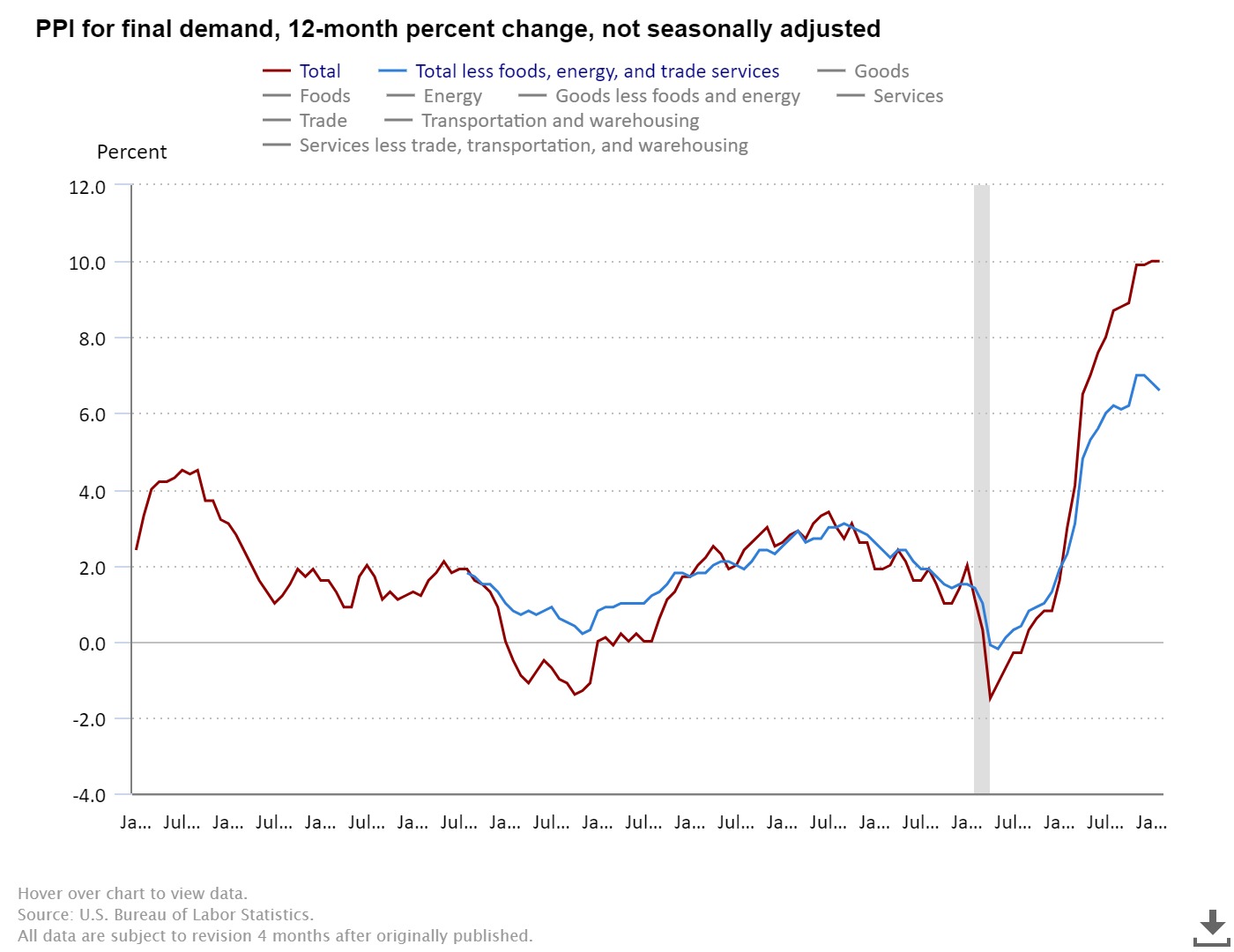
A key measure of US inflation is at a record high although this was in line with expectations.
As the Federal Reserve begins a two day meeting where it is widely expected to raise interest rates, the US producer price index rose by 10% year on year in February.
The January figure was revised up from 9.7% to 10%.
* Revisions * US PPI Final Demand (M/M) Feb: 0.8% (est 0.9%; prev 1.0%; prevR 1.2%)
- US PPI Final Demand (Y/Y) Feb: 10.0% (est 10.0%; prev 9.7%; prevR 10.0%)
- US PPI Ex Food And Energy (M/M) Feb: 0.2% (est 0.6%; prev 0.8%; prevR 1.0%)
— LiveSquawk (@LiveSquawk) March 15, 2022
The core figure excluding food and energy was 8.4%, less than the 8.7% forecast.
The month on month figure was 0.8%, down from a revised 1.2% previously.
Meanwhile there was a sharp drop in manufacturing in March, according to the Empire manufacturing index which fell by 11.8 compared to a rise of 3.1 and an expected increase of 6.1.
12.18pm: Mid-cap index falls further than Footsie
The FTSE 250 is underperforming compared to the blue chip index.
While the FTSE 100 is currently down 0.70% for 50.08 points, the mid-cap index has lost 1.25%.
The biggest fallers are, unsurprisingly, Russia related.
Gold miner Petropavlovsk PLC (LSE:POG) is down 16.67% while inter-dealer broker TP ICAP PLC (LSE:TCAP) is down 13.13% after it said it faced £14mln of losses due to Russian sanctions.
11.25am: UK imposes new trade sanctions on Russia
The UK government has imposed further sanctions on Russia in the wake of the attacks on Ukraine.
It has announced a ban on exports of some luxury goods to Russia, as well as slapping a new 35% tariff on various goods imported from the country.
The tarifs will affect some £900mln of imports, including spirits - yes, that includes vodka - various metals including iron and steel, and white fish.
Meanwhile more companies are distancing themselves from president Putin's regime.
Tobacco giant Imperial Brands PLC (LSE:IMB) said it was transferring all its Russian assets and operations to a local third party, while car dealer Inchcape PLC (LSE:INCH) is also quitting the country, saying it was no longer tenable to operate there.
Elsewhere inter-dealer broker TP ICAP PLC (LSE:TCAP) reported an 81% fall in annual profits and said it faced £14mln of losses due to Russian sanctions.
It said: "We have ceased trading activity with sanctioned clients. The proportion of 2021 revenue from Russian clients was approximately 0.5% of the total. As at 11 March 2022, the value of realised losses on failed settlements is £4m. TP ICAP has also recognised potential unrealised losses of £9m in relation to failed settlements and has written down trade debtors with sanctioned clients by £1m.
"In addition, the Group has outstanding unsettled matched principal transactions in Russian financial instruments of a nominal value of around £12m where neither counterparty has been able to settle at this time and where no net loss has been recognised."

10.54am: US markets set to follow Asia and Europe lower
US stocks are expected to open lower as investors face the double whammy of surging coronavirus (COVID-19) cases in China - leading to large-scale lockdowns - as the conflict in Ukraine enters its 20th day.
The market is also awaiting the outcome of the Federal Reserve’s two-day monetary policy-setting meeting on Wedneday, which is likely to result in a 25 basis point hike in interest rates.
Futures for the Dow Jones Industrial Average fell 0.3% in Tuesday pre-market trading, while those for the broader S&P 500 index shed 0.24% and the tech-heavy Nasdaq declined 0.11%.
US markets ended mixed on Monday ahead of the Fed’s decision and amid hopes of a de-escalation between Ukraine and Russia.
The Dow was flat at 32,945, while the S&P 500 lost 0.74% to 4,173 and the Nasdaq dropped 2.04% to 12,581.
Richard Hunter, head of markets at interactive investor, said: “The imminent Federal Reserve rate decision is expected to result in a hike, and interest rate sensitive stocks such as those within the tech sector have felt the force of selling pressure in the run-up to the decision.
“Not only does this directly impact the tech-heavy Nasdaq index, but there is also a negative effect on the wider S&P500, which has a large exposure to tech. in the year to date, the Nasdaq has now fallen by 20% and the S&P500 by 12.5%."
Meanwhile the FTSE 100 is now 66.9 points or 0.93% at 7126.57.
10.25am: Footsie off its worst but still well down
Leading shares have come off their worst levels but are still firmly in negative territory.
Having fallen as low as 7075, the FTSE 100 is now down 76.95 points or 1.07% at 7116.52.
But the mood is still fragile.
As well as the continuing attacks in Ukraine, the Chinese sell-off is also setting nerves on edge.
Victoria Scholar, Head of Investment, interactive investor, said: “The bloodbath for Chinese equities extends with the Hang Seng in Hong Kong shedding another 5.7% reaching the lowest close since February 2016. Having slumped 11% on Monday its tech index shed another 8.1% on Tuesday with fears there is more downside to come. More than $460bn has been wiped from China’s tech sector this year. The negativity has spread beyond China’s borders with chip makers in Europe taking a hit.
"A toxic combination of rising COVID-19 cases and China’s stance towards the Russia-Ukraine conflict have prompted international investors to shun Chinese equities. This prompted a harsh assessment from analysts at JPMorgan which has downgraded 28 Chinese internet companies including Alibaba and Tencent to underweight, labelling them as ‘uninvestable’ over the next 12 months.”
9.37am: Pearson and water companies defy the gloom
Markets remain under the cosh as the latest Chinese lockdowns add to the uncertainty over the situation in Ukraine, with attacks continuing even as peace talks are taking place.
The FTSE 100 is currently down 106.58 points or 1.48% at 7086.89.
Bucking the downward trend is Pearson PLC (LSE:PSON), up 3.42% at 787.2p. The educational specialist last week rejected a 854.2p a share cash offer from Apollo Global Management (NYSE:APO).
With investors seeking havens for their funds, utility companies are living up to their reputation as defensive plays.
Severn Trent PLC (LSE:SVT) has added 0.88% while United Utilities Group PLC (LSE:UU.) is up 0.57%.
8.33am: Asia-focused firms under pressure
Among the fallers are Asia-focused businesses following the lockdown in China and the slide in the region's markets.
Prudential PLC (LSE:PRU) is leading the losers, down 4.31% while Standard Chartered PLC (LSE:STAN) is down 2.93%.
Miners are also under pressure on concerns about a Chinese slowdown, with Rio Tinto PLC (LSE:RIO) off 3.44% and Anglo American PLC (LSE:AAL) 3.27% lower.
But information and events group Informa PLC (LSE:INF) is up 1.85% after its full year adjusted operating profits rose from £266.6mln to £388.4mln, helped by the return of live and on demand B2B events.
At the statutory pretax level it swung from a hefy £1.14bn loss to a £137.1mln profit.
It is now forecasting 2022 adjusted operating profits of £470mln to £490mln.
8.17am: Leading shares lose ground amid cocktail of concerns
After Monday's slight gains, leading shares have opened lower amid renewed uncertainty caused by the unremitting attack on Ukraine and a lockdown in China
The FTSE 100 has fallen 95.44 points or 1.33% to 7098.03.
Richard Hunter, head of markets at interactive investor, said “Markets were again unable to sustain gains as the cocktail of concerns was extended, with China being added to the list.
"Surging COVID-19 cases in China saw one of Apple’s main iPhone assembly suppliers, Foxconn, shut two factories as part of the Shenzen shutdown. More broadly, the most recent spike in cases has led to concerns that there could be further supply chain disruptions and that China’s economic growth could flatline in the first quarter.
"Adding to investor woes was a reminder that the relationship between China and US remains fractious, following warnings around any Chinese support for the Russian effort [in Ukraine]."
There is also the likelihood of an interest rise from the Federal Reserve this week, followed by a similar move from the Bank of England.
Hunter said: "With the potential for a further rate hike later in the week, and with higher energy and tax bills possibly leading to a cost of living crisis, the UK economy is precariously poised at present even after an improvement in the unemployment rate."
7.45am: UK jobless rate down but average pay drops after inflation
UK jobs data has come in better than expected, with a quarterly increase in the employment rate and a decrease in the unemployment rate.
The unemployment rate fell to 3.9% in the three months to January, down from 4.1% previously and lower than the forecast 4%.
The economic inactivity rate increased by 0.1 percentage points to 21.3%.
Payrolled employees showed another monthly increase (up 275,000) in February 2022 to a record 29.7mln.
Commenting on today’s labour market data, ONS chief economist Grant Fitzner said:
— Office for National Statistics (ONS) (@ONS) March 15, 2022
Continuing, ONS Chief Economist, Grant Fitzner said:
— Office for National Statistics (ONS) (@ONS) March 15, 2022
Growth in average total pay (including bonuses) was 4.8% and growth in regular pay (excluding bonuses) was 3.8% in November 2021 to January 2022.
But in real terms, taking inflation into account, average pay including bonuses fell by 0.1% and excluding bonuses dropped 1%.
This shows the continuing squeeze on households, with more to come as inflation is expected to continue to outpace pay growth and hit 7% in the coming months.
And on the jobless numbers themselves, Tony Wilson, director of the Institute for Employment Studies, said:
“People shouldn’t be fooled by the fall in headline unemployment in today’s figures. Unemployment is falling because people are leaving the labour force at a worryingly high rate, with one hundred thousand fewer in the labour market than just three months ago. Older people are leading this exodus, with half a million fewer people aged over 50 in the labour market than two years ago. This is the largest fall since comparable records began thirty years ago, and is being particularly driven by fewer older women in work. This is happening in spite of continued record vacancies, and the tightest jobs market for employers in at least fifty years.
“With inflation rising, real pay falling and fewer people in work, we need urgent action at the Budget this month to boost employment and earnings, particularly for older people out of work."
Matthew Percival, CBI Director for People and Skills policy, said:
“Highs and lows continue in the UK labour market with rising employment and a record number of jobs available. Yet pay is not keeping pace with inflation and long-term sickness absence continues to drive rising inactivity.
“Supporting employee health so that people are able to return to work requires sustained effort from employers and government”.
6.41am: Market set to fall amid continued uncertainty
The FTSE 100 is predicted to face another setback on Tuesday amid the uncertain mood as Russia’s invasion of Ukraine reached its 20th day, Chinese markets tumble further and ahead of the latest UK unemployment figures.
After rising almost 38 points yesterday to finish at 7,193.47, London’s blue-chip index has been called 50 to 57 points lower on spread-betting platforms.
With the latest reports on the ground in Kyiv indicating that Russian shelling continues to rain down on Ukraine’s capital, while the President Volodymyr Zelenskyy confirmed that negotiations with Russia are set to continue today, financial market sentiment is likely to remain fragile.
Overnight, the US tech-focused Nasdaq index declined over 2% amid higher bond yields, but the blue-chip Dow Jones was flat.
The market's mood, said analyst Michael Hewson at CMC Markets, reflects “optimism over progress on ceasefire talks between Russia and Ukraine, as well as sharp falls in oil and gas prices, and which has seen US oil prices fall below $100 a barrel”.
“Both of these factors seem completely at odds to what is being played out on the ground inside Ukraine and a backdrop of Russian forces which continue to pound Ukrainian cities, with little regard for safeguarding the civilian population.”
Sharp declines in Chinese markets are also casting a shadow, with the Hang Seng down 4.2% and Shanghai Composite falling 3.3% so far, as the city of Shenzhen and the Jilin province were locked down after a surge in Omicron cases.
Looking ahead to the job reports from the Office for National Statistics, which will provide an for January, after unemployment in remained at 4.1% for the three months to December, its lowest levels since July 2020.
“This morning’s numbers for the three months to January is expected to see a further decline to 4%, and another multi month low, while the number of pay-rolled employees for February is expected to increase by 125k, up from 108k in January,” said Hewson.
“The number of vacancies continues to remain high, which probably isn’t too surprising when you see that wages growth continues to exhibit little sign of picking up.
“If employers want to be able to fill some of these roles, they will need to start raising salaries. Excluding bonuses, we’ve seen a fall from 5% in September to 3.7% at the end of the last year.”
US factory inflation data will be out later too, which Hewson says have over the past few months proved to be a fairly accurate leading indicator for consumer price inflation.
They are expected to continue their upward trajectory, in line with the recent moves higher we’ve seen across the board in commodity prices, with headline producer price inflation (PPI) expected to rise from 9.7% to 10%, and a new record high, while core PPI is expected to rise to 8.7% from 8.3%, keeping the pressure on the Federal Reserve ahead of their interest rate decision tomorrow.