
The Merge is coming — and it’s gonna shake things up.
It’s not a meaty twist in primetime show Survivor, or a US$91.8 million non-fungible token (NFT).
Instead, it’s the start of a new chapter for one of the world’s biggest cryptocurrencies — a transition that will take Ethereum from the proof-of-work to the proof-of-stake model.
In this article:
- Back up — what’s this proof-of-stake?
- What is it good for?
- The digital gold goes green
- ETH for the people
- How will it impact Bitcoin?
This move has been in the works for years, and The Merge is one of the final steps required to make Ethereum’s transformation a reality.
Sometime this year, Ethereum’s Mainnet chain will merge with the beacon chain proof-of-stake system.
It means Ethereum will move away from energy-intensive mining practices to a model it believes is more scalable, secure and sustainable — one that requires far less computational power and promotes the decentralisation that’s so core to blockchain’s original mission.
So when will The Merge take place, and what ramifications does it pose for the broader crypto industry?
Back up — what’s this proof-of-stake?
Essentially, proof-of-stake is a kind of consensus mechanism used by blockchain networks to achieve distributed consensus.
In Ethereum’s case, it requires users to stake their ETH to become a validator in the network.
Validators do the same thing as miners in the proof-of-work consensus model (you can read more about that here).
In essence, the validators are responsible for ordering transactions and creating new blocks so that all nodes can agree on the state of the network.
You can find out more about the differences between proof-of-work and proof-of-stake here:
What is it good for?
According to Ethereum, proof-of-stake comes with a number of improvements to the proof-of-work system:
Better energy efficiency: you don't need to use lots of energy mining blocks;
Lower barriers to entry and reduced hardware requirements: you don't need elite hardware to stand a chance of creating new blocks;
Stronger immunity to centralisation: proof-of-stake should lead to more nodes in the network; and
Stronger support for shard chains: a key upgrade in scaling the Ethereum network.
“Unlike proof-of-work, validators don't need to use significant amounts of computational power because they're selected at random and aren't competing,” Ethereum says.
“They don't need to mine blocks; they just need to create blocks when chosen and validate proposed blocks when they're not.
“This validation is known as attesting. You can think of attesting as saying ‘this block looks good to me.’
“Validators get rewards for proposing new blocks and for attesting to ones they've seen … If you attest to malicious blocks, you lose your stake.”
The digital gold goes green
One of the biggest benefits from a move to proof-of-stake is the environmental benefits: the validation uses far less energy and produces far less computational waste than the proof-of-work mining model.
Aussie crypto exchange SwyftX’s CEO, Ryan Parsons, explained it best: “The proof-of-work consensus mechanism, used by Bitcoin, requires miners to compete to solve complex mathematical problems, the outcome of which is a high level of energy consumption.
“By contrast, proof-of-stake consensus allows individual owners of a cryptocurrency to validate transactions without solving complex problems, making it much less energy-intensive,” he told Proactive.
Ethereum’s developer claims it’s on track to reduce the crypto’s environmental impact by 99% once it moves to the proof-of-stake model.
According to Gryphon Digital Mining CEO and director Rob Chang, the innovation in this space reflects a changing attitude among crypto miners.
“As mining technology improves, we expect to see increased efficiencies,” he stated.
“We are also seeing a strong trend towards carbon-neutral energy procurement.
“Just a year ago, the majority of miners did not appear to consider the environmental impact of their energy procurement strategy as they mostly focused on finding the cheapest option.
“Currently, it appears that finding carbon-neutral energy is a major consideration for most miners.”
ETH for the people
Another key aspect of the proof-of-stake model is its security and reduced risk of centralisation.
Instead of kicking off the amazing race every time there’s new crypto to mine, proof-of-stake randomly selects validators to mint a new block on the chain.
Before they can participate, though, validators need to have some skin in the game: in Ethereum’s case, they need to stake at least 32 ETH to be in the running for the validation.
Once validators are in it to win it, their ether is “burned” — placed in a digital wallet with no access key, rendering it effectively useless. If the validator makes fraudulent blocks, they can say goodbye to whatever they staked — effectively putting money down the drain.
Staking also means you don't need to invest in elite hardware to 'run' an Ethereum node.
This should encourage more people to become a validator, increasing the network's decentralisation and decreasing the attack surface area.
The planned upgrades also improves Ethereum's security against coordinated attacks, such as a 51% attack.
This kind of affront can happen if someone controls the majority of the network, meaning they can force through fraudulent change.
“The threat of a 51% attack still exists in proof-of-stake, but it's even more risky for the attackers,” Ethereum notes.
“To do so, you'd need to control 51% of the staked ETH. Not only is this a lot of money, but it would probably cause ETH's value to drop.
“There's very little incentive to destroy the value of a currency you have a majority stake in.”
How will it impact bitcoin?
Ethereum may be the second major cryptocurrency, but Bitcoin remains leagues ahead in terms of value.
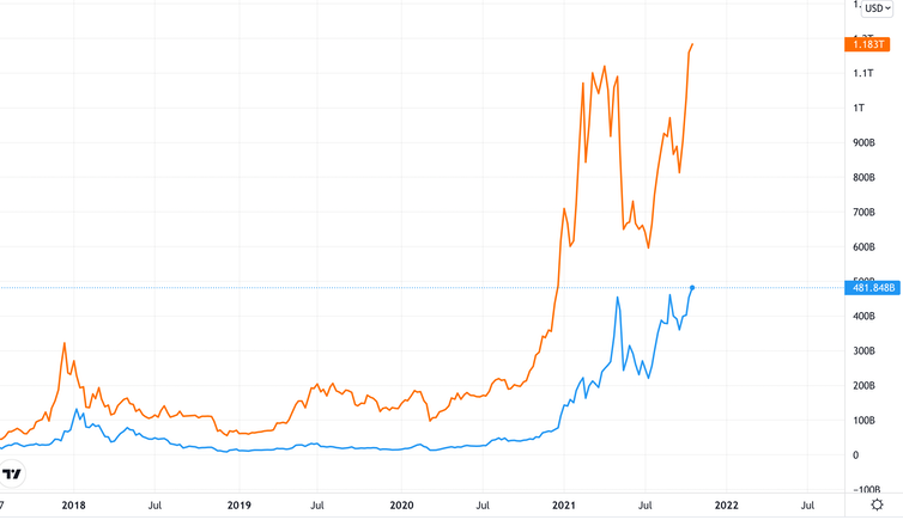
Ether versus bitcoin market caps in October 2021. Source: Daniel Broby (The Conversation).
In a piece for The Conversation, the University of Strathclyde’s Centre for Financial Regulation and Innovation director Daniel Broby said that all eyes will be trained on Ethereum’s impact on Bitcoin as it moves to proof-of-stake.
“Bitcoiners will continue to argue that their protocol is more decentralised than proof of stake, and they have the advantage of being the crypto brand that investors are most comfortable risking their money with,” he explained.
“The question is whether these advantages are outweighed by Ethereum 2.0’s greener credentials and the fact that it can handle more transactions.
“Bitcoin is currently worth about double ether, but talk comes and goes about a “flippening” where ether overtakes it.”
It’s still early days, but as Ethereum changes the way in which it adds and validates blocks on the chain, it could attract a new wave of stakeholders that are invested in a more scalable, secure and sustainable system.