
Vango Mining Ltd's (ASX:VAN) joint venture partner Lodestar Mineral Ltd has received promising assay results following its reverse circulation (RC) drilling program at Contessa, part of the Ned’s Creek joint venture in Western Australia.
The exploration drilling targeted the untested granite contact at Contessa and Central Park with 14 drill holes over a strike of 600 metres at Contessa.
A further 12 vertical holes were completed to verify historic aircore drilling within the Contessa supergene gold mineralisation.
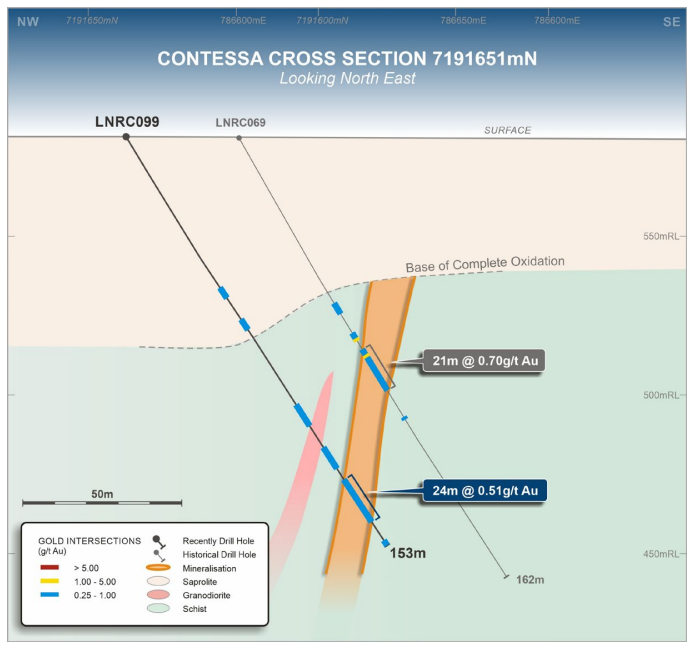
Cross-section of the Contessa prospect
Missing assay results caused delays
While assay results have been received for all holes testing the supergene mineralisation, Lodestar said it was recently and belatedly advised by the laboratory that a batch of samples from the contact-related drilling program had gone missing.
The affected holes are located along the north-eastern end of the target zone.
The backlog affecting laboratories has also impacted Lodestar’s drill samples, with the company saying that samples submitted in November were not acknowledged for initial processing until February, and that it received no communication about the delay until late last week.
Promising results and untested area
The key result from this program is the confirmation of the granite contact as a priority target.
Two of the holes bookend a 1,200-metres contact, and there has been no effective drilling between drill hole LNRC097 and the Central Park prospect.
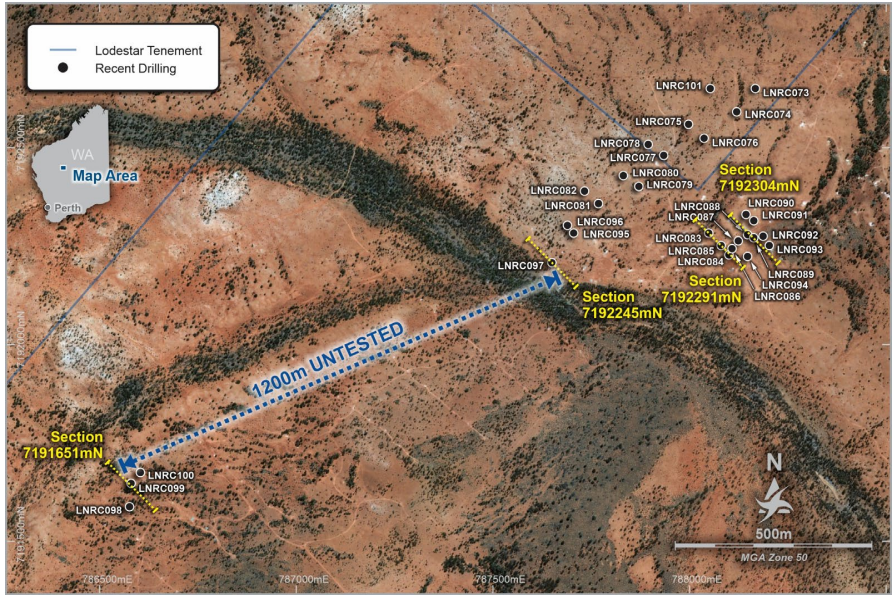
Untested area between prospects.
The companies suspect that in the past, two of the holes were drilled off-contact and the main structure of interest has therefore probably not been tested.
All the contact drill holes reported anomalous gold (greater than 0.1g/t gold) and a characteristic multi-element signature within a very large hydrothermal alteration halo developed on the granite contact, with maximum values of 12 g/t gold, 111 parts per million (ppm) bismuth, 0.22% molybdenum, 0.38% lead and 0.11% tungsten.
Results now received include significant intersections from wide-spaced RC drilling:
➢ 20 metres at 0.69g/t gold from 120 metres, including 8 metres at 1 g/t from 132 metres;
➢ 24 metres at 0.51g/t from 116 metres; and
➢ 4 metres at 2.35g/t from 120 metres
The results are indicative of very extensive contact-related alteration zone with potential for significant mineralisation.
The program is expected to be extended, targeting 1200 metres of granite contact between Central Park and Contessa.
Supergene drilling
The supergene drilling program has been designed to confirm and better define the limits to the mineralisation. The results of the drilling program will be evaluated for use in a resource model.
Drilling in the supergene zone confirms sub-horizontal oxide gold mineralisation:
➢ 12 metres at 1.46 g/t gold from 50 metres;
➢ 8 metres at 1.84 g/t from 36 metres;
➢ 7 metres at 2.99 g/t from 58 metres; and
➢ 4 metres at 1.5 g/t from 36 metres.
Next steps
The joint venture will prioritise extending the RC drilling along the contact between drill hole LNRC097 and Central Park.
Lodestar will trial the use of deep ground penetrating radar (DGPR) and/or passive seismic to identify the position of the contact where there is no surface expression.
The missing drill holes will be re-sampled as soon as possible, with samples expedited for processing once at the laboratory.