
Galileo Mining Ltd (ASX:GAL)’s aircore drill program has returned multiple anomalous palladium assays from the Mission Sill prospect at its 100%-owned Norseman Project in Western Australia.
Follow-up reverse circulation (RC) drilling is being planned beneath the palladium intercepts while follow-up aircore drilling is also planned along the 4 kilometres of untested Mission Sill target zone with no previous palladium exploration.
Additional assays are expected in the coming weeks from more than 50 aircore drill holes on the northern side of Mission Sill prospect and from the Jimberlana prospect.

Exceptional potential of area
Galileo managing director Brad Underwood said: “Palladium at our Norseman project is now a heavy focus of exploration as results continue to demonstrate the exceptional potential of the area.
“We have three prospects all with significant palladium results that urgently require follow up drill testing – Mission Sill, Jimberlana and Mt Thirsty.
“The current results from the Mission Sill prospect have revealed the extent of palladium with over two kilometres of strike length and another four kilometres of strike that has never been explored for palladium.
“The strongest results to date are centred around the contact between ultramafic and mafic rocks in a similar position to mineralisation at known deposits such as the Lac des Iles mine in Canada.
"All the results are from early-stage aircore drilling and the potential at depth needs to be assessed at multiple locations with a larger RC drill rig.
"Results from a further 50 drill holes have yet to be received from the northern Mission Sill and Jimberlana prospects with additional results from Mt Thirsty and regional drilling expected later in the month.
"Positive aircore and geophysical results from the Jimberlana prospect have previously been reported while the Mt Thirsty prospect is now ready for RC drilling planned in April.
"Further drill testing at the Mission Sill and Jimberlana prospects will be undertaken after the completion of heritage surveys and receipt of statutory approvals.”
Results
Significant results along the ultramafic/mafic contact zone at the Mission Sill include
➢ 18 metres at 0.29 g/t palladium from surface;
➢ 22 metres at 0.21 g/t palladium from surface;
➢ 5 metres at 0.28 g/t palladium from surface;
➢ 7 metres at 0.40 g/t palladium from surface;
➢ 6 metres at 0.30 g/t palladium from surface;
➢ 32 metres at 0.20 g/t palladium from surface;
➢ 1-metre at 0.32 g/t palladium from 42 metres;
➢ 1-metre at 0.28 g/t palladium from 2 metres; and
➢ 1-metre at 0.38 g/t palladium from 29 metres.
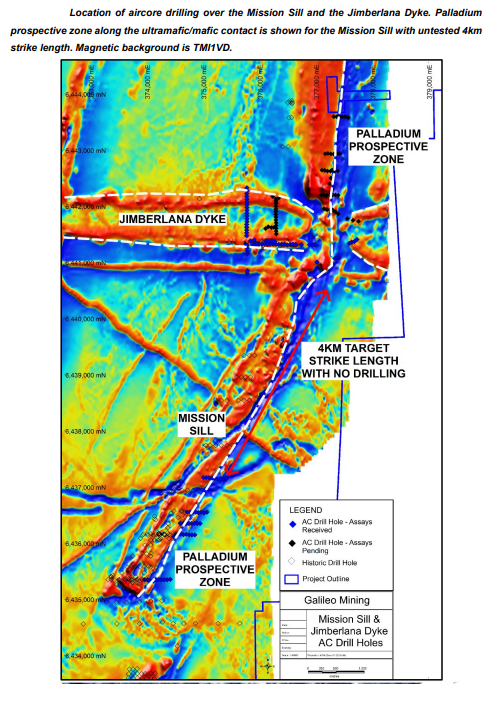
Numerous aircore drill holes from the Mission Sill prospect have returned anomalous palladium results greater than 0.1 g/t palladium.
The target zone is the contact between the ultramafic and mafic units of the Mission Sill. This contact can be delineated in the magnetic imagery and previous RC drilling at this margin has encountered disseminated sulphides in fresh rock (up to 5% in patches, with up to 74 metres at 0.19 g/t palladium in fresh rock).
The aim of the recent aircore drilling was to define palladium anomalism within the regolith to guide the location of RC drilling targeting sulphide mineralisation in fresh rock.
Analyses of multi-element data and petrography of selected samples will be undertaken to assist in this process.
Magnetic interpretation will also be utilised to select areas with the potential for higher-grade mineralisation along the contact position.
Those assays considered to be significantly anomalous contain greater than 0.1 g/t palladium over the width of the assay interval.
Mt Thirsty Prospect
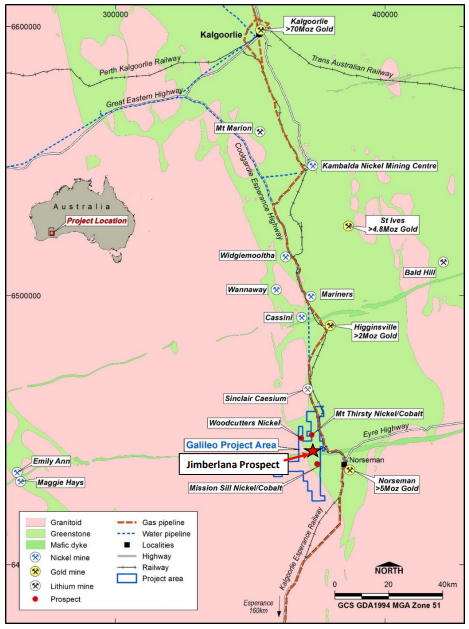
Statutory approvals have been received for RC drilling at the Mt Thirsty prospect.
Work is expected to begin in April 2022, subject to drill rig availability, with around 1,000 metres of drilling planned.
Previous drilling by Galileo beneath the cobalt-nickel laterite resource at Mt Thirsty intersected a zone of sulphide containing highly anomalous levels of palladium, platinum, copper, and nickel.
This sulphide zone occurs within an ultramafic rock unit interpreted to be an apophysis from the Mt Thirsty sill.
The contact between the intruding sill and the flat-lying stratigraphy is the prospective target zone with potential for higher-grade mineralisation.
The grade within the sulphide zone increases towards the east, supporting the idea that more mineralisation occurs within the target zone.