
Natural Resources
7 March 2022
Comment
Strategic Metals (TSX-V:SMD) – Critical, but what are we actually doing about it ?
Strategic Metals (TSX-V:SMD) and minerals are defined as those vital to modern technology and industry, often where substitution is not possible and supply is limited and potentially subject to disruption.
The Covid pandemic has highlighted growing global concerns over supply chain security in a de-globalising world economy. These concerns are being driven home now by the unfolding consequences of Russia’s invasion of Ukraine and the potential for countries to weaponise commodity supply.
As the world accelerates toward a bifurcated economic and financial system – a Western one and a China-centric one – increasing global political risk has prompted much commentary and forthright warnings of the importance of access to “strategic” metals. Amongst others, the US and the EU and have been increasingly vocal on the issue, compiling lists, policies and in some cases money, to encourage public and private capital to invest in new supply and processing capacity.
Rare Earth Elements (REEs) feature highly on the lists given their importance to energy transition technologies as well as other high tech and military applications and they are a useful case in point. Indeed, the recently released USGS 2022 list of critical minerals (accessible here) includes 16 of the 17 REEs.
China overtook the USA as the world’s dominant miner and, more importantly, processor of Rare Earths in the 1990’s and having achieved a 90% global market share, introduced export restrictions in 2009 which eventuated in a 500% price spike in 2011. A Western scramble for alternatives ensued but subsided prettty rapidly as export restrictions were reversed.
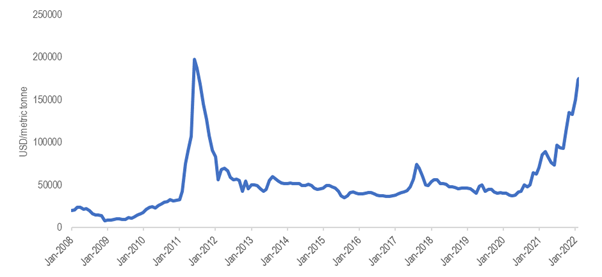
China Praseodymium-Neodymium Oxide Market Price Shanghai, January 2008 to present. Source: Bloomberg
Since then, mining companies in Australia, UK and elsewhere have been trying hard to provide diversification and new sources of supply but despite their efforts, progress to embed production and processing of these key metals in Western supply chains has been painfully slow. There are still only two Rare Earth producers of scale outside of China, Australia’s Lynas Rare Earths and MP Materials in the USA. (It is worth noting however, that the material produced from MP Materials’ mine in California is shipped to China for separation, given that there is no suitable processing facility in the USA). Plans for alternative extraction and processing projects have struggled to attract Western capital and, with some exceptions, new plans largely remain on the drawing board.
China has shown no such reticence, and its intention to maintain a strangle hold on these key decarbonisation commodities looks set to continue.
Chinese processing giant Shenghe has been on a shopping spree in recent years, quietly engaging with actual and potential new non-Chinese producers, gathering positions and/or offtake agreements in a portfolio of the most promising projects including Greenland Minerals and MP Materials. Last month Shenge took a 20% stake in ASX listed Peak Rare Earths from private equity group Appian Capital. Peaks’s Tanzanian project, Ngualla, is arguably the best undeveloped Rare Earth deposit globally and the company has plans to put a processing plant in the UK, the first in Europe.
In terms of commodity markets Rare Earths are a pretty niche corner but they are perhaps illustrative of the issue.
In the decade since the 2011 price spike China’s market dominance of the Rare Earth supply chain hasn’t changed and neither has its willingness to deploy the necessary long term capital to ensure it doesn’t. At the same time the economic importance of the metals and concomitant vulnerability of Western economies to supply shocks has only grown.
Commodity price increases are perhaps beginning to reflect heightened geopolitical risk and may stimulate the multi-stakeholder approach that is likely to be required if the West wants to really secure it’s supply chains of some critical metals.
The recent history of Rare Earths doesn’t necessarily bode well, at least not yet. As the old cliché goes, the cure for high prices is high prices, but given the current backdrop they may be around for a bit longer.
Charlie Cryer
Head RFC Ambrian London
+44 (0)20 3440 6834
charlie.cryer@rfcambrian.com
This document has been approved under section 21(1) of the FMSA 2000 by RFC Ambrian Limited ("RFC Ambrian") for communication only to eligible counterparties and professional clients as those terms are defined by the rules of Financial Conduct Authority. Its contents are not directed at retail clients as RFC Ambrian does not provide investment advisory services to retail clients.
RFC Ambrian publishes this document as non-independent research which is a marketing communication under the Conduct of Business rules. It has not been prepared in accordance with the regulatory rules relating to independent research, nor is it subject to the prohibition on dealing ahead of the dissemination of investment research. It does not constitute a personal recommendation and does not constitute an offer or a solicitation to buy or sell any security. Neither RFC Ambrian nor any of its directors, officers, employees or agents shall have any liability, howsoever arising, for any error or incompleteness of fact or opinion in it or lack of care in its preparation or publication; provided that this shall not exclude liability to the extent that this is impermissible under the law relating to financial services. All statements and opinions are made as of the date on the face of this document and are not held out as applicable thereafter. This document is intended for distribution only in those jurisdictions where RFC Ambrian is permitted to distribute its research. In particular, it is not intended for distribution in and is not directed as persons in the United States.
On the date of this document, RFC Ambrian, RFC Ambrian's holding company, persons connected with it and their respective directors may have a long or short position in any of the investments mentioned in this document. RFC Ambrian is a member of the London Stock Exchange and is regulated and authorised by the Financial Conduct Authority. RFC Ambrian is registered in England and Wales no. 4236075. Its registered office is at Octagon Point, 5 Cheapside, London EC2V 6AA.
NOTICE: The information in this e-mail message is confidential and may also be privileged. It is only intended for the above-named addressee/s. If you are not a named addressee, you must not disclose, copy or take any action in reliance on this e-mail and should delete it from your system. If you have received this e-mail in error, please contact the sender by return e-mail or by telephone +44 (0)20 3440 6800. We believe, but do not warrant that this e-mail and any attachments are virus free. You should take full responsibility for virus checking.